
Small households
If you’re buying rolls for one or two people, you’ll want an amount you can finish or store appropriately. Individually sold rolls and small packs give you different ways to plan lunch.


For lunch for one or two people, individually sold kaiser rolls are a practical choice if you’ll eat them that day. A small pack works well for several planned lunches. If you eat rolls irregularly, a frozen pack lets you bake only what you need, provided you have freezer space and an oven. Whatever you choose, check the type of bread, allergens, and storage and preparation instructions.
If you’re buying rolls for one or two people, you’ll want an amount you can finish or store appropriately. Individually sold rolls and small packs give you different ways to plan lunch.
If you want a wholemeal roll, check the product description and nutrition information. A white kaiser roll and a wholemeal one are different choices, even if they look similar.
Look for a product explicitly labelled gluten-free, and check the ingredients and full allergen information too. The shape of a kaiser roll tells you nothing about these qualities.
First, work out how many rolls you need for your lunches and whether you’ll eat them straight away or store them. Then compare the type of bread, how it’s prepared, and any requirements you have for ingredients and allergens.
| What to consider | What to check before buying | Who should consider this? |
|---|---|---|
| Portion size and storage | Check the number of rolls and the storage instructions. An individually sold roll suits immediate use; a frozen option may work better if you want to save some for later. | If I’m only planning one lunch, I don’t want to be left with unused rolls; portion size is the top priority for around 36% of consumers. |
| Wholemeal and fibre | Check that it says ‘wholemeal’ and compare the fibre per 100 g in the nutrition information. | For regular lunches, I want to make an informed choice between white and wholemeal. Around 29% of consumers give this the highest priority. |
| Preparation and keeping some in stock | Check whether the rolls are ready to eat or need baking, and what equipment you’ll need. | My lunch routine varies, so I want to have rolls ready to prepare whenever it suits me; this flexibility matters most to around 21% of consumers. |
| Gluten and allergens | Look for an explicit gluten-free label and check the ingredients, allergens and any ‘may contain’ information. | I need a gluten-free product and want to know what other allergens it contains. For an estimated 14% of consumers, checking the label is the first thing they look for. |
If you don’t use the remaining rolls in time, you’ll have bread left over. The Voedingscentrum lists bread among the food groups that are wasted at home.
Choose an amount that matches your planned lunches: an individually sold roll for immediate use, or a pack you can store appropriately according to the label.
Looks alone won’t tell you whether a kaiser roll is wholemeal. Albert Heijn lists 7,1 g of fibre per 100 g for its wholemeal kaiser roll, compared with 2,9 g per 100 g for its white bake-off kaiser rolls; these are two different products.
Look for the ‘wholemeal’ label and, if fibre matters to you, compare the amount per 100 g on the label.
A gluten-free label doesn’t rule out other allergens. Schär Kaiserbrötchen lists soya and may contain traces of mustard.
Every time you buy, check both the gluten-free label and the full ingredients and allergen information.
Jumbo states that its frozen kaiser rolls must not be refrozen after defrosting.
Follow the pack instructions and take only the number of rolls you need for each lunch out of the freezer.
These examples show the pack sizes and product formats you may come across; check the current packaging of the roll you choose.
Albert Heijn lists white bake-off kaiser rolls in packs of four and a wholemeal kaiser roll sold individually.
Jumbo lists white kaiser rolls in a four-pack for the freezer and a pack of ten for baking at home.
Lidl features kaiser rolls in its oven-fresh range.
ALDI lists fresh white kaiser rolls and De Afbakker white bake-off kaiser rolls.
PLUS lists white bake-off kaiser rolls in packs of four, as well as individually sold white and wholemeal kaiser rolls.
Dirk lists a pack of kaiser rolls to bake at home.
If you want to buy several kaiser rolls for light lunches, this pack contains four. Check the packaging for preparation and storage instructions before deciding whether this format suits your plans.
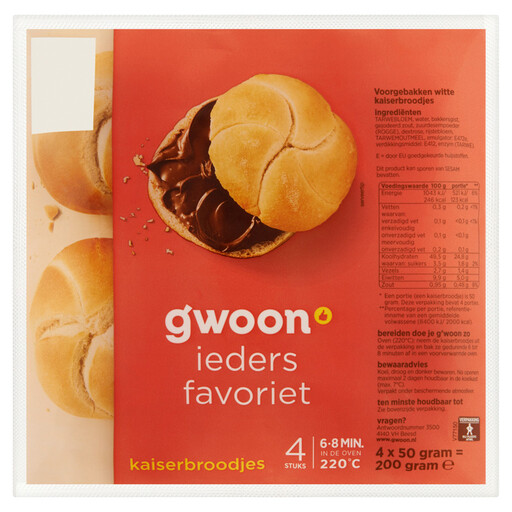 Image not available
A pack of four for anyone planning several lunch portions. The ingredients information lists wheat and iodised salt. Check the packaging to see whether the rolls need baking and how to store them after opening.
No. A kaiser roll is a small bread roll, not half a loaf. For a light lunch, though, buying one individually can serve the same purpose: you can buy only the portion you need.
Yes. If the pack says to prepare them from frozen, you can take out the number you need each time. Jumbo says its frozen option should be prepared in the oven and warns that the rolls must not be refrozen after defrosting.
Don’t assume so: check the ingredients list for the specific product for ‘iodised salt’ or ‘baker’s salt’. This can vary from one roll to another; the product name ‘kaiser roll’ alone doesn’t tell you.
Choose a roll explicitly labelled gluten-free and check the allergen information too. Schär Kaiserbrötchen is sold as gluten-free, but also lists soya and may contain traces of mustard; always check the label on the pack you buy.
Check the bread type and compare the nutrition information per 100 g, particularly if fibre matters to you. The Voedingscentrum advises replacing white bread with wholemeal or brown bread as much as possible; for your own purchase, also consider the portion size and preparation method.