A standard pack of four kaiser rolls is a good fit for an Italian evening with four guests if everyone has one roll and the rest of the menu provides the Italian touch. If you want the bread itself to suit the theme, look at Italian rolls. Either way, check the pack size, preparation instructions and ingredients before you choose.
Which bread option is right for you?
Hosting four or more diners
You want to know in advance how many rolls to put on the table, and you’re happy for the rest of the menu to provide the Italian touch. Compare the pack size with the number of guests and how many rolls you plan to serve each person.
Cooking for a menu where the bread should match the theme
You want the bread itself to have an Italian touch. PLUS describes its Italian rolls as wheat rolls made with olive oil and oregano; standard kaiser rolls play a different role at the table.
Shopping for specific dietary or ingredient requirements
You look beyond the pack size, perhaps because a guest needs to eat gluten-free or you want to compare the stated fibre content. Check the current packaging of the product you plan to serve.
What should you look for when choosing?
First, work out how many rolls you need. Then decide whether standard kaiser rolls will suit your menu, or whether you want the bread itself to add an Italian touch.
| What to consider | What to check before buying | Who should consider this? |
|---|
| Rolls per guest |
Compare the number of rolls in each pack with the number of diners. |
If I want to give each of four guests one roll, a pack of four is a straightforward choice. Around 42% of consumers prioritise a simple choice of bread. |
| The right quantity |
Check the pack size and, for frozen rolls, the storage instructions. |
For a larger table, I want enough bread without having too much left over. Around 33% of consumers prioritise getting the right quantity. |
| An Italian touch |
Check whether the bread itself contains ingredients that suit the menu, and how many rolls are in the pack. |
When bread takes centre stage on my table, I want the type of bread to suit the Italian evening. Around 17% of consumers prioritise this theme. |
| Ingredients and fibre |
Read the allergen information and compare the nutritional information per 100 g if fibre matters to you. |
If a guest needs to avoid gluten, I should choose a product explicitly labelled gluten-free; if I’m looking for a particular fibre content, I’ll check the stated nutritional values. For around 8% of consumers, dietary or ingredient requirements like these are decisive. |
Things to watch out for when choosing
-
Looking only at the number of packs
The Italian rolls mentioned here come in packs of two, while several standard kaiser rolls are sold in packs of four. So you may need a different number of packs for the same table.
First, count your guests and decide how many rolls each person will have. Then compare the number of rolls in each pack.
-
Assuming kaiser rolls are Italian bread
Standard kaiser rolls and Italian rolls are different types of bread. PLUS lists olive oil and oregano in its Italian rolls.
Choose standard kaiser rolls if you want the bread to be a neutral accompaniment to the menu. Look at Italian rolls if you want the bread itself to fit the theme.
-
Guessing the ingredients from the product category
AH and PLUS list wheat in their standard kaiser rolls. You also can’t assume that every loaf contains baker’s salt: according to the Voedingscentrum, bakers aren’t required to use it.
Read the current ingredients and allergen information. If you need a gluten-free option, look for an explicit gluten-free label and check for other allergens too.
Brands compared
Dirk / 1 de Beste
1 de Beste sells standard kaiser rolls in a pack of four, weighing 200 g.
- The pack size suits a table of four if everyone has one roll.
- Check the packaging if ingredients or allergens will influence your choice.
Jumbo
Jumbo lists standard kaiser rolls in packs of four and ten, and also sells frozen varieties.
- The frozen wholemeal kaiser rolls contain 6,7 g of fibre per 100 g.
- Follow the storage instructions for frozen rolls. Jumbo warns that its listed frozen kaiser rolls should not be refrozen after defrosting.
Albert Heijn
AH lists four standard kaiser rolls weighing 220 g, as well as Italian rolls sold in packs of two.
- AH says its standard kaiser rolls can be prepared in an oven or air fryer.
- If you need a gluten-free option, check the ingredients: AH’s standard kaiser rolls contain wheat.
PLUS
PLUS sells standard white kaiser rolls in packs of four, as well as Italian rolls as a separate type of bread.
- PLUS describes its Italian rolls as white wheat rolls made with olive oil and oregano.
- The standard white kaiser rolls contain wheat; check the label if you have any ingredient or allergen requirements.
ALDI / De Afbakker
ALDI lists De Afbakker white kaiser rolls weighing 300 g and Italian rolls in packs of two, each weighing 100 g.
- These products give you a choice between standard kaiser rolls and Italian rolls.
- Read the packaging of the product you choose if ingredients or allergens are important to you.
Lidl
Lidl lists bake-at-home kaiser rolls in a pack of six.
- A pack of six could suit a table where you want to serve six rolls.
- Lidl says this product is available in store only.
Kaiser rolls on Joybuy
This pack of four kaiser rolls suits a table of four if everyone has one roll. Check the preparation instructions and current ingredients information before serving.
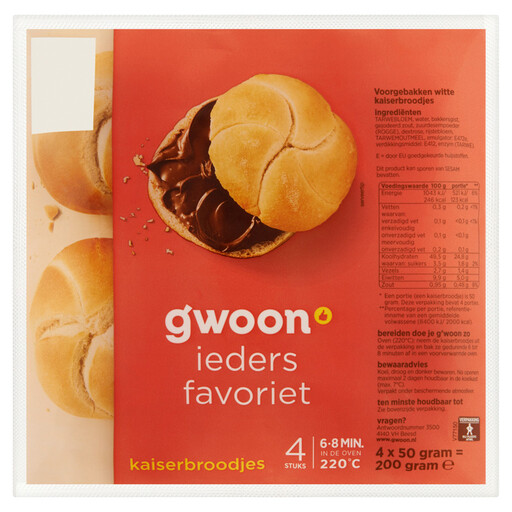 Image unavailable
g'woon Kaiser Rolls, 4 pcs, 200g
Four rolls may be enough for four guests if everyone has one.
The pack states that it weighs 200 g. Check the preparation instructions on the packaging.
The product description lists cereals containing gluten, milk, sesame and soya; if you have allergies, check the current packaging.
View on Joybuy
Frequently asked questions
Can I cook kaiser rolls in an air fryer?
You can if the packaging includes air-fryer instructions. AH recommends 5–6 minutes at 200 °C for its kaiser rolls, while PLUS recommends 4 minutes at 200 °C for its variety. Follow the instructions for the rolls you actually buy.
Are standard kaiser rolls suitable for a gluten-free guest?
AH and PLUS standard kaiser rolls aren’t gluten-free: they contain wheat. If you need a gluten-free option, choose a product explicitly labelled gluten-free and check the current label for other allergens too.
Does bread in the Netherlands always contain iodine from baker’s salt?
No. According to the Voedingscentrum, bakers aren’t required to use baker’s salt. For packaged bread, check the ingredients list to see whether baker’s salt or iodised salt is listed, rather than assuming it from the type of bread.


