
Families looking to buy wholemeal more often
You’re looking for Kaiser rolls for a meal where wholemeal ingredients and fibre matter, while also considering what everyone likes to eat.


If you want to prioritise wholemeal options for a roll-based meal, choose Kaiser rolls that are clearly labelled as wholemeal. For fussy eaters, you could buy white and wholemeal rolls side by side, then gradually change the balance. Compare fibre per 100 g and check the ingredients, allergens and preparation instructions on the packaging.
You’re looking for Kaiser rolls for a meal where wholemeal ingredients and fibre matter, while also considering what everyone likes to eat.
You don’t want to replace all your white rolls at once. The Netherlands Nutrition Centre points out that wholemeal can taste different from white bread, and that it can take time to get used to.
You’re choosing between fresh rolls and rolls to bake at home. In that case, the preparation method and storage advice on the packaging are important.
Choose these: if wholemeal ingredients and the fibre in the roll are your priorities.
Bear in mind: the different taste, which a fussy eater may need time to get used to.
Choose these: if a familiar taste matters more for this meal.
Bear in mind: the white examples from Albert Heijn and PLUS contain less fibre per 100 g than their wholemeal examples.
Choose these: if not everyone at the table wants to eat wholemeal straight away.
Bear in mind: this means choosing two separate products. Having both in your shopping basket says nothing about the ingredients in an individual roll.
| What to consider | What to check when buying | Who it matters to |
|---|---|---|
| Wholemeal ingredients and fibre | Look for the wholemeal label and compare fibre per 100 g on the same basis. | If I want to choose rolls with more fibre, I look at the wholemeal option first. This is the top priority for around 50% of consumers. |
| Getting used to the taste | Check the ingredients and allergens for each type before buying white and wholemeal rolls together. | If a fussy eater isn’t ready to switch straight away, I want to be able to offer both types. Around 30% of consumers prefer a gradual change. |
| Preparation and storage | Check whether the rolls need to be baked at home, and follow the preparation and storage instructions on the packaging. | For a planned meal, I want to know when and how to prepare the rolls. This practical convenience is the main consideration for around 20% of consumers. |
The colour and the name Kaiser roll don’t tell you how much wholemeal flour or fibre the product contains. For example, PLUS states that its wholemeal Kaiser roll contains 67% wholemeal wheat flour.
Check the product name and ingredients list, and compare fibre per 100 g.
According to the Netherlands Nutrition Centre, bakers aren’t required to use baker’s salt. Ingredients can therefore vary between Kaiser rolls.
If it’s relevant to your choice, check the ingredients list of the product you’ve chosen for iodised salt or baker’s salt.
Albert Heijn recommends baking its white part-baked Kaiser rolls in the oven for 8–10 minutes. PLUS also gives air fryer instructions for its white option. So one cooking time won’t suit both products.
Before buying, check which preparation method suits you, then follow the instructions on the packaging.
The range includes an individual wholemeal Kaiser roll and a pack of ten white part-baked Kaiser rolls.
PLUS offers an individual wholemeal Kaiser roll and white Kaiser rolls to bake at home.
This range offers white Kaiser rolls to bake at home.
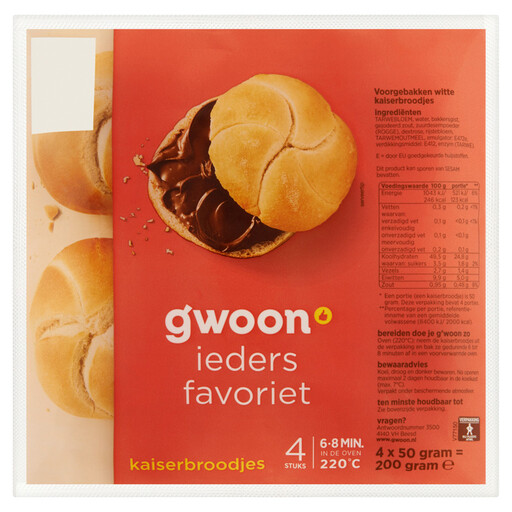
Dirk lists a pack of four part-baked Kaiser rolls under this own-brand label.
This pack of four Kaiser rolls could suit a planned roll-based meal. Check the packaging to see whether this option matches your preference for white or wholemeal.
 No image available
For anyone looking for four Kaiser rolls in one pack.
Four rolls, 200 g in total.
Check the packaging to see whether this option is white or wholemeal. If you want to bake the rolls at home, check the preparation instructions, too.
Look for the word wholemeal in the product name, then check the ingredients list. PLUS states that its wholemeal Kaiser roll contains 67% wholemeal wheat flour. The name Kaiser roll alone doesn’t tell you which type of grain has been used or how much fibre it contains.
No, you can’t assume that. According to the Netherlands Nutrition Centre, bakers aren’t required to use baker’s salt. So check the ingredients list of the roll you want to buy.
Check the current allergen information for each option separately. The white and wholemeal examples described contain wheat and gluten-containing cereals; some products also list possible traces of other allergens.
It depends on the product you choose. PLUS recommends cooking its white part-baked Kaiser rolls for four minutes in a preheated air fryer at 200 °C. Follow the preparation instructions on the packaging you buy, not those for a different roll.