What should you look for when choosing?
First, decide when you want to eat the roll and what matters most to you: room for fillings, wholemeal, convenient storage or suitable allergen information.
| What to consider |
What to check when buying |
Who it matters to |
| Size and fillings |
Check the size of the whole roll and whether it’s fresh or needs to be baked first. The term ‘thick cut’ doesn’t tell you anything useful about its slice thickness. |
If I want to fill my roll generously, I want to be able to judge whether its size is suitable before I buy it. Around 34% of consumers prioritise finding a roll that’s a good size for fillings. |
| Wholemeal and fibre |
Look for the explicit ‘wholemeal’ label and compare the fibre listed per 100 g; don’t judge by colour alone. |
For a lunch I eat regularly, I want to make a conscious choice between white and wholemeal. That’s why around 33% of consumers prioritise wholemeal and fibre. |
| Preparation and storage |
Read the baking and storage instructions, especially whether you can bake the rolls from frozen and what to do after thawing. |
If I only need a few rolls at a time, I want to be able to store the rest according to the packaging instructions. Convenient storage is the main priority for around 25% of consumers. |
| Gluten and allergens |
Check the ingredients, allergen information and any ‘may contain’ statement for the specific product. |
If I need a gluten-free product or one that meets other dietary requirements, I can’t rely on the name ‘kaiser roll’. For around 8% of consumers, checking the product makes all the difference. |
Relevant brands and own-label ranges
The kaiser rolls described in these own-label ranges vary in several ways, including white or wholemeal, fresh or bake-at-home, and frozen or unfrozen. Check the details for each product.
Albert Heijn
Offers both white bake-at-home kaiser rolls and a fresh wholemeal kaiser roll.
- The white bake-at-home pack described contains four part-baked rolls, each weighing 55 g, and gives instructions for cooking them in an oven or air fryer.
- The wholemeal roll described is a different product, weighing 70 g each; the stated 7,1 g of fibre per 100 g applies to that variety.
Jumbo
Offers white bake-at-home rolls, white and wholemeal frozen rolls, and a separate gluten-free product from Schär.
- The white bake-at-home variety described lists 2,9 g of fibre per 100 g; the frozen wholemeal variety lists 6,7 g per 100 g.
- Follow the storage instructions for the frozen varieties. The separate gluten-free Schär product contains soya.
Lidl
Offers kaiser rolls to bake at home.
- This product type is a good fit if you want to bake your rolls at home before filling them.
- Check the ingredients, allergens and nutritional information on the packaging of the variety you choose.
ALDI / De Afbakker
Offers white De Afbakker kaiser rolls to bake at home.
- The pack described contains six white wheat rolls weighing 300 g in total; ALDI recommends baking them for 5–7 minutes.
- To compare fibre or allergens, check the nutritional information and ingredients on the current packaging.
PLUS
Offers a wholemeal kaiser roll sold individually.
- An individual roll is a handy option if you don’t want to buy a multipack.
- Check the nutritional information and ingredients for this roll if fibre, salt or allergens are important to your choice.
Dirk / 1 de Beste
Offers 1 de Beste Kaiserbroodjes as bake-at-home rolls in a pack of four.
- The pack described weighs 200 g; Dirk recommends cooking the rolls in an oven or air fryer for 6–8 minutes.
- Use the current packaging to check nutritional information and allergens when comparing this product with another roll.
Kaiser rolls on Joybuy
This kaiser roll is an option if you’re looking for a base for fillings. Check the size and preparation method yourself if you want to fill it generously or eat it straight away.
 No image available
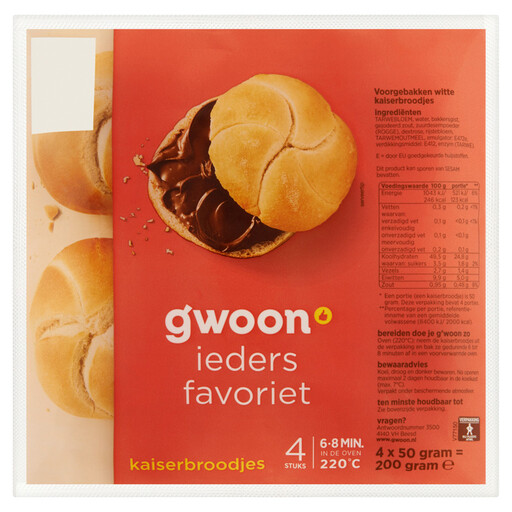
g'woon Kaiser Rolls, 4 rolls, 200 g
A kaiser roll to use as a base for fillings. Check the size and texture for yourself if you’re planning to use heavy or moist fillings.
Pack: 4 rolls, 200 g. Check the preparation method and current allergen information on the packaging.
View on Joybuy
Frequently asked questions
Does ‘thick cut’ mean something specific for kaiser rolls?
Don’t assume there’s a standard slice thickness: the products described by Albert Heijn, Jumbo, Dirk and Lidl are whole kaiser rolls. If you’re planning generous fillings, check the size of the roll and whether it needs baking first.
When should I choose a wholemeal kaiser roll instead of a white one?
Choose the variety explicitly labelled wholemeal if wholemeal and fibre are your priorities. The wholemeal rolls described by Albert Heijn and Jumbo list 7,1 and 6,7 g of fibre per 100 g respectively; Jumbo lists 2,9 g per 100 g for its white bake-at-home variety. Compare the labels on the specific products, including the allergen information.
Can I refreeze frozen kaiser rolls after thawing?
Not if the packaging advises against it. The frozen kaiser rolls described by Jumbo state that you shouldn’t refreeze them after thawing. Follow the instructions for the product you buy.
Does every kaiser roll contain iodised baker’s salt?
You can’t tell from the type of bread. According to the Voedingscentrum, using baker’s salt isn’t compulsory; check the ingredients list for ‘iodised salt’ or ‘baker’s salt’, or ask the baker.
How do I choose a kaiser roll if I need to avoid gluten?
Check the current ingredients and allergen information for the specific product rather than relying on the name of the roll. The regular varieties described by Albert Heijn and Jumbo contain gluten-containing cereals; Jumbo lists Schär Kaiserbrötchen separately as a gluten-free product, but it contains soya and may contain mustard.


