
Families who use lots of rolls at once
If you regularly serve several rolls at a time, the number of rolls and the net weight are more useful things to compare than the size of the bag alone.


Choose kaiser rolls for a large family based on how many you’ll actually use and how you can store them. A larger pack suits meals with lots of people, while a smaller pack or frozen option may be more convenient if mealtimes vary. Also compare white and wholemeal options using the nutritional information, and check the ingredients and preparation instructions for each product.
If you regularly serve several rolls at a time, the number of rolls and the net weight are more useful things to compare than the size of the bag alone.
When mealtimes vary, storage instructions matter. A long-life pack, freezing rolls at home and buying frozen rolls each call for a different approach to planning.
If you’re choosing between white and wholemeal kaiser rolls, compare the wholemeal description, ingredients and fibre per 100 g.
First, work out how many rolls your family will eat at a meal. Then consider storage, the difference between white and wholemeal options, and the product information that matters when using them.
| What to consider | What to check when buying | Who it matters to |
|---|---|---|
| Suitable quantity | Compare the number of rolls, the net weight and how many rolls you use per meal. | When I need rolls for lots of people at once, I want a pack that gets used up without leaving too many over. Getting the right quantity is a priority for around 40% of consumers. |
| Stock and storage | Read the use-by and storage instructions, and check whether you have room in the freezer. | When our mealtimes vary, I want to be able to store rolls until we need them. Convenient storage is the main consideration for around 30% of consumers. |
| White or wholemeal | Check the product description and ingredients; compare fibre per 100 g. | When we eat rolls often, I want to make an informed choice between white and wholemeal. Around 20% of consumers pay most attention to wholemeal options and fibre content. |
| Ingredients and preparation | Read the ingredients, allergen and preparation information; check each product to see whether it lists iodised salt or baker’s salt. | Before I buy rolls, I want to know what’s in them and how to prepare them at home. This product information comes first for around 10% of consumers. |
Four rolls in a 200 g pack and ten rolls in a 650 g pack don’t tell you the same thing about portion size. Dirk lists 200 g for a four-pack reviewed here; Albert Heijn lists 650 g for a ten-pack.
Check both the number of rolls and the net weight, and think about how many you’ll use for a typical family meal.
The shape of a roll doesn’t tell you whether it’s white or wholemeal. Jumbo lists 6.7 g of fibre per 100 g for its wholemeal frozen kaiser rolls reviewed here; PLUS lists 6.9 g per 100 g for its wholemeal kaiser roll.
If the difference between white and wholemeal matters to you, check the product description and nutritional information.
Salt information varies from product to product. A general assumption about kaiser rolls is no substitute for checking the pack’s ingredients list.
Check the current label to see whether iodised salt or baker’s salt is listed among the ingredients.
The own-brand product reviewed here is a 650 g pack of ten white bake-at-home kaiser rolls.
The range reviewed here includes white kaiser rolls in packs of four and ten, plus a wholemeal frozen option.
Lidl lists individual kaiser rolls as an in-store product.
ALDI lists white bake-at-home kaiser rolls under its De Afbakker own brand in a 300 g pack, as well as an individual fresh white kaiser roll.
PLUS lists white bake-at-home kaiser rolls in packs of four and an individual wholemeal kaiser roll.
Dirk lists a 200 g four-pack under the product name 1 de Beste, as well as a ten-pack of white rolls from Bakker van der Akker.
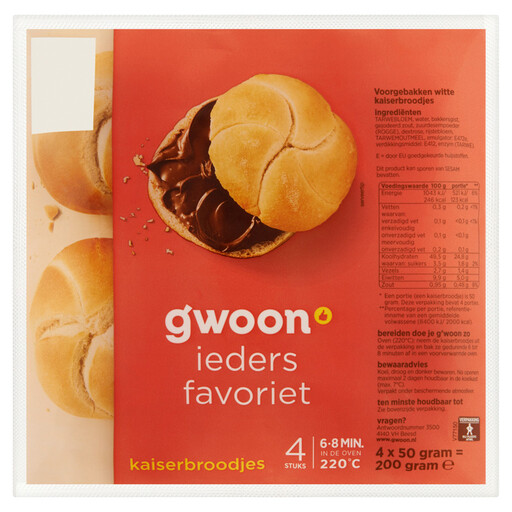
This pack of four kaiser rolls lets you match the number of rolls and the net weight to a family meal. Check the pack for ingredients, storage instructions and any preparation guidance.
 No image available
Four rolls may suit a meal where you need this quantity. The pack contains 200 g; check the label to see whether and how the rolls need to be prepared.
No. Choose a ten-pack if you’ll use the rolls within the stated storage period; a smaller pack may be a better fit if your mealtimes vary. Compare the number of rolls and the net weight, rather than judging by the size of the pack alone.
White and wholemeal are different product descriptions, so check the ingredients and nutritional information for the roll you choose. Jumbo lists 6.7 g of fibre per 100 g for its wholemeal frozen option reviewed here, while PLUS lists 6.9 g per 100 g for its wholemeal roll reviewed here.
Don’t assume so. Check the current ingredients list for the specific product to see whether it lists iodised salt or baker’s salt.
Follow the storage instructions on the pack you choose. Albert Heijn says its bake-at-home kaiser rolls reviewed here can be frozen on the day of purchase. For its wholemeal frozen option reviewed here, Jumbo specifies storage at −18 °C and says the rolls must not be refrozen after defrosting.
Read the ingredients and allergen information on the current pack. The kaiser rolls reviewed here don’t all have the same ingredients; Albert Heijn lists wheat and rye, among other ingredients, for its white ten-pack.