
If you’re serving generously topped rolls
If you want to serve warm rolls with toppings, how you cut them will determine how you fill them. A Lidl recipe uses halved Kaiser rolls for stir-fried vegetables and strips of steak.


Choose part-baked Kaiser rolls if you want to warm several rolls shortly before serving; fresh individual rolls are a better choice if you don’t want to plan for baking. Cut a roll in half to add fillings between the top and bottom, or hollow it out for a filling that cooks inside the roll. If you’re catering for dietary requirements, check the current packaging: a standard white or wholemeal Kaiser roll isn’t automatically gluten-free.
If you want to serve warm rolls with toppings, how you cut them will determine how you fill them. A Lidl recipe uses halved Kaiser rolls for stir-fried vegetables and strips of steak.
Would you like to serve white and wholemeal rolls, or does a guest need an explicitly gluten-free option? PLUS lists a wholemeal Kaiser roll as well as Schär Kaiserbrötchen labelled gluten-free. Check the other allergens on the packaging you choose, too.
If you only need a few rolls, it’s worth comparing individual rolls with smaller packs. ALDI lists an individual white Kaiser roll; Jumbo, PLUS and Dirk list packs of four.
First decide whether you want to top or fill the rolls, how many you want to prepare at once and which ingredients your guests need to avoid.
| What to consider | What to check when buying | Who it matters to |
|---|---|---|
| Cutting and filling | Decide whether you’ll cut the roll in half horizontally for toppings or hollow it out for a filling that cooks inside. Don’t assume that ‘medium sliced’ means a specific thickness. | If you want to put vegetables or meat between two halves, or cook a hot filling inside the roll, how you plan to serve it comes first. This would be the most important choice for around 40% of consumers. |
| Preparation and quantity | Check the number of rolls and the preparation instructions on the pack you choose; baking times and suitable appliances vary by product. | If all the rolls need to be served warm at the same time, you’ll want to know whether the preparation method and pack size suit your gathering. This would be the main consideration for around 40% of consumers. |
| Ingredients and allergens | Read the current ingredients and allergen information; if you need a gluten-free option, choose only a pack explicitly labelled gluten-free. | If a guest needs to avoid certain ingredients, the information on that particular pack matters most. Around 20% of consumers would prioritise this check. |
That description doesn’t tell you how the Kaiser roll will be cut for your chosen filling. You’ll also need a different cut for an open roll than for one with a hot filling.
Plan how you’ll cut the roll yourself: Lidl halves it for toppings, while Jumbo explains how to leave a rim and base intact when preparing a filled roll.
White and wholemeal wheat varieties from Albert Heijn, Jumbo and PLUS, among others, are not a substitute for a product explicitly labelled gluten-free. Even a separate gluten-free variety may contain other allergens.
Check the current packaging when you buy. According to the product information, the gluten-free Schär Kaiserbrötchen listed by PLUS contain soya and may contain mustard.
A pack of four, six or ten rolls won’t necessarily suit the number of guests or the different types of bread you want to serve.
Work out how many rolls of each type you need, then compare the number of rolls and the total weight. Follow the storage instructions on the pack you choose for any leftovers.
AH Kaiserbroodjes are a pack of 10 part-baked white wheat rolls, weighing 650 g in total.
Jumbo’s white Kaiserbroodjes are pre-baked wheat rolls in a pack of 4, weighing 200 g in total.
PLUS lists white part-baked rolls, an individual wholemeal Kaiser roll and separate gluten-free Schär Kaiserbrötchen.
Dirk lists a pack of four own-brand Kaiser rolls to bake at home.
ALDI lists both an individual white Kaiser roll and De Afbakker Kaiserbroodjes wit: 6 wheat rolls, weighing 300 g in total, to bake at home.
A Lidl recipe shows how to top halved Kaiser rolls for a global food night.
This pack of four Kaiser rolls may suit a small gathering. Choose how to cut them to suit the toppings, and check the preparation instructions on the packaging.
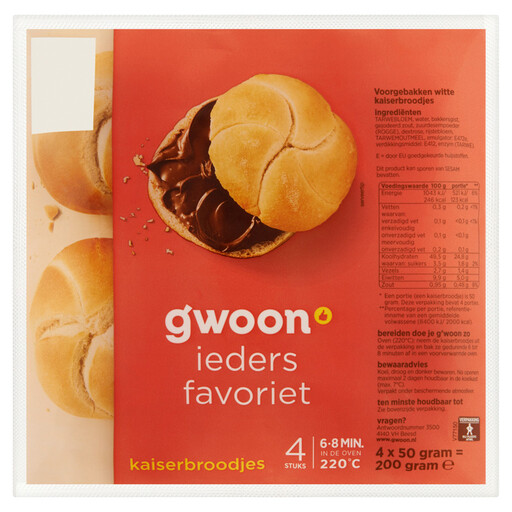 Image unavailable
Four Kaiser rolls may suit a small gathering or a table with several types of bread.
The pack contains 4 rolls and weighs 200 g. Check the packaging to see whether you need to bake the rolls, whether they’re already sliced and which allergens are listed.
Halve them horizontally to add fillings between the top and bottom; hollow them out if you want to cook a filling inside the roll. Lidl uses halved rolls for vegetables and strips of steak. For an oven-baked filled roll, Jumbo describes making a cut while leaving the rim and base intact.
Follow the instructions on the pack you choose, as timings vary by product. For its white part-baked rolls, PLUS recommends 6–8 minutes in the oven at 220 °C or 4 minutes in the air fryer at 200 °C; Albert Heijn recommends 8–10 minutes at 220 °C for AH Kaiserbroodjes.
Don’t assume they are: the white and wholemeal wheat varieties mentioned contain gluten-containing cereals. If you need a gluten-free option, choose a pack explicitly labelled gluten-free and check the other allergen information, too. The Schär Kaiserbrötchen listed by PLUS contain soya and may contain mustard.
Follow the storage instructions on the pack you choose. For AH Kaiserbroodjes, Albert Heijn recommends storing them in a cool, dark, dry place and freezing them at home on the day of purchase; Jumbo recommends storing its pack in a cool, dry, dark place and keeping it in the fridge for no more than two days after opening.