
Small households looking to cut down on leftovers
If you don’t eat kaiser rolls every day, you could choose a small pack or a frozen option that lets you bake only the amount you need for each snack.


A half loaf isn’t a standard size for kaiser rolls, so choose an after-school snack based on how many rolls you need and the storage instructions. A pack of four works well if you use them in time; frozen rolls are an option if you only want to bake a few at a time. If wholegrain matters, compare the nutritional information. If you need to avoid gluten, choose a product that is explicitly labelled gluten-free. Check for other allergens too, and follow the rules set by the school or childcare provider.
If you don’t eat kaiser rolls every day, you could choose a small pack or a frozen option that lets you bake only the amount you need for each snack.
For an after-school bread snack, compare white and wholemeal options by checking the ingredients, fibre per 100 g and allergens.
You may need a roll that is explicitly labelled gluten-free, but check for other allergens and any ‘may contain’ warnings too. Before packing one, ask what rules the school or childcare provider follows.
Work out how many rolls you’ll need for each snack and how to store the rest. Then compare the grain type, allergens and preparation instructions on the pack you’re buying.
| What to consider | What to check | Who it matters to |
|---|---|---|
| Portions and leftovers | Number of rolls and storage instructions after opening; for frozen rolls, check whether you can bake just some of them. | If I only need rolls after school now and then, I don’t want the rest to go unused. Around 31% of consumers prioritise portion control. |
| Wholegrain and fibre | Grain type in the ingredients and the amount of fibre per 100 g. | I want to choose between white and wholemeal for this snack, rather than relying on the product name alone. For around 25% of consumers, this nutritional information is the first thing they consider. |
| Allergens | Current ingredients, allergens and ‘may contain’ warnings; also ask about the school or childcare provider’s rules. | If someone needs to avoid certain ingredients, I want to know whether this particular roll is suitable before packing it. Around 25% of consumers put allergen avoidance first. |
| Preparation | Equipment needed, temperature and baking time; check whether you can bake the rolls straight from frozen. | After school, I want to know whether I can prepare the rolls in time using the oven or air fryer I have. Preparation is the most important factor for around 19% of consumers. |
Kaiser rolls are individual rolls. If you want to avoid leftovers, the number of rolls in a pack tells you more than the description ‘half loaf’.
Choose an amount you’ll use in time, or look for rolls you can bake a few at a time from frozen.
The white and wholemeal kaiser rolls from Albert Heijn and Jumbo included in this comparison contain gluten-containing cereals. For the wholemeal option reviewed, Jumbo also lists soya.
Check the current ingredients and allergens on the exact pack you’re buying, especially before sending a roll to school.
For the frozen kaiser rolls reviewed, Jumbo states that they must not be refrozen after thawing.
Take only the amount you need out of the freezer and follow the storage and preparation instructions on the pack.
According to the Netherlands Nutrition Centre, bakers are not required to use baker’s salt. Its use therefore varies from product to product.
Check the ingredients list on packaged bread, or ask which salt has been used if the bread is sold loose.
The AH kaiser rolls reviewed are white rolls for baking at home, sold in packs of four.
The Jumbo range reviewed includes white and wholemeal frozen kaiser rolls, both sold in packs of four.
The Schär Kaiserbrötchen reviewed are sold as gluten-free rolls.
This pack of four Kaiser Rolls is an option for a small after-school snack. Check the storage and preparation instructions if you won’t be using all the rolls at once.
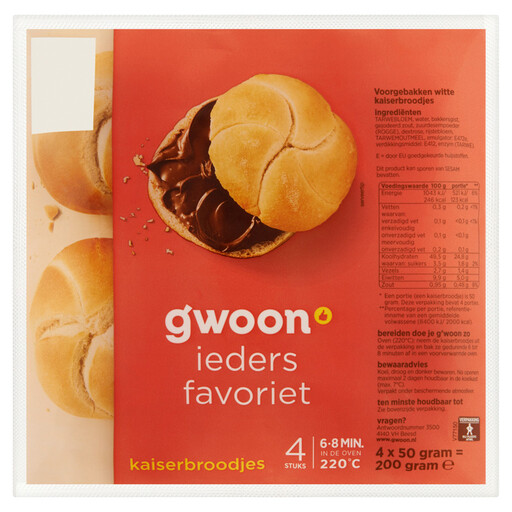 Image not available
Four rolls in one pack are a good fit for a small snack if you can use the rest in line with the storage instructions.
Before packing one, check the listed allergens, including gluten-containing cereals, milk, sesame and soya, and check the rules set by the school or childcare provider.
If you want to warm the rolls or store them after opening, follow the instructions on the pack.
Don’t assume a regular kaiser roll will be suitable: the standard options from Albert Heijn and Jumbo reviewed here contain gluten-containing cereals. Look for a product explicitly labelled gluten-free, and check for other allergens, any ‘may contain’ warnings and the rules set by the school or childcare provider.
Choose a small pack you can use in time, or frozen rolls so you can bake only the amount you need. Jumbo says the frozen option reviewed can be baked straight from frozen and must not be refrozen after thawing. According to Albert Heijn, the AH option reviewed is not suitable for home freezing.
No, don’t assume this is true of every product. The Netherlands Nutrition Centre says bakers are not required to use baker’s salt. Check the ingredients list for packaged rolls, or ask which salt has been used if they’re sold loose.