
Vandaag of morgen in huis

Kwaliteit gegarandeerd

Welkomstaanbiedingen ontgrendelen: GRATIS bezorging | Tot 80% korting | Gratis 30 dagen JoyPlus-proefperiode
Download de app
A flat battery or soft tyre usually happens at the most inconvenient time: on the motorway, in a car park or during a camping trip. A jump starter with compressor combines an emergency car starter with a portable tyre inflator, and often a power bank and LED light.
However, a high amp rating does not tell you everything. The right choice depends on your vehicle, engine size and how often you use the compressor. Pay particular attention to these common pitfalls.
A specification such as 7000A jump starter stands out, but peak current is not a complete measure of everyday performance. Also check:
A jump starter for a small petrol engine is not automatically suitable as a jump starter for a diesel car, SUV or van. Check the engine size in the product information and compare it with your vehicle.
150 PSI indicates the maximum pressure, not how quickly a tyre will inflate. For regular use, airflow, heat generation, hose length and automatic shut-off are also important.
A jump starter with air compressor and preset pressure can be practical. For example, you set the desired pressure in bar or PSI and the pump stops automatically, according to the product description. Also check whether a cooling period is required after prolonged inflation. Some models must not run for more than ten minutes at a time.
A built-in light, USB port or OBD2 fault-code reader can be useful, but consider how they are implemented:
A compact power bank for cars is particularly handy for a phone, dashcam or tablet. A 12V output can also support accessories such as a cool box or car vacuum cleaner, but always check the maximum power output.
Most models in this category are designed for 12V vehicles. That does not mean they are suitable for 24V lorries or the high-voltage battery of a fully electric car. In a hybrid vehicle, the jump starter will generally be used with the 12V circuit; consult the car’s manual.
Examples from the product specifications:
A larger engine requires not only a high peak current, but also the correct clamps and a sufficient charge level. Fully charge an emergency starter before keeping it in the car.
A car tyre inflator should ideally have:
For the normal tyre pressure, use the value shown on the sticker inside the door frame or fuel flap of your car, not the maximum pressure stated on the compressor. The maximum value of 150 PSI is a technical upper limit for various models, not a recommended tyre pressure.
Look for a smart cable with protection against reverse polarity, short circuits, overheating and overcharging. This helps to reduce operating errors, but it does not replace correctly connecting the red clamp to positive and the black clamp to negative or a suitable earth point.
Store the device in a cool, dry place. Lithium batteries lose capacity when stored empty for several months. For several models, the product information recommends checking the charge every two to three months. Do not use cables or casing that show visible damage.
The choices below are linked to recognisable usage situations. The stated performance is based on the product descriptions supplied by the brands and should be checked on the product page before purchase.
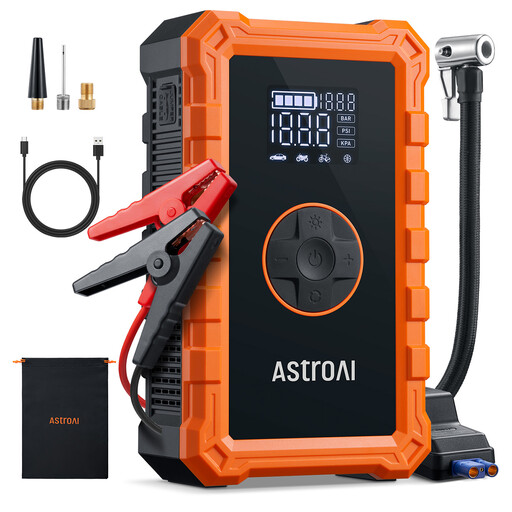
Why it suits this profile: This model combines a 1500A starting function with a 150 PSI compressor and a large digital display. According to the product description, it is designed for petrol engines up to 6.0 litres and diesel engines up to 3.0 litres.
The product description lists five inflation modes, automatic shut-off and a recommended cooling break after ten minutes of continuous use. This means you can look beyond the PSI figure alone.
150 PSI compressor, 2.4-inch display, LED lighting and USB charging. Suitable for everyday use with a compact car.

Why it suits this profile: The combination of a stated peak current of 4500A, a 150 PSI digital compressor and four lighting modes is ideal for drivers who want to use several functions while on the road.
The specifications list five inflation modes, three pressure units, automatic shut-off and ten safety features. Do check the stated engine limit for your car.
Suitable for 12V cars, SUVs and engines within the stated limits; LCD display and carry case included.
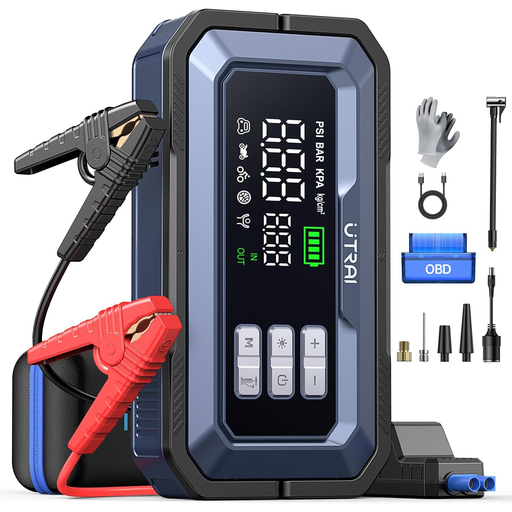
Why it suits this profile: According to the product description, this model supports 12V petrol cars, diesel engines up to 14 litres and hybrid models. The 160W DC output and OBD2 fault-code reader make it interesting for road trips, SUVs and vans.
The specifications mention a 19-cylinder compressor, temperature protection, four pressure units and five inflation modes. The stated 7000A remains a peak figure; check full vehicle compatibility.
150 PSI compressor, 160W 12V output, 18W USB-C charging, 2000 lumens according to the product description and supplied OBD2 adapter.
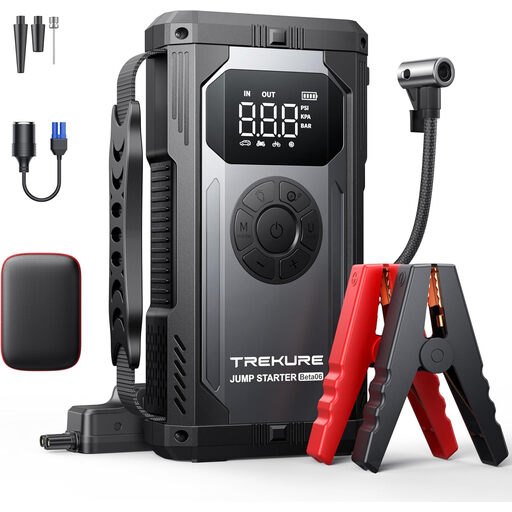
Why it suits this profile: According to the product information, this emergency starter is designed for 12V vehicles with petrol engines and diesel engines up to 10 litres. The 35 l/min compressor and 12V output are well suited to SUVs, vans and longer journeys.
The product description mentions automatic stop at the set pressure, multiple units and an LCD display. Before use, check the permitted inflation time and allow the device to cool down.
Stated peak current of 5500A, 150 PSI, 23800mAh according to the product information, dual USB output and emergency lighting.
We have put together a complete, up-to-date list of products that fully meet these strict selection criteria and the applicable European safety regulations.
This depends on battery capacity, charging cycles, temperature and storage. Manufacturers sometimes state a number of charging cycles, but this is a product specification under certain conditions, not a guarantee for every user. Regularly topping up the charge and storing the device in a cool place will help maintain its available capacity.
You can, provided the model is explicitly suitable for the engine size and 12V system of your diesel car. A model for a small diesel engine is not automatically suitable for an SUV or van. Also check that the battery is not damaged, leaking or frozen.
The compressor uses the jump starter’s internal battery, and consumption increases with high pressure, large tyres and prolonged inflation. Automatic shut-off prevents unnecessary pumping. Allow the device to cool down after intensive use, then recharge it.
