
Vandaag of morgen in huis

Kwaliteit gegarandeerd

Welkomstaanbiedingen ontgrendelen: GRATIS bezorging | Tot 80% korting | Gratis 30 dagen JoyPlus-proefperiode
Download de app
A dead battery or a flat tire always comes unexpectedly. In the middle of morning rush hour, or late at night in a deserted parking lot. Waiting for roadside assistance is often time-consuming and expensive. A jump starter with a compressor seems like the perfect solution: a compact device that can start your car and inflate your tires.
But the market is flooded with models that promise a lot but deliver little. Before you invest in a car emergency starter, it's crucial to know what to look for. Many buyers fall into the same traps, ending up with a device that fails them precisely when they need it most.
Here are the 3 most common missteps and how to avoid them.
Many manufacturers advertise with impressively high peak power, such as 3000A or even 5000A. This number represents the maximum current the booster can deliver for a fraction of a second. It's a marketing gimmick. What really matters for starting your engine, especially a cold diesel engine, is the continuous starting power (cranking amps). This is often not clearly stated.
The result? You buy a car jump starter that looks powerful on paper but, in practice, lacks the power to start your specific vehicle, leaving you stranded with a dead battery anyway.
A jump starter with air compressor that also functions as a car power bank and flashlight sounds ideal. The pitfall is that with many cheaper models, each individual function underperforms. The compressor takes forever to inflate a tire even slightly, the power bank is dead after half-charging your phone, and the flashlight barely provides any light. You're paying for features that are useless in an emergency.
A 12V jump starter operates with high currents. An incorrect connection can have disastrous consequences for your car's electronics, or even cause the jump starter itself to burn out. Yet, budget models often cut corners on essential safety protections. The lack of protection against reverse polarity (connecting the clamps incorrectly), short circuits, and overheating is a risk you don't want to take.
To avoid a bad purchase, focus on the specifications that truly matter. Check these three points before making a choice.
Look beyond peak power. Search for information about which engines the jump starter is suitable for. A reliable manufacturer will clearly state the maximum engine displacement, for example, suitable for up to 10.0-liter gas engines and 8.0-liter diesel engines. This gives a much better indication of its actual power than a standalone amp rating. Ensure the model is explicitly suitable for 12V systems, which is standard for passenger cars.
For a portable tire inflator, two values are important:
The capacity of the internal battery, expressed in milliampere-hours (mAh), determines how many times you can start a car or charge your phone. A model with Quick Charge (QC 3.0) ports will charge your devices significantly faster. Additionally, always check the list of safety features. Look for a model with at least protection against:
Not every model is suitable for everyone. We have selected a product that fits a specific user profile, based on objective specifications.
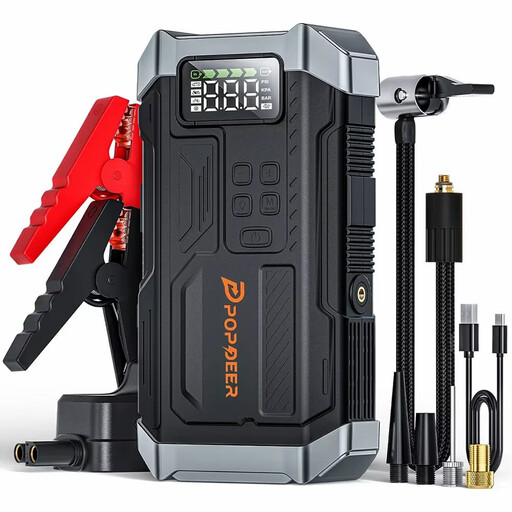
Why This Fits Their Persona: This user wants one reliable device for any conceivable roadside emergency. Whether for the family car, the RV, or the work van, this model offers the power and versatility to avoid any surprises. Ideal for anyone who wants to be prepared for a dead battery, a flat tire, or a dead phone.
This model bypasses the 'weak all-in-one' pitfall by specifying clear performance metrics: a starting power suitable for large engines (10L gas/8L diesel) and a compressor with a solid airflow (35L/min). According to the manufacturer, it includes 10 built-in safety features, addressing the pitfall of missing protections.
Powerful Specs: The combination of 5000A peak power and a 150 PSI compressor makes it suitable for heavy-duty tasks.
Ease of Use: The compressor features a smart preset and auto-stop function, which prevents over-inflation.
We have compiled a complete, up-to-date list of products that fully meet these strict selection criteria and safety regulations.
Even when not in use, a jump starter slowly loses its charge. It's good practice to check the charge every 3 to 4 months and fully recharge the device. This ensures it's ready for use in an emergency. Store it in a place with a moderate temperature, so not permanently in a car exposed to direct sun or freezing cold.
No, this is a common misconception. Your car's starter motor will only draw the amount of current (amps) it needs. A higher peak power simply means the jump starter has more power in reserve. This is actually an advantage, especially with a very dead battery or in cold weather. The built-in safety mechanisms prevent too much current from being delivered.
jump starter with air compressor come with various attachments (nozzles). With these, you can also easily inflate bicycle tires, air mattresses, sports balls, and other inflatables. This makes it a handy device for camping or a day out.