
Vandaag of morgen in huis

Kwaliteit gegarandeerd

Welkomstaanbiedingen ontgrendelen: GRATIS bezorging | Tot 80% korting | Gratis 30 dagen JoyPlus-proefperiode
Download de app
A flat battery or soft tyre usually happens at the most inconvenient moment: on the motorway, in a dark car park or during a camping trip. A jump starter with compressor combines a car battery booster with a portable tyre inflator, power bank and often an LED emergency light. That sounds practical, but not every model is suitable for every vehicle or use case.
As a Joybuy Product Recommendation Officer, I mainly filter products by verifiable specifications. So don’t focus solely on the highest amp figure shown on the packaging. Actual suitability also depends on the engine type, 12V compatibility, battery charge, compressor capacity and operating time.
A claim such as 7000A or 8000A does not automatically mean that every vehicle will start without any problems. Also check:
A jump starter for a small petrol car has different requirements from a model for a large diesel engine. A 24V lorry system is not the same as a 12V battery and must not simply be connected.
150 PSI is the maximum pressure that a compressor can reach according to the product specification. For a car tyre, the combination of airflow, heat management and automatic shut-off is more important. A device with 150 PSI can still work slowly if its airflow is limited.
So check whether the airflow is stated in litres per minute, whether the desired pressure can be preset and whether the compressor stops automatically. Follow the recommended cooling time. Many portable compressors should not run continuously for more than around ten minutes.
Smart jump leads with reverse-polarity protection, short-circuit protection and temperature monitoring can help when used correctly, but they do not replace proper checks. According to the instructions, the red clamp must be connected to the positive terminal and the black clamp to the negative terminal or a suitable earth point. Do not use a jump starter with a damaged, leaking or frozen battery.
Brands’ claims about protection or performance are marketing claims. For example, UTRAI lists ten layers of protection for the JS-30; this is a manufacturer’s product specification and does not guarantee that every incorrect connection will be consequence-free.
First, note down the vehicle type and engine size. Then check the stated compatibility:
A jump starter for an SUV and diesel car should therefore not only have a high peak power rating, but should also be explicitly specified for your engine size.
A useful car air compressor should ideally have:
For inflating tyres on the go, a model with a display and preset pressure is easier to operate than a pump that requires you to check the pressure continuously.
Capacity is often shown in mAh, but the usable energy also depends on voltage, electronics and temperature. Also look for:
A car power bank is useful for navigation, your phone or a dashcam, but running a compressor for an extended period uses a lot of energy. Recharge the device after use and avoid storing it for long periods in a hot, enclosed car.
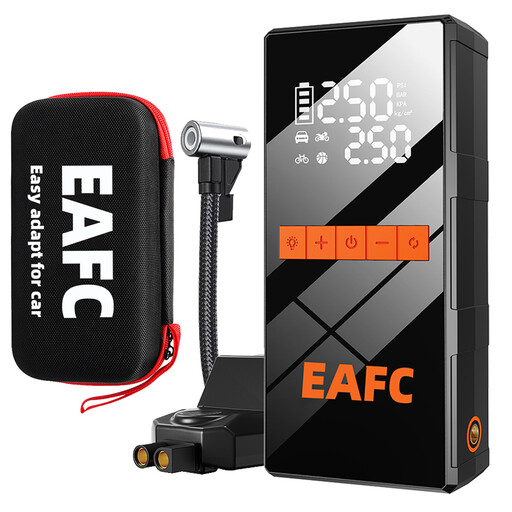
Why it suits this profile: According to the product specification, this compact model is intended for petrol engines up to 4.0 litres and diesel engines up to 2.0 litres. That makes it suitable for drivers looking for straightforward emergency assistance for a smaller car.
The product information clearly states the engine limits, a 150 PSI compressor and automatic shut-off. This makes its intended use more specific than a standalone peak amp figure.
150 PSI air pump, USB output, LED lighting and a compact design for storage in the car.
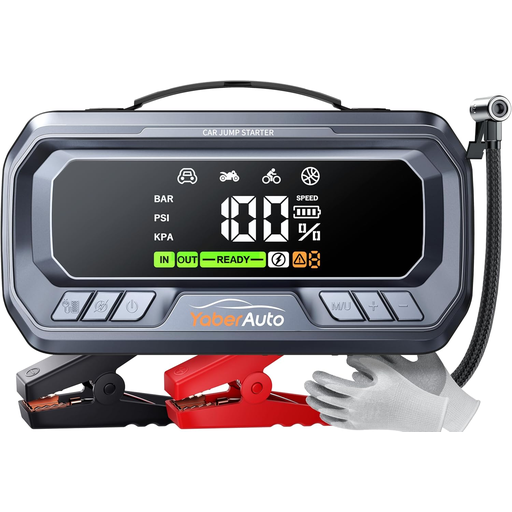
Why it suits this profile: According to the manufacturer, the YA90 supports 12V vehicles, including diesel engines up to 8.0 litres, and offers 65W bidirectional USB-C PD charging.
The specifications list starting current, peak current, engine limit and a 160 PSI compressor separately. According to the description, the 3.3-inch display shows the preset tyre pressure, among other information.
16000mAh battery, 65W USB-C PD, 160 PSI air compressor and 600-lumen LED emergency light.
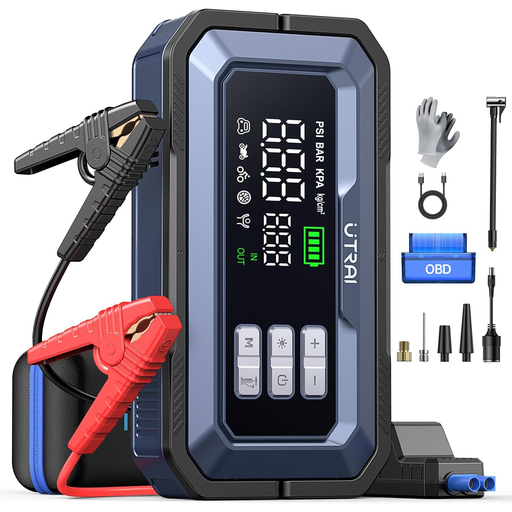
Why it suits this profile: According to the product information, this model is designed for 12V petrol vehicles, diesel engines up to 14 litres and hybrid models. The additional DC output is useful for campers and drivers with 12V accessories.
Its suitability for large engines is stated separately. In addition, the compressor has adjustable pressure, multiple units and a temperature sensor, according to the manufacturer.
7000A peak current, 150 PSI compressor, 160W DC output, 2000-lumen lighting and OBD2 adapter.
We’ve put together a complete, up-to-date list of products that fully meet these strict selection criteria and the applicable European safety regulations.
No. Check the voltage, engine size and specified fuel type. Most models in this category are intended for 12V vehicles. A vehicle with a 24V system or a severely damaged battery will generally fall outside normal use.
Its service life depends on charging cycles, storage temperature, usage and maintenance. Store the device somewhere cool and dry, avoid prolonged heat in the car and recharge it regularly according to the instructions. A flat lithium battery that is not recharged for several months may become less usable.
Yes, the compressor uses a relatively large amount of energy. A small pressure adjustment requires less power than filling a completely flat tyre. Set the correct pressure, use the automatic shut-off and follow the recommended operating and cooling times. Afterwards, check the tyre pressure again at a fixed service station if necessary.
