
Vandaag of morgen in huis

Kwaliteit gegarandeerd

Welkomstaanbiedingen ontgrendelen: GRATIS bezorging | Tot 80% korting | Gratis 30 dagen JoyPlus-proefperiode
Download de app
A dead battery or a flat tire always happens unexpectedly. A jump starter with a compressor seems like the perfect all-in-one solution to avoid being stranded on the roadside waiting for assistance. However, the market is flooded with models that promise a lot but disappoint in practice. Many devices become useless after a few months or underperform when you need them most.
Before you purchase a jump starter with compressor, it's crucial to know what to look for. We'll discuss the three most common pitfalls and the specifications that truly matter. This will help you avoid a bad purchase and ensure you're prepared for emergencies.
Much of the marketing focuses on impressive numbers while hiding significant weaknesses. Watch out for the following three pitfalls:
battery booster might manage one weak starting attempt, but it lacks the power for a completely dead battery, especially in the cold. The continuous current output is more important than a brief peak.car jump starter, portable tire inflator, and car power bank can fall short on all fronts. The compressor is often too weak to fully inflate a car tire and shuts down after a few minutes due to overheating. The power bank function charges your phone at an excruciatingly slow pace.To choose a reliable car jump starter, focus on these three verifiable specifications.
The peak current, measured in amperes (A), determines if the jump starter has enough power for your engine. A booster that's too weak is useless.
12V jump starter with at least 2000A to 3000A.The effectiveness of the built-in tire inflator depends on the maximum pressure (PSI or Bar) and the air flow rate (L/min).
The internal battery powers not only the jump-starting function but also the compressor and USB ports.
Below are several models that score well on the above criteria, matched to different user profiles.
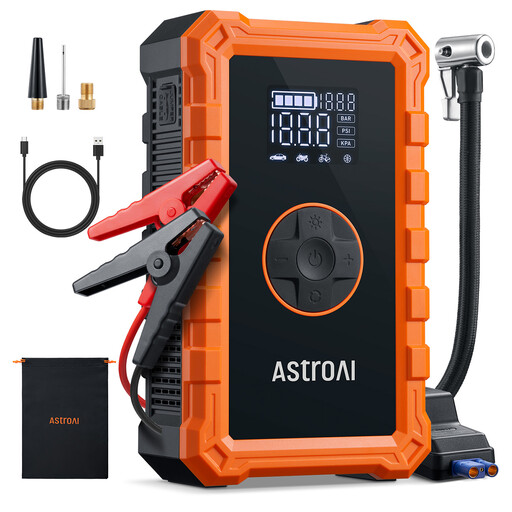
Why This Fits Their Persona: A compact and reliable model for the average car owner. Powerful enough for most gasoline and smaller diesel cars (up to 6.0L gas/3.0L diesel). Its size makes it easy to store in the glove compartment or trunk.
This model avoids the "all-in-one" disappointment. The compressor has 5 preset modes and an auto-shutoff function, making it user-friendly. The large 2.4-inch screen provides clear information, instead of vague indicator lights.
Compact design with a clear, readable screen. The compressor is practical to use thanks to its preset modes and automatic shutoff.

Why This Fits Their Persona: Ideal for owners of RVs, vans, boats, or multiple vehicles. The high peak current of 4500A is suitable for large engines (up to 9.0L gas / 8.0L diesel) and offers reliability under tough conditions.
This model tackles the overheating pitfall. According to the manufacturer, its honeycomb cooling structure reduces heat generation by 30%. The 10-layer protection system, including reverse polarity protection, prevents the most common safety risks.
Very high peak current (4500A) for demanding tasks. The design is focused on reliability in extreme temperatures (-20°C to 60°C).
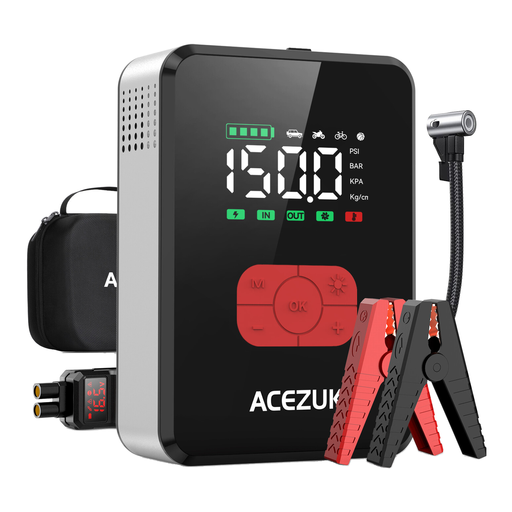
Why This Fits Their Persona: For those who refuse to compromise. With a peak current of 7000A and a 26800mAh capacity, this model is designed to start virtually any 12V vehicle, including all gasoline engines and diesels up to 12L.
This model counters the "peak current myth" by combining high amperage with a large battery capacity. The intelligent jump clamp has its own screen that provides feedback and warns against incorrect use, minimizing safety risks.
Extremely high peak current (7000A) and a large 3.3-inch display. The smart clamp with its own screen offers an extra layer of safety and convenience.
We have compiled a complete, up-to-date list of products that fully meet these strict selection criteria and safety regulations.
Most manufacturers recommend fully charging a jump starter every 3 to 6 months, even if you don't use it. This helps extend the lifespan of the lithium-ion battery and ensures it's ready for use when you need it. Modern models have low self-discharge but will still lose some charge over time.
Yes, modern jump starters are designed with safety in mind. Features like reverse polarity protection (prevents damage if you connect the clamps incorrectly), spark-proof technology, and short-circuit protection make them safe to use, even for someone with no technical knowledge. However, always read the user manual before use.
No, not every car jump starter is suitable for a diesel engine. Diesel engines have a higher compression ratio and require significantly more starting current (amperes) than gasoline engines, especially in cold weather. Always check that the jump starter's peak current and recommended engine displacement (in litres) match your diesel vehicle's specifications. A booster that is too weak will not be able to start the engine.
