
Vandaag of morgen in huis

Kwaliteit gegarandeerd

Welkomstaanbiedingen ontgrendelen: GRATIS bezorging | Tot 80% korting | Gratis 30 dagen JoyPlus-proefperiode
Download de app
A dead battery or a low tire always happens unexpectedly and at the worst possible time. You're ready to leave for work on a cold morning, or you discover it just as you're about to leave for vacation. A jump starter with a compressor is a convenient all-in-one solution that gets you back on the road quickly, without depending on roadside assistance.
But not every jump starter is worth the money. The market is flooded with models that promise a lot but disappoint in practice. Before you make a choice, it's important to recognize two common pitfalls that can cost you money and frustration.
You don't need to be a technical expert to make a good choice. By paying attention to a few key specifications, you can separate marketing hype from facts.
The most important figure is not the peak power, but the starting power (also known as starting current or 'cranking amps'). This is the power the jump starter can deliver for several seconds to turn over your engine.
A good 12v jump starter clearly states which engine size (in litres) it is suitable for. For an average passenger car with a petrol engine up to 3.0 litres, a model that delivers 400-600A of starting power is often sufficient. For larger SUVs or diesel engines, you'll need more power.
Almost every compressor can reach a high pressure of 150 PSI, but that says nothing about its speed. The compressor's efficiency is determined by the airflow in litres per minute (L/min).
Also, look for handy features like an automatic stop function. You set the desired tire pressure (e.g., 2.5 bar), and the compressor stops automatically when it's reached.
A jump starter power bank must be reliable and hold its charge. The capacity in milliampere-hours (mAh) indicates how many times you can start a car or charge a phone. Just as important is the self-discharge rate. A quality portable jump starter loses very little power when left unused in your car for months. Check the manufacturer's specifications for the recommended charging frequency (e.g., every 3-6 months) to keep the battery in good condition.
To help you with your choice, we've matched several popular models to different user profiles. These recommendations are based on objective product specifications.
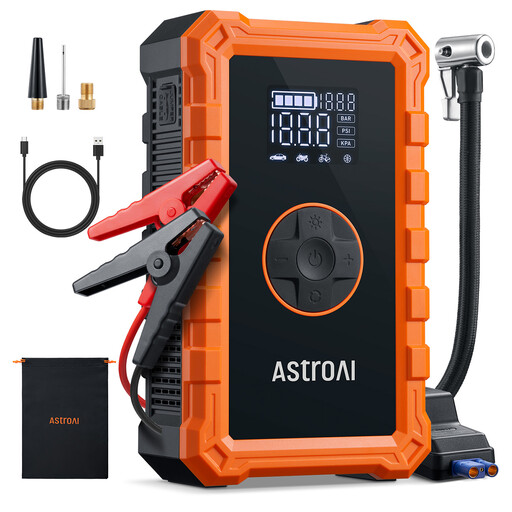
Why This Fits Their Persona: This is an excellent all-rounder for most cars. It's compact, offers enough starting power for standard petrol and smaller diesel engines, and has a decent compressor for emergencies. Ideal for the commuter who wants to be prepared.
With a specified airflow of 25 L/min, the compressor is genuinely useful and not just for show. The starting power is realistic for the specified engine sizes (up to 6.0L petrol/3.0L diesel).
All-in-one convenience with a clear 2.4-inch digital screen that shows both battery status and tire pressure. The automatic stop function on the compressor is very practical.
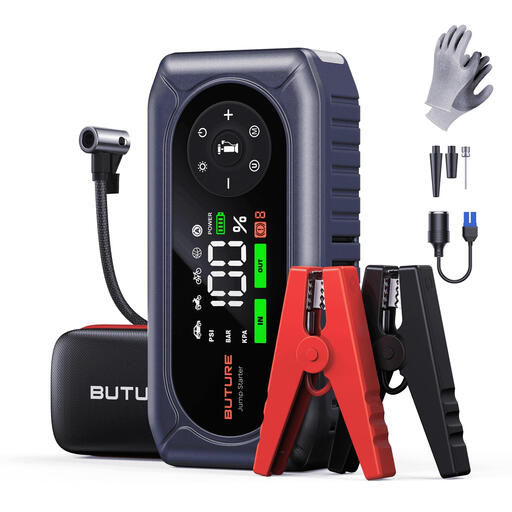
Why This Fits Their Persona: Anyone with a larger engine (large SUV, van, camper) needs more starting power. This model delivers the power required for large petrol and diesel engines, combined with a robust build and a 150 PSI compressor.
This model actually delivers the higher power needed for large engines, where lighter models would fail. The manufacturer's mentioned cooling technology helps prevent overheating during heavy use.
High starting power (suitable for engines up to 9.0L petrol / 8.0L diesel according to the manufacturer) and a clear LCD screen for easy operation of all functions.
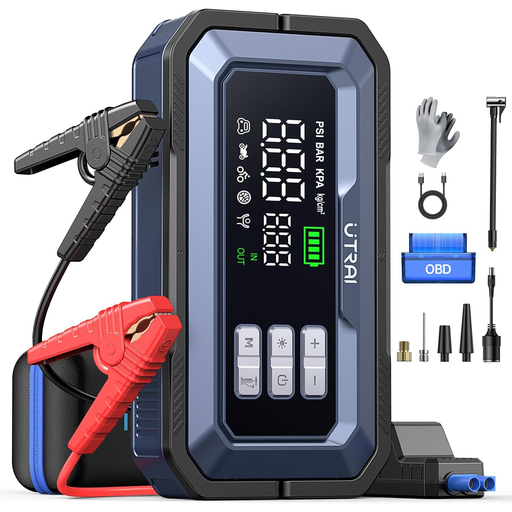
Why This Fits Their Persona: For those who want the ultimate all-in-one device. This is not only an extremely powerful jump starter but also a mobile power station with a 160W DC output (for coolers), an OBD2 fault code reader, and a very bright work light.
This is not an 'all-in-one' compromise. Every feature is powerful and well-executed, from the enormous starting power to the 150 PSI compressor and the 2000 lumen lamp. The extra features like the OBD2 reader are genuinely useful.
Unprecedented versatility. Functions as a mobile power station for camping or emergencies, including a diagnostic tool to read the car's fault codes.
We've compiled a complete, up-to-date list of products that fully meet these strict selection criteria and safety regulations.
The lifespan depends on usage and storage. Most lithium-ion models are designed for hundreds of charge cycles and last about 3 to 5 years with proper maintenance (charging every 3-6 months). To preserve the battery, do not store it in direct sunlight or extreme freezing temperatures.
Yes, they are designed for that. The trunk or glove compartment is a great place. However, extreme temperatures, such as a car in direct sun in the summer or during a severe frost, can shorten the internal battery's lifespan. Check the manufacturer's recommended storage temperature for the best results.
Not necessarily. It's more important that the starting power matches your engine type. A car jump starter with 6000A for a small city car is overkill and unnecessarily expensive. Look at the manufacturer's recommendation for the engine size (in litres) of petrol and diesel engines. That is a more reliable indicator for making the right choice.
