
Vandaag of morgen in huis

Kwaliteit gegarandeerd

Welkomstaanbiedingen ontgrendelen: GRATIS bezorging | Tot 80% korting | Gratis 30 dagen JoyPlus-proefperiode
Download de app
A dead battery or a flat tire always happens unexpectedly and at the worst possible moment. Waiting for roadside assistance can take hours and is often expensive. A jump starter with a compressor seems like the perfect all-in-one solution for your trunk. However, many devices on the market fail to deliver on their promises, leaving you stranded on the side of the road anyway.
Before you invest in an emergency starter for your car, it's important to recognize the common pitfalls. Much of the marketing focuses on impressive numbers that mean very little in practice.
car power bank delivers at 5V or 12V. As a result, the device may provide far fewer charges in reality than promised.portable compressor that takes forever to inflate a tire or fails to reach the set pressure. The focus on multifunctionality then comes at the expense of the two most important functions: starting and inflating.To avoid a bad purchase, it's better to focus on a few concrete specifications. These determine whether a jump starter with air compressor will do its job when you really need it.
The most important thing is the power to start your engine. Look beyond the advertised Peak Amps. While a higher number is often better, it's crucial to know what type of engine the battery booster is suitable for. A large diesel engine (e.g., 3.0L) requires significantly more starting power than a small gasoline engine (1.2L). A good guideline:
7000A jumpstarter or higher to be safe, especially at low temperatures.All models discussed here are 12V jump starters, the standard for passenger cars, vans, and RVs in the Netherlands.
For the car tire inflator function, two values are important. The maximum pressure, expressed in PSI (Pounds per Square Inch) or Bar, indicates the pressure to which the pump can inflate. Most cars have a tire pressure between 30-40 PSI (2.0-2.8 Bar), so a compressor that can reach 150 PSI is more than adequate.
More important is the airflow (L/min). This number determines the speed of inflation. A low airflow means you'll be waiting a long time. Manufacturers don't always list this, but a model that specifically mentions its speed (e.g., "a tire from 0 to 35 PSI in 5 minutes") gives a better indication of its performance.
Below is a selection of products, matched to specific user profiles. These are not "winners," but practical choices based on their specifications and intended use.
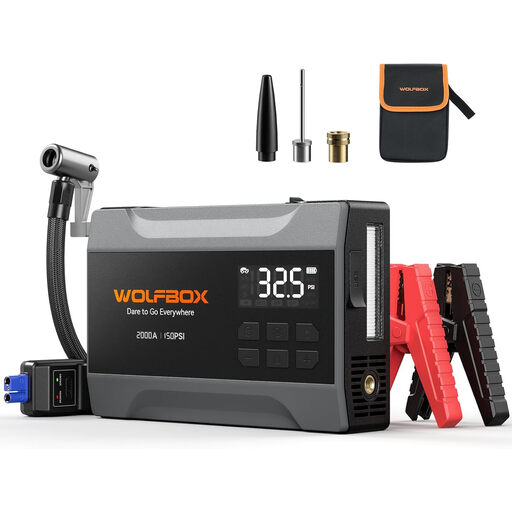
Why This Fits Their Persona: Ideal for drivers of standard gasoline cars who want a reliable and compact emergency solution for the glove compartment. It offers peace of mind for daily trips without paying for unnecessary power.
This model avoids the 'peak amps trap' by clearly stating it is suitable for gasoline engines up to 5L. No vague promises, just a clear specification.
Its compact size and balanced set of features (starting, inflating, LED light) make this a practical and no-nonsense choice for the average driver.
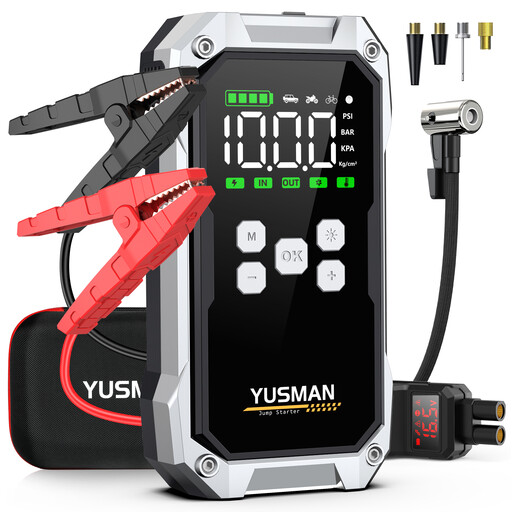
Why This Fits Their Persona: A powerful all-rounder for those who travel with a larger car, SUV, or RV. The power is sufficient for heavier engines, and the extra features are handy for camping trips or long journeys.
This model bypasses the 'all-in-one' trap by combining robust performance with a complete set of accessories (storage case, various nozzles), indicating a focus on durability and ease of use.
The combination of 5000A peak power, suitability for 10.0L diesel engines, and smart safety clamps offers an excellent balance between power and safety.
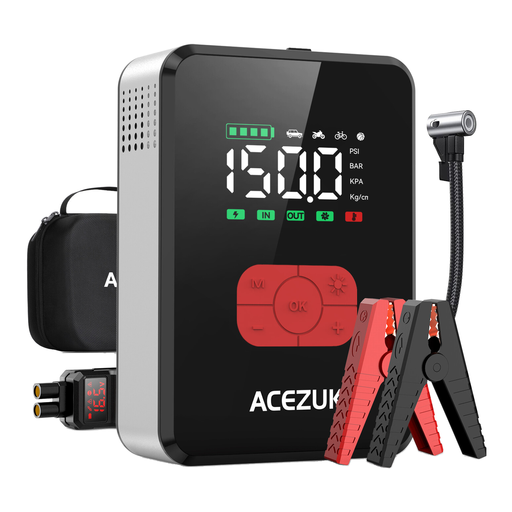
Why This Fits Their Persona: For those who depend on a large, heavy-duty vehicle. This model delivers the extreme power needed to reliably start large diesel engines (up to 12L according to the manufacturer), even in adverse conditions.
This is the direct answer to the pitfall of underpowered starters. The specification for 12L diesel engines and the 7000A peak leave little to the imagination. It is designed for pure power.
Unmatched starting power for virtually any 12V vehicle. The smart compressor with a display and auto-stop function adds a layer of precision and convenience.
We have compiled a complete, up-to-date list of products that meet these strict selection criteria and EU safety regulations.
Most manufacturers recommend fully charging an emergency car starter every 2 to 3 months, even if you don't use it. This helps keep the internal battery in good condition and ensures it's ready for use when you need it. Always consult your specific model's manual for the best maintenance advice.
A jump starter is designed to provide a short, powerful burst of current to start the engine. It is not a battery charger. Once the engine is running, the car's alternator will recharge the battery. However, if the battery is old or faulty, it may no longer hold a charge and will need to be replaced.
Not necessarily. It's more important that the starting power matches your vehicle. A small gasoline car doesn't need a 7000A jumpstarter. An overly powerful booster isn't harmful, but you're paying for power you don't use. Match the power to your engine (gasoline/diesel and displacement) for the best value for money.
