
Vandaag of morgen in huis

Kwaliteit gegarandeerd

Welkomstaanbiedingen ontgrendelen: GRATIS bezorging | Tot 80% korting | Gratis 30 dagen JoyPlus-proefperiode
Download de app
A dead battery or a flat tire always happens unexpectedly. A jump starter with a compressor seems like the perfect all-in-one solution. However, the market is flooded with models making lofty claims. Many drivers only discover after purchase that their new gadget falls short in practice. As a Joybuy Product Recommendation Officer, I'll help you see through the marketing hype and choose a model that actually delivers on its promises.
Before you make a decision, it's crucial to recognise the most common marketing traps. These often lead to you ending up with a useless device.
To avoid a bad purchase, focus on the specifications that matter in practice. These are the non-negotiable features of a reliable portable jump starter.
Don't be blinded by peak amperage. Instead, look at the recommended engine displacement (in litres) for which the emergency car starter is suitable. For most standard passenger cars with petrol engines up to 2.5L, a model rated for engines up to 6.0L petrol is more than sufficient. Do you have a larger diesel, an SUV, or a van? Then choose a model that explicitly supports larger diesel engines. A good 12V jump starter will state this clearly.
A functional jump starter with an air compressor has two key features:
A battery booster with a compressor is only truly multi-functional if its extra features are also useful. A good power bank with jumper cables has at least one USB port with fast-charging technology (like QC3.0) to quickly charge your smartphone. A built-in LED light is standard, but a model with multiple modes (flashlight, strobe, SOS) offers added safety during a breakdown in the dark.
Not everyone has the same needs. Below is a selection tailored to different user profiles.
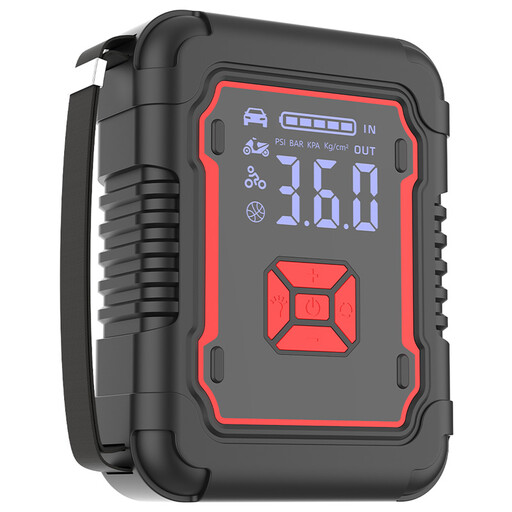
Why This Fits Their Persona: Ideal for those seeking a compact, reliable all-in-one solution to keep in the car. Perfect for most passenger vehicles, and its fast-charging function provides a practical power bank for on-the-go use.
The 150 PSI compressor has an auto-stop function, making it genuinely useful and avoiding the "useless compressor" pitfall.
Compact size, easy to store. QC3.0 18W fast-charging port for efficiently charging devices.
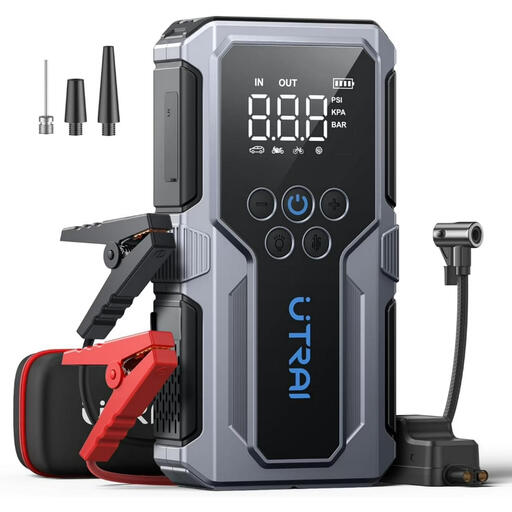
Why This Fits Their Persona: Suitable for larger engines (up to 8.5L petrol, 6.5L diesel). The clear LCD screen for the compressor and the extensive LED functions make this an excellent choice for campers and those who work on their own cars.
Tackles the "myth of peak amps" by providing clear engine compatibility specifications, which gives a more realistic picture of its starting power.
Digital display with pressure presets for the compressor. Suitable for a wide range of vehicles, including SUVs and boats.

Why This Fits Their Persona: For owners of large cars, vans, or boats with heavy-duty engines (up to 9.0L petrol, 8.0L diesel). The high starting power and advanced cooling make this a reliable choice for demanding jobs.
The high 4500A peak is backed by concrete engine displacement specifications, which inspires confidence. The honeycomb cooling system prevents overheating, a common issue with powerful models.
Very high starting power for heavy-duty engines. Advanced cooling technology and a 10-layer safety system.
We have compiled a complete, up-to-date list of products that fully meet these strict selection criteria and safety regulations.
Generally, it is recommended to fully charge the jump starter every 3 to 6 months, even if you don't use it. This keeps the internal battery in good condition and ensures it's ready for use when you need it. Always consult the manufacturer's manual for specific advice.
Yes, most modern jump starters are designed to operate within a wide temperature range, often from -20°C to 60°C. Extreme cold can temporarily reduce the battery's performance. It is therefore wise to check the product's specifications and, in case of severe frost, store it indoors.
Not necessarily. It is more important that the starting power matches your vehicle's engine. An extremely powerful car jump starter for a small city car offers no extra benefit and is unnecessarily expensive. Focus on the recommended engine displacement (in litres) specified by the manufacturer for the most efficient and safe result.
