
Vandaag of morgen in huis

Kwaliteit gegarandeerd

Welkomstaanbiedingen ontgrendelen: GRATIS bezorging | Tot 80% korting | Gratis 30 dagen JoyPlus-proefperiode
Download de app
A dead battery or a flat tire always happens unexpectedly. Being stranded on the side of the road isn't just an inconvenience; it can throw your entire schedule into disarray. A jump starter with a compressor seems like the perfect solution: one device for two common problems. But the market is flooded with models making lofty promises. Unfortunately, many of those promises lead to a purchase you'll regret.
Before you invest in a car emergency starter, it's crucial to know the pitfalls. Many buyers fall for the same marketing tricks and end up with a device that fails them when they need it most.
jump starter with air compressor that takes fifteen minutes to slightly inflate one tire is impractical in an emergency. Maximum pressure (PSI) is important, but the inflation speed (liters per minute) is what truly counts.To make a smart choice, you need to look beyond the marketing hype. Focus on the specifications that really matter. Here are the three most important points to check.
The car jump starter must be powerful enough for your engine. Pay attention to two values:
A gasoline engine up to 2.0 liters typically requires a cranking current of 300-400A. A diesel engine or a larger gasoline engine (over 3.0 liters) will need 600A or more. So, look beyond just the peak value.
A 12v compressor is more than just a number. The maximum pressure, expressed in PSI or Bar, indicates how much you can inflate the tire. Most car tires don't require more than 40-50 PSI, so a compressor that reaches 150 PSI is more than sufficient.
More important is the inflation speed, often indicated in liters per minute (L/min). A higher value means your tire will inflate faster. A model with a low L/min rating can be frustratingly slow, especially with a completely flat tire.
A portable battery booster also serves as a power bank for your car and other devices. The capacity determines how many times you can jump-start a car or charge your phone.
Different drivers have different needs. We've selected a few options that suit various user profiles, based on their specifications.
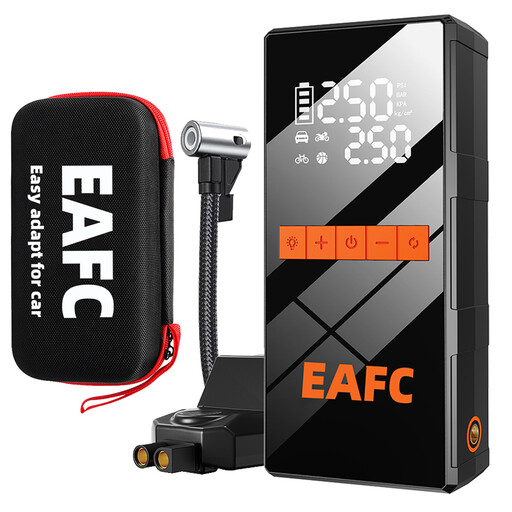
Why This Fits Their Persona: This model is a practical 4-in-1 solution for the average driver. It offers enough starting power for most gasoline and smaller diesel cars, plus a functional compressor for emergencies or routine tire top-ups. It's ideal for keeping in the trunk for daily commutes or road trips.
It doesn't promise extreme performance but delivers a realistic 1200A peak and 600A starting current. The compressor's auto-stop feature prevents over-inflation and is practical to use.
A balanced and multifunctional device (starter, compressor, power bank, flashlight) in a compact package. The 8000mAh battery capacity is sufficient for multiple jump-starts or charging a phone.
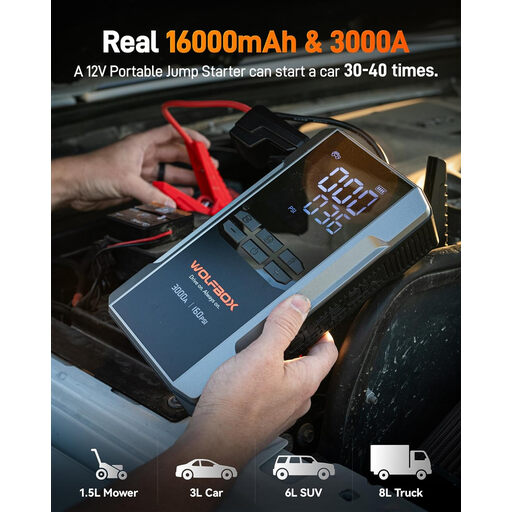
Why This Fits Their Persona: For owners of SUVs, vans, RVs, or cars with large engines (up to 8.0L gas or 6.0L diesel). The high peak and cranking currents provide the reliability needed for heavy-duty vehicles, while the compressor is powerful enough for larger tires.
This model backs up its high 3000A peak claim with clear specifications for large engines. The battery capacity is transparently listed as 59.2Wh, a more reliable metric than mAh alone.
Very high starting capacity for demanding vehicles. The 65W fast-charging feature ensures the booster itself recharges quickly, which is useful for professional or heavy use.
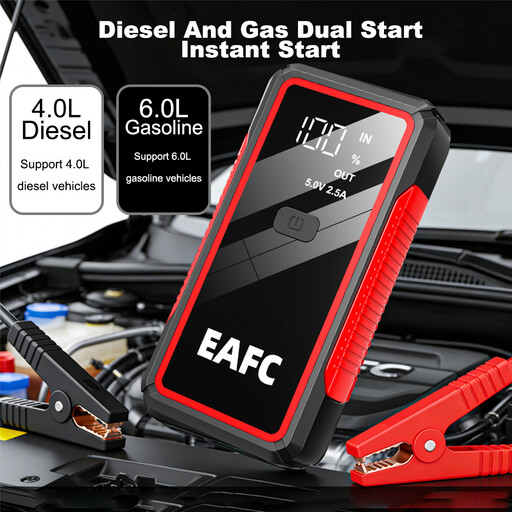
Why This Fits Their Persona: For the user who already owns a separate compressor or simply wants a compact, powerful, and affordable jump starter. This device focuses on one job: starting your car. It's smaller and lighter than models with a built-in compressor.
This model doesn't pretend to do it all. It's a pure jump starter focused on delivering a powerful 2000A peak without the extra bulk and cost of a compressor you might not need.
Very compact and lightweight, it fits easily in the glove compartment. The 10000mAh battery offers a good balance of power and size, and it also functions as a handy power bank.
We have compiled a complete, up-to-date list of products that fully meet these strict selection criteria and safety regulations.
Most manufacturers recommend fully charging a jump starter every 3 to 6 months, even if you don't use it. This helps keep the battery in good condition. It's always wise to fully charge the booster before embarking on a long road trip. Consult your specific model's manual for the best advice.
Yes, modern jump starters are equipped with multiple safety features. These include protection against reverse polarity (if you connect the clamps incorrectly), short circuits, over-voltage, and overheating. As long as you follow the instructions and connect the clamps correctly (red to the positive terminal, black to the negative terminal or a metal part of the engine block), it is safe to use for your car's electronics.
The built-in compressors are designed for car, motorcycle, and bicycle tires. They are also suitable for inflating sports balls or air mattresses. For the very large tires of a tractor or large truck, for example, they are often not powerful or fast enough. Always check the product's maximum pressure (PSI/Bar) to see if it is suitable for your application.
