
Vandaag of morgen in huis

Kwaliteit gegarandeerd

Welkomstaanbiedingen ontgrendelen: GRATIS bezorging | Tot 80% korting | Gratis 30 dagen JoyPlus-proefperiode
Download de app
A clicking sound when you turn the key. A flat tire just when you're in a hurry. Every driver knows the feeling of helplessness during a car breakdown. In the past, this meant waiting for roadside assistance or a helpful neighbor with jumper cables. Today, there's a more compact solution: a jump starter with a compressor. This multifunctional device can not only start your car but also inflate your tires.
However, the market is flooded with models that promise the world. Before making a purchase, it's wise to know what to look for. Many devices fall short due to misleading specifications or an impractical design.
Here are the most common pitfalls:
jump starter with air compressor is only useful if the pump does its job. Many cheaper models have a weak compressor that takes forever to inflate a tire, overheats quickly, and needs to cool down after ten minutes.portable jump starter should be light and compact.To avoid a bad purchase, focus on the specifications that truly matter. Don't be distracted by marketing terms; look at the facts.
The starting current, expressed in amperes (A), determines if the car battery booster is powerful enough for your engine. The peak current is the maximum power the device can deliver for a short burst. This number is often exaggerated. More important is the actual, stable starting current.
A good jump starter with tire inflator is a lifesaver. The pressure is measured in PSI (Pounds per Square Inch) or Bar. Most car tires require a pressure between 30 and 40 PSI (approximately 2.1 to 2.8 Bar).
cordless tire inflator automatically stops when it's reached. This prevents over-inflated tires and makes it much easier to use.Most modern jump starters also function as a power bank for your car.
Not every jump starter is suitable for every user. We have highlighted some popular choices and matched them with a fitting user profile.
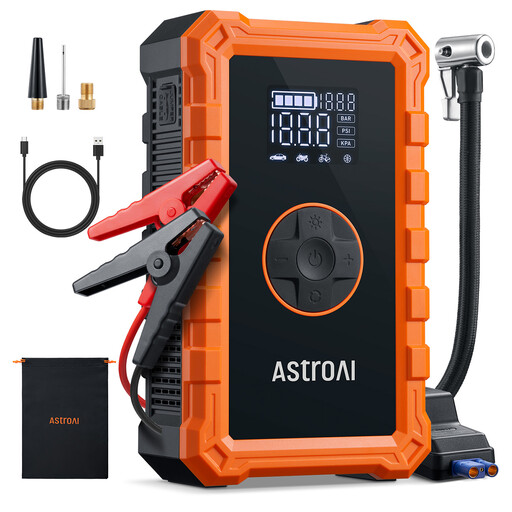
Why This Fits Their Persona: Ideal for the average driver with a gasoline or smaller diesel car. This compact all-in-one device provides peace of mind for the daily commute without unnecessary specs.
The 1500A peak current is realistic and more than enough for most cars, avoiding the 'peak amps trap.' The compressor has an automatic shut-off feature, which bypasses the pitfall of an unreliable pump.
The clear 2.4-inch screen displays status and tire pressure in real-time. Its compact design allows all accessories to be stored within the unit itself.
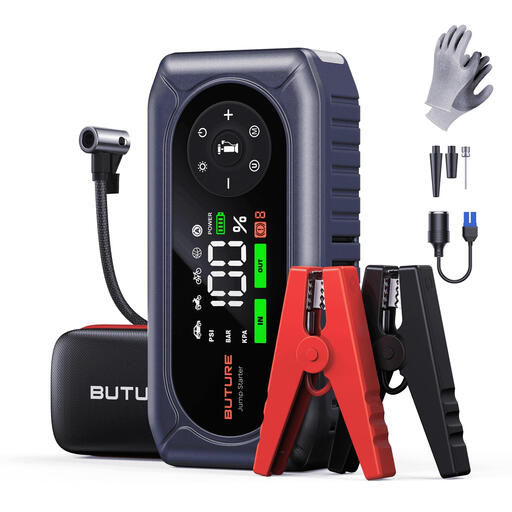
Why This Fits Their Persona: For owners of larger vehicles like SUVs, vans, or RVs. The high starting current provides security for heavy-duty gasoline and diesel engines, perfect for road trips and camping adventures.
Here, the high 4500A peak current is functional and not just empty marketing, as it's necessary for larger engines. According to the manufacturer, its honeycomb cooling technology reduces heat generation by 30%, tackling the pitfall of an overheating compressor.
Suitable for engines up to 9.0L gasoline and 8.0L diesel. The 150 PSI compressor with 5 preset modes makes inflating various tires (car, bike, ball) very straightforward.
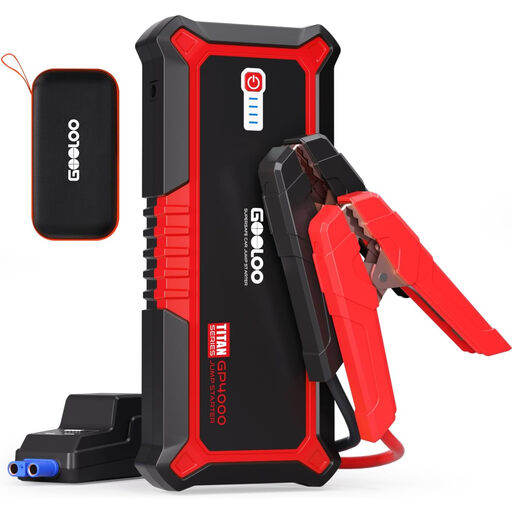
Why This Fits Their Persona: For those who already own a separate tire inflator and are looking for maximum starting power in the most compact form factor. This is a pure, powerful battery booster without the extra bulk of a compressor.
This model bypasses the pitfall of a mediocre compressor by simply not having one. It focuses on a single task: delivering reliable starting power. The robust, compact design is built for durability and ease of use.
Extremely powerful with a 4000A peak current, suitable for all gasoline engines and diesels up to 10.0L. It also functions as a powerful power bank with a fast-charging feature for other devices.
We have compiled a complete, up-to-date list of products that fully meet these strict selection criteria and safety regulations.
Most manufacturers recommend charging a lithium-ion jump starter every 2 to 3 months, even if you don't use it. This ensures the battery remains in good condition and the device is ready for use when you need it. Always check the recommendations in the manual for your specific model.
Not necessarily. An extremely high amperage is only useful if you have a very large engine (e.g., a heavy-duty diesel). For most passenger cars, a model with a 1500A to 2000A peak current is more than sufficient. There's no need to pay more for unused power. It's more important that the starting current matches your vehicle.
Yes, most 12V jump starters are universally compatible with cars, motorcycles, boats, RVs, and even lawnmowers with a 12V battery. The included attachments for the compressor also make it suitable for inflating bicycle tires, balls, and other inflatables. However, always check that your battery's voltage (12V) matches the jump starter's specifications.
