
Vandaag of morgen in huis

Kwaliteit gegarandeerd

Welkomstaanbiedingen ontgrendelen: GRATIS bezorging | Tot 80% korting | Gratis 30 dagen JoyPlus-proefperiode
Download de app
A dead battery or a flat tyre always happens unexpectedly and at the worst possible moment. Waiting for roadside assistance is an option, but being self-reliant is more practical. A jump starter with a compressor seems like the ideal solution: a compact device that can start your car, inflate your tyres, and even charge your phone. But the market is flooded with models that promise a lot but deliver little.
Before you invest in such a handy tool, it's important to see through the marketing hype. Many buyers make the same mistakes and end up with a device that lets them down when they need it most. These are the most common pitfalls:
battery booster is that it's charged when you need it. Many cheaper models use lower-quality batteries that lose their charge quickly, even when not in use. After three months in the trunk, there's a good chance it will be dead itself.A good jump starter with a compressor is a valuable part of your car emergency kit. Let's look at the specifications that really matter.
To avoid a bad purchase, it's best to focus on a few verifiable specifications. These determine whether a jump starter will do its job or is just an expensive piece of plastic.
Don't be dazzled by peak power. It's more important to look at the compatibility specified by the manufacturer, expressed in engine displacement (litres) for petrol and diesel. A diesel engine requires significantly more starting power than a petrol engine of the same size.
12v jump starter suitable for at least 3.0L diesel engines. This gives you the confidence that jump-starting a dead battery will also work in winter.The term starting current is a more reliable indicator than peak current, but unfortunately, it's not always listed. Therefore, use the recommended engine displacement as your main guideline.
A portable compressor must be functional. Pay attention to two values:
tyre inflator moves air. A value of 25 L/min or higher is recommended. Anything below that means a long wait. A good compressor should be able to take a standard car tyre from 32 to 36 PSI within a few minutes.Also, check if the device has an auto-stop feature. This allows you to set the desired pressure, after which the compressor stops automatically. This prevents over-inflated tyres and is ideal for those who are not technically inclined.
The internal battery determines not only the starting power but also how many times you can use the device before it needs to be recharged. A capacity of around 15,000 mAh is a good starting point. More importantly is the quality: look for models that explicitly state they hold their charge for a long time (e.g., a standby time of 12-24 months). Nevertheless, charge the device every 3 to 6 months.
Useful extras that complete a car starter are:
power bank for your car to charge your phone or tablet.Based on these objective criteria, we have highlighted a number of popular choices that suit different user profiles.
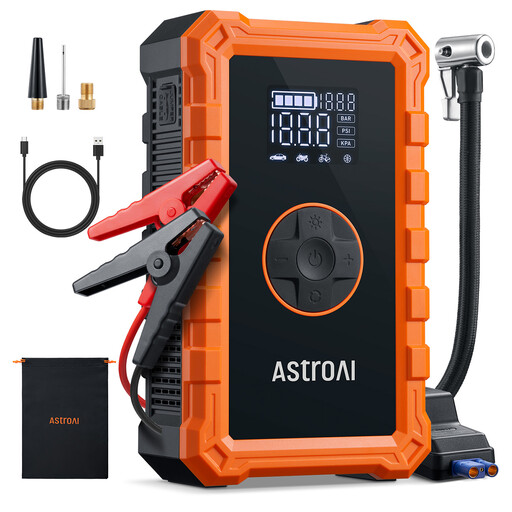
Why This Fits Their Persona: Ideal for those seeking a compact and reliable device for a standard passenger car. It fits easily in the glove compartment and offers enough power for most petrol and smaller diesel engines.
The specifications (1500A, 6.0L petrol/3.0L diesel) are realistic and more than sufficient for the target user. The manufacturer states the compressor delivers 25 L/min, a functional speed for topping up tyres.
Compact design with a clear 2.4-inch screen that displays both battery status and tyre pressure. The auto-stop function on the compressor is very user-friendly.

Why This Fits Their Persona: For owners of campers, boats, or large diesel SUVs. This model provides the serious starting power needed for engines up to 10.0L diesel, which is a huge reassurance when you're far from civilization.
Although 8000A is a peak value, it's supported by the claim that it can handle all petrol engines and 10.0L diesel engines. According to ACEZUK, the compressor delivers 35 L/min, an above-average airflow that can also handle larger tyres.
Very powerful and versatile. The large 3.4-inch LCD screen displays all information at a glance, which is useful in stressful situations. Comes with a sturdy carrying case.

Why This Fits Their Persona: For those who want a robust, safe, and reliable device for the family car, motorcycle, or SUV. The focus is on ease of use and built-in safety features, so anyone in the family can use it without worry.
BUTURE emphasizes its 10-layer smart protection, including spark-proof and reverse polarity protection. This addresses the fear of doing something wrong. The compatibility (9.0L petrol/8.0L diesel) is powerful yet believable.
The combination of a powerful starter, a smart compressor with 5 presets, and a clear LCD screen makes this a very complete package. The rugged housing is designed for reliability in all weather conditions.
We have compiled a complete, up-to-date list of products that fully meet these strict selection criteria and local regulations.
Even if you don't use it, a battery slowly loses its charge. It's good practice to fully charge your jump starter every 3 to 6 months. This ensures it's ready for use when you need it. Some models have a longer standby time, but regular maintenance is still wise.
Yes, most modern lithium-ion jump starters are designed to start even completely dead batteries. Many models have a special 'boost' or 'force start' button for this purpose. This function bypasses the standard safety detection and sends power directly to the battery. Only use this function if you are certain the clamps are connected correctly, as described in the manual.
Not necessarily. An extremely high peak amperage is only needed for very large engines (think heavy-duty trucks or large boats). For an average passenger car, a model with a realistic specification (e.g., 1500A-3000A peak) and good engine compatibility (up to 6.0L petrol/4.0L diesel) is more than sufficient. Paying more for unnecessarily high power is a waste of money. Instead, focus on build quality, compressor performance, and battery reliability.
