
Vandaag of morgen in huis

Kwaliteit gegarandeerd

Welkomstaanbiedingen ontgrendelen: GRATIS bezorging | Tot 80% korting | Gratis 30 dagen JoyPlus-proefperiode
Download de app
A dead battery is an inconvenience. A dead battery and a flat tire, far from home, is a scenario every driver dreads. A jump starter with a compressor seems like the perfect all-in-one solution. But the market is flooded with models that promise more than they can deliver. Before you invest in a car emergency starter, it's crucial to know what to look for.
Many devices fail precisely when you need them most. These are the most common pitfalls:
battery booster can start a cold diesel engine.jump starter with air pump is convenient, unless it takes an eternity to inflate a tire. Many budget-friendly models have a weak pump that overheats quickly and is unsuitable for a car tire.car power bank feature is useless if the battery self-discharges quickly. An unreliable battery means your device will be dead at the moment of truth.To avoid buyer's remorse, focus on the specifications that truly matter. Don't be distracted by marketing jargon.
The starting power determines whether you can actually start your car. Pay attention to two values:
A good car jump starter with compressor should be more than just a gadget.
portable 12v tire inflator must be efficient.The capacity, expressed in milliampere-hours (mAh), determines how many times you can use the booster before it needs recharging. A model with 15,000 mAh or more typically offers enough power for multiple start attempts and for charging your phone. Also, check for the presence of USB ports (preferably with fast charging) and a bright LED light with an SOS function.
Below are some popular choices, matched with specific user profiles.
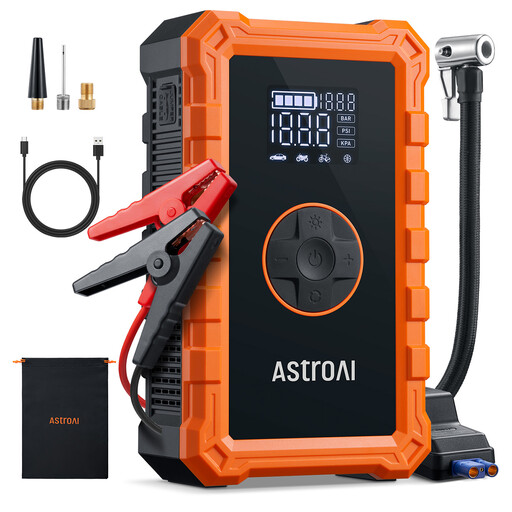
Why This Fits Their Persona: Ideal for the average driver with a petrol car, station wagon, or compact SUV. This model is compact enough for the glove compartment but powerful enough for most emergencies.
The specifications are clear: suitable for 6.0L petrol and 3.0L diesel engines. The compressor delivers 25L/min, avoiding the slow-pump pitfall.
A great balance between size, starting power, and compressor performance. The large 2.4" screen is also easy to read in daylight.
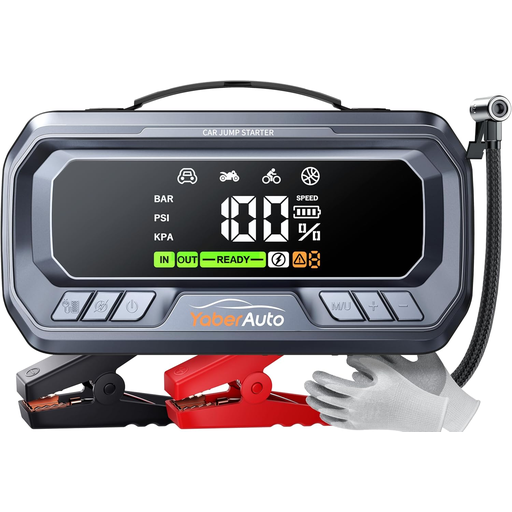
Why This Fits Their Persona: For owners of a large SUV, RV, van, or a heavy-duty diesel. This user needs absolute certainty, even in winter or with an almost completely dead battery.
With a peak of 6500A and support for diesel engines up to 8.0L, this model bypasses the "Peak Amp Trap" by delivering genuinely immense power. The 160 PSI compressor is also geared for heavy-duty use.
Extreme starting power and a unique DC output mode to continuously power devices (like a cooler). The 65W PD fast-charging function can also charge your laptop.
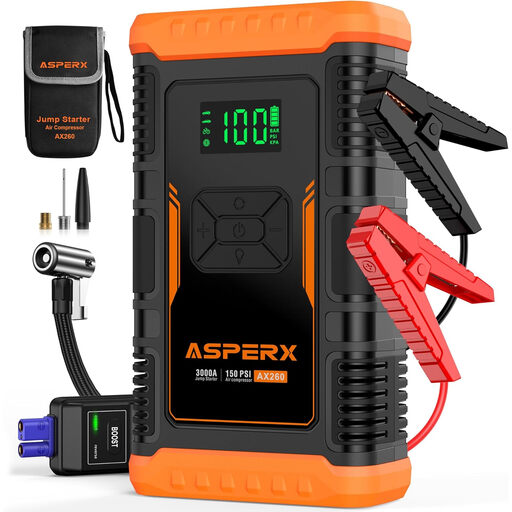
Why This Fits Their Persona: Perfect for campers and adventurers who want a reliable and multifunctional device for the road. This model combines a powerful starter with a fast compressor for tires, air mattresses, and balls.
According to ASPERX, the compressor delivers an airflow of 35L/min, which is significantly faster than many competitors. The 3000A peak current is more than enough for large petrol (up to 10.0L) and diesel engines (up to 8.0L).
Powerful and fast compressor, combined with high starting power. The robust design with a honeycomb structure for heat dissipation is geared towards reliability.
We've compiled a complete, up-to-date list of products that meet these strict selection criteria and safety regulations.
To maximize the battery's lifespan, it's recommended to fully charge the jump starter after each use. If you don't use it, charge it at least once every 3 to 6 months. A full battery is crucial for the jump-starting function and prevents damage to the internal battery.
Yes, you can do this without any issues. A jump starter powerful enough for a diesel engine can easily start a petrol engine. However, the reverse is not always true. A model designed only for small petrol engines will likely not have enough power for a diesel.
Peak Amps is the maximum current the booster can deliver for a very short time. Cranking Amps is the current delivered over several seconds to actually turn the engine over. Although manufacturers often emphasize peak amps, the engine displacement compatibility (in litres) is a more reliable indicator of performance.
