
Vandaag of morgen in huis

Kwaliteit gegarandeerd

Welkomstaanbiedingen ontgrendelen: GRATIS bezorging | Tot 80% korting | Gratis 30 dagen JoyPlus-proefperiode
Download de app
Imagine this: you're in a deserted car park or on your way to a holiday destination, and your car won't start. A dead battery. Or you discover a slowly deflating tire, far from civilisation. These are the situations where a reliable jump starter with compressor makes the difference between a minor interruption and a ruined day.
But the market is flooded with models that promise the world. Before you make a purchase, it's crucial to recognise the common pitfalls that lead to buyer's remorse.
To avoid wasting money, there are a few technical specifications you should always check. These determine whether a car jump starter will do its job when it counts.
Look beyond the peak power. The most important question is: is the 12V battery booster suitable for your engine? Manufacturers usually specify which engine types (petrol or diesel) and what maximum displacement (in litres) the booster is designed for.
A portable tire inflator is only useful if it's powerful enough. Pay attention to two values:
The capacity of the internal battery, expressed in milliampere-hours (mAh), determines how many times you can start a car or charge your phone. A capacity of around 20,000 mAh is a good benchmark for versatile use. Also, check for the presence of a bright LED light with different modes (solid, strobe, SOS), which can be essential during a breakdown in the dark.
Not every driver has the same needs. Below is a selection of models tailored to different user profiles.
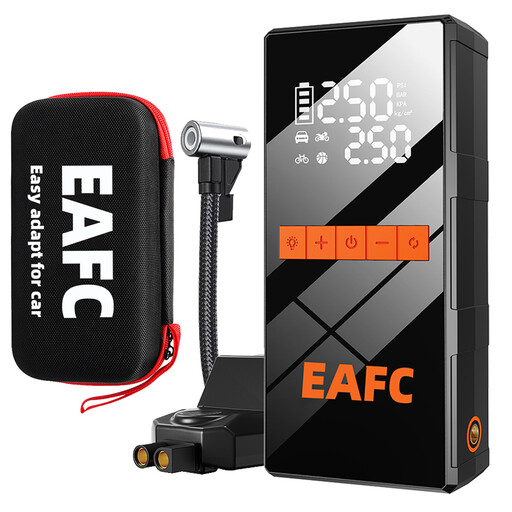
Why it's a match for this profile: Ideal for those seeking an affordable all-in-one solution for a standard passenger car. This model provides the basic functions without making you pay for excess power you don't need. Perfect to keep in the boot for emergencies.
The manufacturer is clear about its limitations (4.0L petrol/2.0L diesel), so you won't have false expectations about its starting power. The 150 PSI compressor is functional for standard tire maintenance.
A complete 4-in-1 kit (jump starter, compressor, power bank, LED light) in a compact form factor. Great value for money for basic needs.
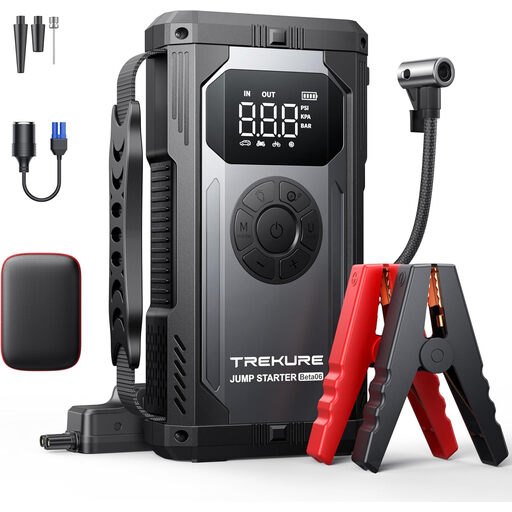
Why it's a match for this profile: For the owner of an SUV, camper, or van, or for those with multiple vehicles. This model offers serious power and a capable compressor, making it a reliable partner for travel and heavy-duty use.
The high peak power is backed by a clear claim for large engines (up to 10.0L diesel). The compressor has a decent airflow of 35 L/min, proving it's not just an afterthought.
Powerful enough for virtually any consumer vehicle. The large battery capacity (23800mAh) makes it a robust power bank for the road.
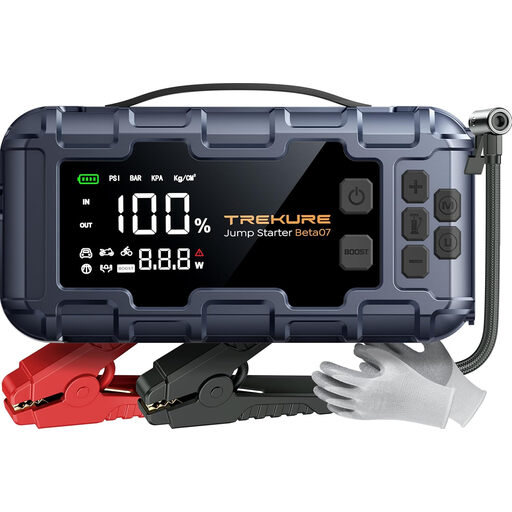
Why it's a match for this profile: For those who value speed, efficiency, and the latest technology. The fast-charging feature means the booster itself is ready to go again quickly, and the powerful compressor gets the job done in record time.
This model tackles the pitfall of a slow, weak compressor with an impressive 45 L/min airflow and 160 PSI. The 45W PD fast-charging feature solves the problem of a device that needs a long time to recharge.
Very fast recharging via 45W USB-C PD. The combination of a powerful compressor and a large, clear 3.3-inch display significantly enhances usability.
We have compiled a complete, up-to-date list of products that meet these strict selection criteria and EU safety regulations.
Most manufacturers recommend fully charging the jump starter every 2 to 3 months, even if you don't use it. This helps maintain the health of the lithium-ion battery and ensures it's ready for use when you need it. Always consult the manual for your specific model for the best maintenance advice.
Not necessarily. It's more important to match the power to your vehicle. A 12V battery booster with 2000A is more than enough for most petrol cars. A model with 5000A or more is designed for heavy-duty diesel engines in trucks or campers. Overpaying for unused power is unnecessary. Choose a model that matches your car's engine size.
Yes, most models are designed to operate within a wide temperature range, often from -20°C to +60°C (-4°F to +140°F). However, extreme cold can temporarily reduce the battery's performance. It's therefore a good idea to occasionally bring the booster inside during very low temperatures to charge it and keep it at room temperature.
