
Vandaag of morgen in huis

Kwaliteit gegarandeerd

Welkomstaanbiedingen ontgrendelen: GRATIS bezorging | Tot 80% korting | Gratis 30 dagen JoyPlus-proefperiode
Download de app
A dead battery or a flat tire always happens unexpectedly. Waiting for roadside assistance is often the only option. A jump starter with a compressor promises an all-in-one solution for self-reliance on the road. But not every device lives up to that promise. Many models are overloaded with marketing claims that mean little in practice.
As a Joybuy Product Recommendation Officer, I'm here to help you make the right choice. We'll look past the flashy ads and focus on what really counts, so you can find a reliable car jump starter that won't let you down.
Before you make a decision, it's crucial to recognise two common misleading claims. These often lead to you ending up with a device that's useless when you actually need it.
The Myth of Sky-High Peak Amps (Amperes) Manufacturers often advertise extremely high peak amps, like 6000A or even 8000A. This number sounds impressive, but it says very little about the actual starting power for a standard passenger car. The peak current is the maximum current the device can deliver for a fraction of a second. For most petrol and diesel cars, a stable, lower starting current is far more important. An unnecessarily high peak current is often a marketing gimmick you pay extra for.
The "Compressor" That Can Barely Inflate a Bicycle Tire Many multifunctional jump starters have a built-in car jump starter with tire pump. The specifications often look fine, until you try to inflate a car tire. A weak compressor can take hours to get a tire to the right pressure or will shut down due to overheating. The maximum pressure (PSI) is important, but the airflow rate (litres per minute) determines the actual speed and effectiveness.
To avoid a bad purchase, focus on the specifications that truly matter. Check these three points before buying a portable battery booster.
Look beyond the advertised peak power and check which engine types the jump starter is compatible with. This is usually indicated in litres (L) for petrol and diesel engines.
4500A jump starter or higher is a wise choice.A good 12v car tire inflator is an essential part of a multifunctional jump starter. Pay attention to two values:
A modern 12V power bank with jumper cables must be equipped with multiple safety protocols. Essential protections include:
The battery capacity, expressed in milliampere-hours (mAh), determines how many times you can start a car or charge your phone. A capacity of 16,000 mAh or more is a good guideline for all-around use.
Below is a selection of models tailored to different user profiles, based on their objective specifications.
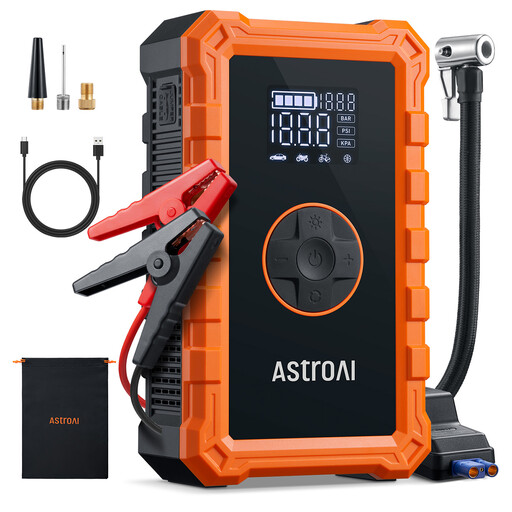
Why This Fits Their Persona: Ideal for the driver of a standard passenger car looking for a compact and reliable all-in-one solution. It fits easily in the glove compartment and is simple to use thanks to its clear screen.
The 1500A peak current is realistic and powerful enough for engines up to 6.0L petrol. The 150 PSI compressor with an auto-shutoff feature is practical and eliminates guesswork.
Large 2.4-inch screen for a clear reading of status and tire pressure. Compact design that allows all accessories to be stored inside.
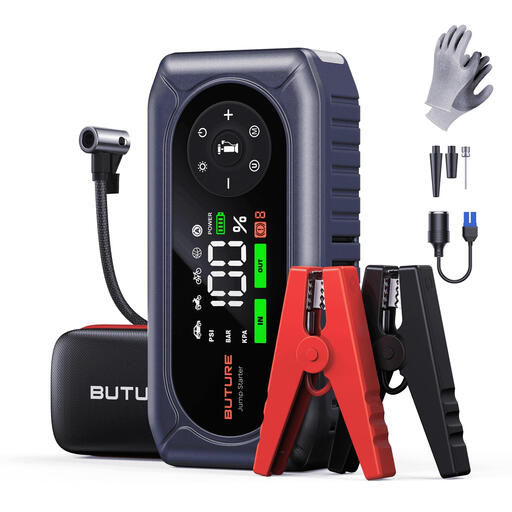
Why This Fits Their Persona: Suitable for owners of an SUV, RV, or a heavy-duty diesel vehicle. This model offers the extra power and robustness needed for larger engines and demanding situations, such as camping or off-roading.
The 4500A peak current is functional here, designed for engines up to 9.0L petrol or 8.0L diesel. The 150 PSI compressor with 5 preset modes is versatile and powerful enough for larger tires.
Operates in extreme temperatures (-20°C to 60°C). Features 10-layer safety protection and a bright 500-lumen LED light with an SOS mode.
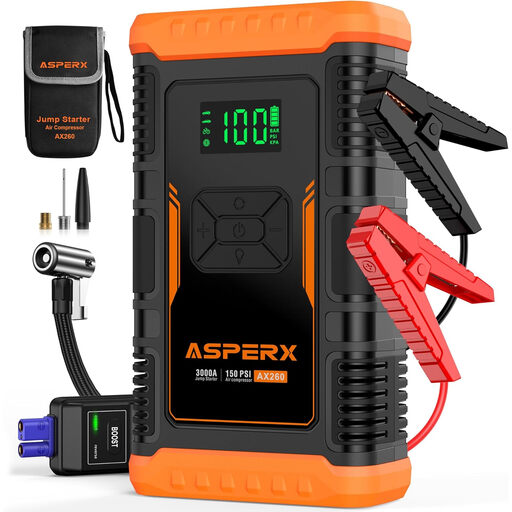
Why This Fits Their Persona: For those seeking a reliable emergency solution without paying for top-tier specifications. This model offers an excellent balance of power, functionality, and price for most vehicles.
The 3000A peak current is a solid middle ground, suitable for engines up to 10L petrol or 8.0L diesel. The compressor delivers a fast inflation rate of 35 L/min, avoiding the pitfall of a slow pump.
Excellent value for money. Integrates five functions, including a fast wireless inflator and power bank capability, in a relatively lightweight package.
We have compiled a complete, up-to-date list of products that fully meet these strict selection criteria and safety standards.
Most manufacturers recommend fully charging the jump starter every 3 to 6 months, even if you don't use it. Modern lithium-ion batteries hold their charge for a long time but will gradually lose some capacity over time. Regular charging ensures the device is ready for use when you need it and extends the battery's lifespan.
Yes, provided you use a model with modern safety features. A good jump starter with air compressor has built-in protection against reverse polarity, short circuits, and overvoltage. These systems prevent damage to your car's sensitive electronics, even if you accidentally connect the clamps incorrectly. Always read the manual for the correct procedure.
Not necessarily. Diesel engines have a higher compression ratio and require significantly more starting power than petrol engines, especially in cold weather. Always check that the jump starter is explicitly rated for the engine displacement (in litres) of your diesel vehicle. A jump starter that is too weak will fail to start a diesel engine and could even be damaged in the process.
