
Vandaag of morgen in huis

Kwaliteit gegarandeerd

Welkomstaanbiedingen ontgrendelen: GRATIS bezorging | Tot 80% korting | Gratis 30 dagen JoyPlus-proefperiode
Download de app
A dead battery is the most common cause of a car breakdown. It happens to everyone, often at the most inconvenient time. A jump starter with a compressor seems like the perfect all-in-one solution: you can start your car and inflate your tyres with a single device. But the market is flooded with models that promise a lot but deliver little. Many drivers fall into marketing traps and end up with a device that still leaves them stranded.
As a Joybuy Product Recommendation Officer, I'm here to help you make the right choices. We'll look past the flashy ads and focus on what really matters. Here are the most common pitfalls and how to avoid them.
The 3 pitfalls of choosing a jump starter:
portable car air compressor should have a clear maximum pressure (PSI) and an auto-shutoff feature to prevent over-inflation.To avoid a bad purchase, you need to pay attention to a few crucial specifications. These determine whether a car jump starter is suitable for your vehicle and situation.
Ignore the peak amperage and focus on the starting current and the recommended engine displacement (litres). A diesel jump starter needs significantly more power than one for a petrol engine due to higher compression.
12v jump starter with a starting current above 1000A and explicit support for large diesel engines (e.g., up to 10.0L).A good built-in compressor should be able to deliver at least 120 PSI, although most car tyres only need 30-40 PSI. The extra capacity ensures the motor doesn't get overloaded. An indispensable feature is the auto-shutoff function: you set the desired pressure, and the compressor stops automatically. This prevents dangerously over-inflated tyres.
The capacity, expressed in milliampere-hours (mAh), determines how many times you can start a car or charge your phone. A model with 8000 mAh is fine for emergencies, while 20,000+ mAh is more suitable for campers or if you want to charge multiple devices. Always look for a battery booster with "smart clamps." These offer protection against:
Below are some models that suit different user profiles, based on their objective specifications.
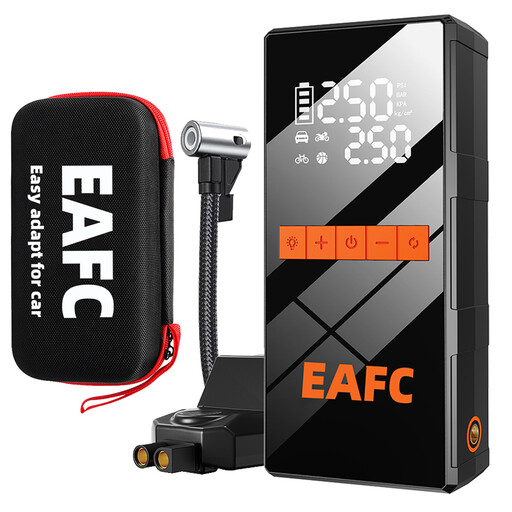
Why it's a match: This is a practical 4-in-1 emergency kit for most passenger cars (petrol up to 4.0L, diesel up to 2.0L). It's compact enough to store in the glove compartment and offers all the basic functions: jump-starting, compressor, power bank, and flashlight.
The 150 PSI compressor with an auto-shutoff feature is genuinely useful and not a gimmick. The starting power is realistically matched to the specified engine sizes.
A complete and affordable all-in-one solution for the most common roadside emergencies.
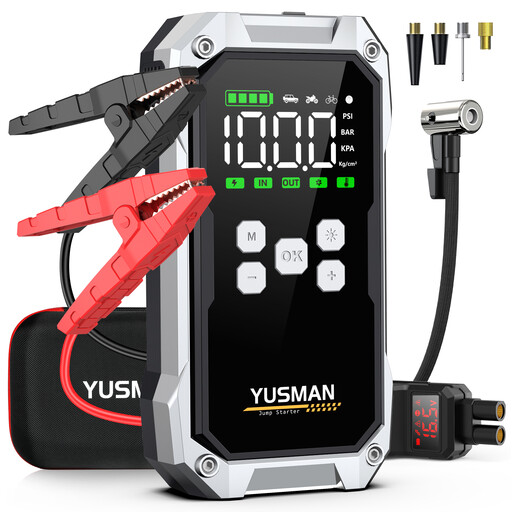
Why it's a match: This is a powerhouse for those who need maximum power. Ideal for owners of RVs, vans, boats, and cars with large diesel engines (up to 10.0L). Its large battery capacity (21800mAh) also makes it perfect for off-grid camping.
This model bypasses the "peak amperage myth" by actually delivering the power needed for large engines. The smart clamps with audible and visual warnings prevent the pitfall of unsafe use.
Extremely high starting power suitable for virtually all petrol and large diesel engines, combined with a functional compressor.
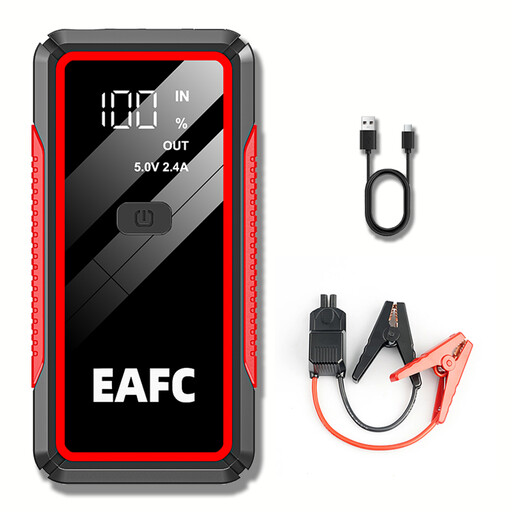
Why it's a match: For those who already have a separate tyre inflator and are looking for a pure, powerful, and compact `emergency car starter`. This model focuses on one task: starting your car. It's powerful enough for most cars (up to 6.0L petrol/4.0L diesel) but is much more compact than a model with a built-in compressor.
This device avoids the pitfall of a mediocre all-in-one by specialising. It delivers a powerful starting function in a highly portable format, without the extra weight and bulk of a compressor.
A powerful `car jump starter` with a peak power of 2000A in a remarkably compact and lightweight design.
Being well-prepared is key. Check out our full range of products that help you get on the road safely and without worry.
Even when not in use, the battery slowly loses its charge. It is advisable to fully charge your jump starter every 2 to 3 months to maximise the battery's lifespan. Most manufacturers also recommend fully charging the device immediately after purchase and after each use.
Yes, provided it is used correctly. Modern jump starters are equipped with smart jumper cables that protect against the most common errors, such as short circuits or connecting the clamps incorrectly. Always follow the instructions: connect the red clamp to the positive (+) terminal of the battery and the black clamp to an unpainted metal part of the car's chassis (a ground point), not to the negative (-) terminal.
No, this is a common mistake. Diesel engines have a much higher compression ratio and require significantly more starting power than petrol engines, especially in cold weather. Always check that the specifications of the jump starter explicitly state that it is suitable for diesel engines and pay close attention to the maximum supported engine displacement (in litres).
