
Vandaag of morgen in huis

Kwaliteit gegarandeerd

Welkomstaanbiedingen ontgrendelen: GRATIS bezorging | Tot 80% korting | Gratis 30 dagen JoyPlus-proefperiode
Download de app
A dead battery or a flat tire always happens unexpectedly. In the middle of the night, on a deserted road, or just when you're in a hurry. Waiting for roadside assistance is often the only option. A jump starter with a compressor seems like the perfect solution: a compact device that can start your car and inflate your tires. But the market is flooded with models that promise a lot but fail to deliver in practice.
Before you invest in such a multifunctional jump starter, it's crucial to recognize the common pitfalls. Many drivers fall for clever marketing and end up with a device that's useless when it really matters.
To avoid a bad purchase, focus on the specifications that truly matter. These are the objective criteria that determine whether a device will do its job.
Look beyond the advertised peak current. The most important question is: is the jump starter suitable for your engine? Manufacturers often indicate the engine displacement (in liters) and fuel type (gasoline/diesel) a model is suitable for. An average gasoline car will be fine with a starting current of 300-500A, while a larger diesel engine requires more power. A good power bank with jumper cables will clearly state its compatibility, for example, "suitable for gasoline engines up to 8.0L and diesel engines up to 6.0L".
A jump starter with an air pump is only useful if the pump is powerful enough. Pay attention to two values:
Capacity is expressed in milliampere-hours (mAh). A higher capacity means you can start the car more times or charge more devices. Just as important is the battery technology. Newer technologies, such as sodium-ion, offer advantages like extremely low self-discharge (~1% per month), a longer lifespan (thousands of cycles), and better performance in extreme temperatures. This ensures that your 4-in-1 jump starter is ready for use immediately, even after a cold winter or hot summer.
Below are some models selected based on their specifications, catering to different user profiles.
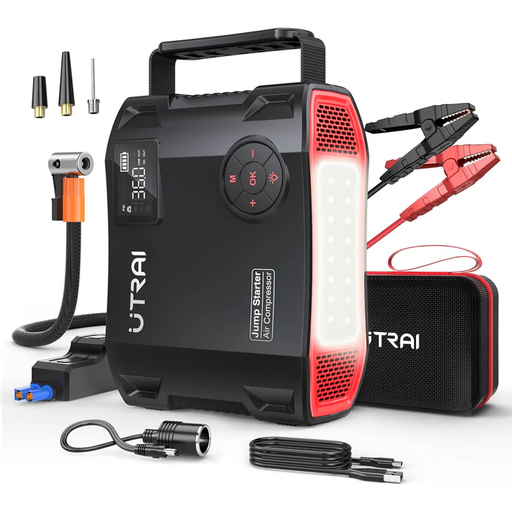
Why This Fits Their Persona: Perfect for the driver of a family car, SUV, or van who needs a powerful and reliable all-in-one solution. This device provides peace of mind for both daily commutes and holiday trips.
The specifications are transparent: its compatibility (up to 10.0L diesel) is clearer than just a peak current figure. The compressor has a high airflow of 45L/min, thus avoiding the 'slow compressor' pitfall.
The 160W DC output is a unique feature that allows you to power 12V devices like a cooler or car vacuum. The 6-month standby time is practical.
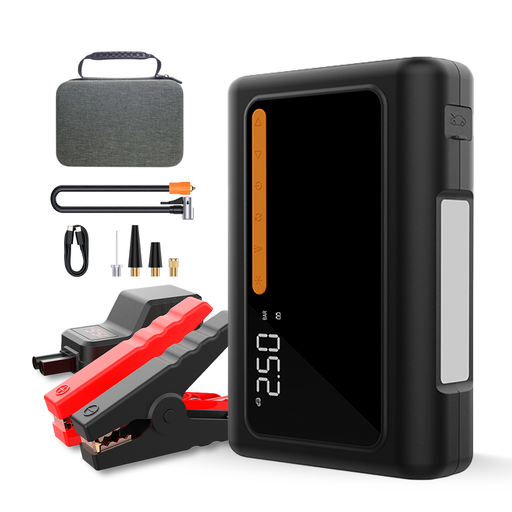
Why This Fits Their Persona: For the user who invests in the latest technology for maximum safety and durability. Ideal for those who want to keep the device permanently in their car, regardless of the season.
Tackles the 'dead rescue' pitfall with a sodium-ion battery. It has a self-discharge rate of only ~1% per month and a lifespan of 6,000 cycles, which is 7-15x longer than lithium-ion according to the manufacturer.
Superior safety: the sodium-ion chemistry is fire-resistant. The device operates in an extreme temperature range of -40°C to 80°C, allowing it to be stored in the car worry-free.
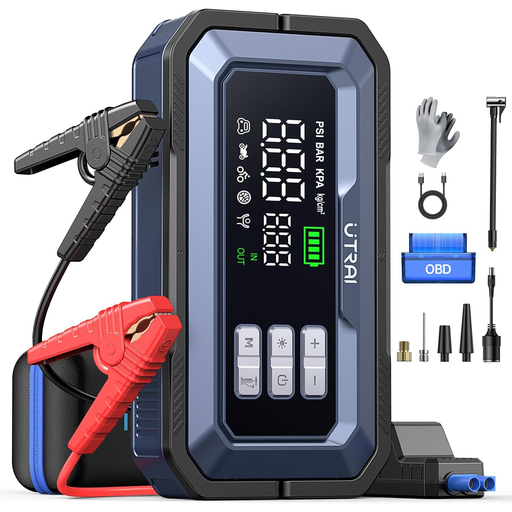
Why This Fits Their Persona: Designed for owners of RVs, large vans, and heavy-duty diesel vehicles. This model not only offers extreme starting power but also advanced features that are useful during a breakdown.
Avoids the 'peak current myth' by explicitly specifying that it is suitable for diesel engines up to 14L. The housing is made of V0-grade flame-retardant material for extra safety during heavy use.
Unique extras like an OBD2 fault code reader, a very powerful 2000 lumen work light, and a 160W DC output make this a complete diagnostic and emergency tool for serious users.
Not all jump starters are multifunctional. If you only need a reliable pump for your motorcycle tires, we have a selection of compact and efficient models.
This depends on the battery's self-discharge rate. For most models with a lithium-ion battery, it is recommended to check and recharge them every 3 to 6 months. Models with low self-discharge, such as those with a sodium-ion battery, may only need to be checked once a year. Always consult the manufacturer's manual for specific maintenance advice.
Not necessarily. It is more important that the starting power matches your vehicle's engine (engine size and fuel type). An extremely high peak power is often unnecessary for a compact city car and makes the product needlessly expensive. Focus on the recommended engine compatibility provided by the manufacturer to make the right choice.
Always check the recommended operating temperature range of the device. Most jump starters function down to -20°C (-4°F), which is typically sufficient for most winters. In the summer, the temperature inside a car can get very high. Models that can withstand higher temperatures (e.g., up to 60°C or even 80°C / 140°F to 176°F) are safer to keep in your vehicle year-round.
