
Vandaag of morgen in huis

Kwaliteit gegarandeerd

Welkomstaanbiedingen ontgrendelen: GRATIS bezorging | Tot 80% korting | Gratis 30 dagen JoyPlus-proefperiode
Download de app
A dead battery or a flat tyre always happens unexpectedly and at the worst possible moment. A jump starter with a compressor seems like the perfect all-in-one solution. But the market is flooded with models that promise impressive specifications, which often disappoint in practice. Many drivers fall for marketing traps and end up with a device that leaves them stranded.
Before making a purchase, it's crucial to recognise the three most common pitfalls:
car power bank or for multiple jump-start attempts can be very disappointing.portable tyre inflator that works in theory but is too weak in practice. They inflate extremely slowly, overheat quickly, and shut off before your tyre reaches the correct pressure. In an emergency, this is useless.To avoid a bad purchase, focus on the specifications that truly matter. Check these three points before choosing a jump starter with air compressor.
Don't be dazzled by the peak amperage. The starting current is the continuous current that the 12v battery booster can deliver to turn over your engine.
car jump starter with a starting current of 1000A or more.The peak current is only relevant as an indicator of the maximum 'boost' the device can provide for a short burst.
The capacity, expressed in mAh, gives an indication of how many times you can start a car or charge your phone. However, a more realistic figure is the capacity in Watt-hours (Wh), as this accounts for voltage. A capacity of 16,000 mAh (around 60 Wh) is a good starting point for most users. Also, pay attention to the standby time: how long the emergency car starter holds its charge when not in use. Models with low self-discharge only need to be recharged every 3 to 6 months.
For the built-in compressor, two values are important:
We have selected several popular models and matched them to specific user profiles based on their objective specifications.
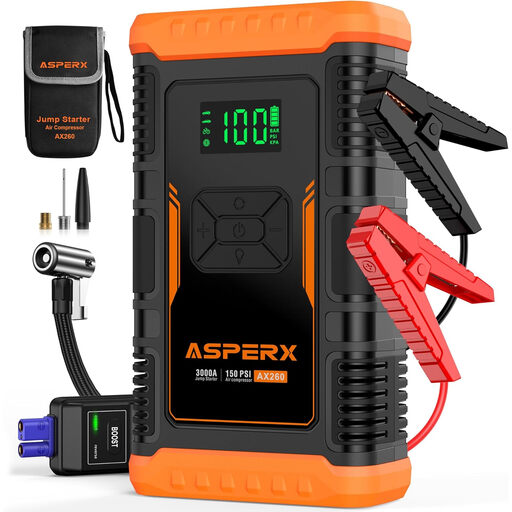
Why This Fits Their Persona: Ideal for the driver of a family car or compact SUV who wants a reliable all-in-one solution for roadside emergencies. This device is compact enough for the glove compartment but powerful enough for most situations.
The compressor delivers an airflow of 35 L/min, avoiding the pitfall of a slow, unusable pump. The specifications are clear about its compatibility (up to 10L petrol/8L diesel), which is more realistic than just advertising a high peak current.
A good balance between starting power and a fast compressor. The honeycomb design for heat dissipation helps prevent overheating during use.
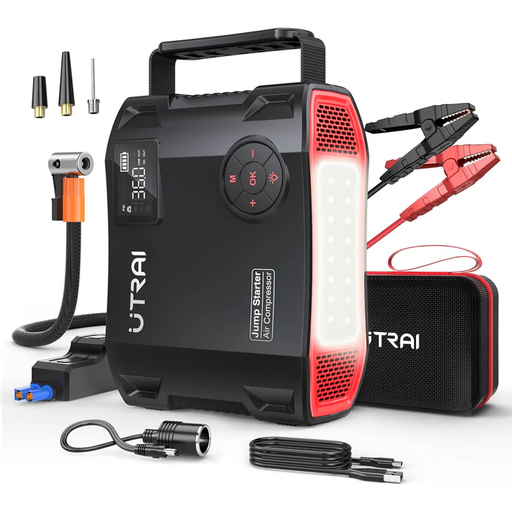
Why This Fits Their Persona: For drivers of large SUVs, vans, or vehicles with a heavy-duty diesel engine (up to 10.0L). This user profile needs absolute certainty that their jump starter can handle the job, even in winter.
This model focuses on pure power. The 6000A peak current is backed by a large 27,000 mAh battery and is explicitly rated for diesel engines up to 10.0L. This goes beyond the vague claims of many competitors.
A very powerful compressor with 45 L/min airflow, which can fill a tyre in about 4 minutes. The 160W DC output can also power other 12V devices like a portable cooler.
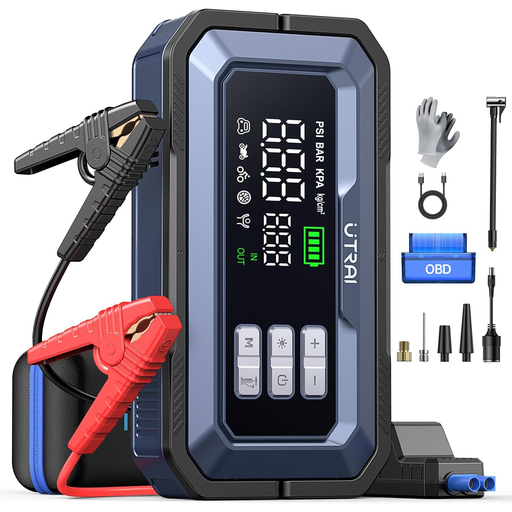
Why This Fits Their Persona: This is more than a jump starter; it's a mobile power station for those who go off-grid. Perfect for powering camping equipment, inflating air mattresses, and serving as a powerful light source in the dark.
Where other models fail as a power bank, the JS-30 delivers a serious 160W DC output via a cigarette lighter socket. This is a concrete, usable feature rather than a vague promise.
Extremely powerful with 7000A peak power (suitable for diesel up to 14L). The 2000 lumen work light is exceptionally bright and can be rotated 90°, making it ideal for repairs or as a campsite light.
We have compiled a complete, up-to-date list of products that meet these strict selection criteria and local safety regulations.
Most modern lithium-ion jump starters have a low self-discharge rate. It is recommended to check and fully charge the device every 3 to 4 months. This ensures it's ready for use when you need it. Do not store it with a dead battery, as this can shorten its lifespan.
Yes, you can, but be mindful of the temperatures. Most models have an operating temperature range of approximately -20°C to 60°C (-4°F to 140°F). In a hot car under direct sunlight, the interior temperature can exceed this, which may damage the battery. During a typical winter, it's generally fine to store it in the car.
Not necessarily. An extremely high peak current is useless if you have a small city car. It's more important to choose a model that matches your engine. An overly powerful starter isn't harmful, but you'll be paying for power you don't need. Focus on a reliable starting current that is suitable for your engine type (petrol or diesel) and displacement.
