
Vandaag of morgen in huis

Kwaliteit gegarandeerd

Welkomstaanbiedingen ontgrendelen: GRATIS bezorging | Tot 80% korting | Gratis 30 dagen JoyPlus-proefperiode
Download de app
A dead battery or a flat tire always happens unexpectedly and at the worst possible moment. Waiting for roadside assistance is often the only option. A jump starter with a compressor seems like the perfect solution: a compact device that can start your car and inflate your tires. But the market is flooded with models making lofty promises. Many drivers fall for marketing traps and end up with a device that leaves them stranded when it really matters.
As a Joybuy Product Recommendation Officer, I'm here to help you make the right choices. We'll look past the flashy advertisements and focus on what truly matters. Here are the most common pitfalls and how to avoid them.
Pitfall 1: The Peak Current (Amps) Myth Brands advertise with sky-high peak current ratings (e.g., 5000A), but this number says little about the actual starting power. This peak is often only available for a fraction of a second. The continuous starting current, which is needed to actually turn an engine over, is far more important and is significantly lower.
Pitfall 2: Unrealistic Battery Capacity (mAh) The capacity in milliampere-hours (mAh) is often presented in a misleading way. A rating of 20,000 mAh sounds impressive, but it's usually based on the internal 3.7V cells. The actual capacity at the 12V your car requires is much lower. A better metric is Watt-hours (Wh), as it accounts for the voltage.
Pitfall 3: The 'All-in-One' Disappointment A device that acts as a jump starter, tire inflator, power bank, and flashlight sounds ideal. Unfortunately, many cheap models are a master of none. The compressor is too slow, the jump-start function is unreliable, and the power bank barely charges your phone. Quality in the core functions is essential.
To avoid a bad purchase, you need to pay attention to a few key specifications. These determine whether a portable jump starter is worth the investment.
Don't be dazzled by peak current. Look for the recommended engine displacement (in litres) for petrol and diesel engines. A 12V jump starter for a 2.0L petrol engine requires less power than one for a 3.0L diesel. A model with a "Boost" function can be particularly useful. According to manufacturers, this feature can provide the necessary power to start a battery with a very low voltage.
A car jump starter with a tire inflator must be effective. The maximum pressure, expressed in PSI (Pounds per Square Inch), is important, but the airflow rate in litres per minute (LPM) determines the speed. A model with a low LPM will take forever to inflate a tire. An automatic shut-off feature, which turns off the compressor at the preset pressure, is a practical addition that prevents over-inflation.
As mentioned earlier, Watt-hours (Wh) is a more reliable indicator of a portable battery starter's capacity than mAh. You can calculate this by multiplying the capacity in Ampere-hours (Ah) by the voltage (V). Modern lithium-ion (Li-ion) or lithium iron phosphate (LiFePO4) batteries are lightweight, compact, and hold their charge longer than outdated lead-acid variants. They also make the device a convenient power bank with jumper cables for your electronics.
Not everyone has the same needs. That's why we've highlighted several products that fit specific user profiles, based on their objective specifications.
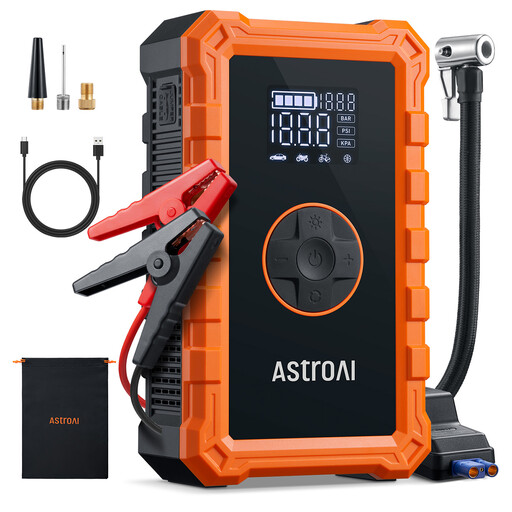
Why This Fits Their Persona: Ideal for those seeking a reliable and user-friendly all-in-one for a standard passenger car. Its compact size fits easily in the glove compartment or trunk. The large, clear screen makes operation simple, even for those who aren't tech-savvy.
This model focuses on core functions. The 1500A peak current is realistic for the specified engine sizes (up to 6.0L petrol/3.0L diesel), and the 150 PSI compressor with an automatic shut-off feature is practical and functional, without unnecessary frills.
Large 2.4-inch screen for a clear readout of status and tire pressure. According to the manufacturer, the compressor delivers 25L/min, enabling rapid inflation.
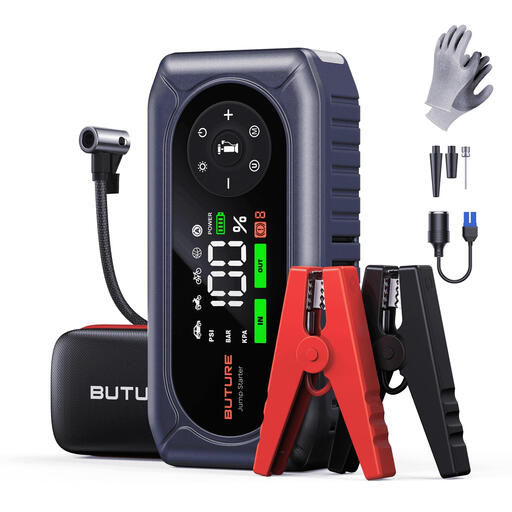
Why This Fits Their Persona: For owners of larger vehicles like RVs, vans, or diesel-powered SUVs. This model offers high starting power and a rugged build, suitable for demanding conditions. The powerful LED light is a bonus for breakdowns after dark or while camping.
The 4500A peak current is backed by specifications for large engines (up to 9.0L petrol/8.0L diesel), demonstrating that its power is functional. It's not an empty marketing claim but is geared towards heavy-duty use. The focus is on power and reliability.
High starting power suitable for large engines. According to the manufacturer, the device is designed to perform in extreme temperatures (-20°C to 60°C) and features a 500-lumen LED light with an SOS function.
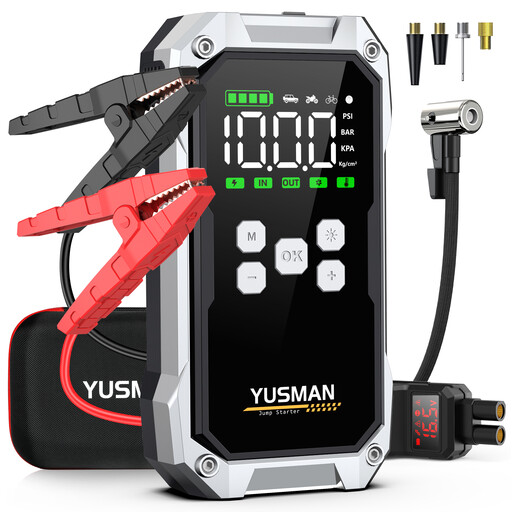
Why This Fits Their Persona: This user is looking for a functional and safe battery booster with compressor without paying for unnecessary extras. This model offers impressive specifications for its price range, including very high starting power and a built-in compressor.
Despite its high 5000A claim, this model delivers well on the essential functions. The focus is on the combination of a powerful emergency car starter and a 150 PSI compressor. The included smart safety clamps with audible and visual alerts prevent the common mistake of incorrect connection.
Very high starting power for a wide range of vehicles (all petrol / 10.0L diesel). Includes smart clamps with comprehensive protection features, which enhances user safety.
We've compiled a complete, up-to-date list of products that fully meet these strict selection criteria and local safety regulations.
How often should I charge a jump starter with a compressor? Most manufacturers recommend fully charging the jump starter every 2 to 3 months, even if you don't use it. This helps keep the battery in good condition and ensures it's ready for use when you need it. Always consult the user manual for your specific model for precise advice.
Can a jump starter revive a completely dead battery? Yes, many modern jump starters have a 'Boost' or 'Force Start' function, specifically designed for batteries with very low or even zero voltage. This function bypasses the standard safety detection and sends power directly to the battery to enable engine starting. However, it is a starting aid, not a battery charger. To fully charge a dead battery, you will need a trickle charger.
Is a higher peak current (Amps) always better? Not necessarily. It's more important that the starting power of the jump starter with air compressor is appropriate for your vehicle. An extremely high peak current offers no advantage for a small city car and is often more of a marketing tool. Choose a model recommended by the manufacturer for your car's engine displacement (in litres) and type (petrol or diesel).
