
Vandaag of morgen in huis

Kwaliteit gegarandeerd

Welkomstaanbiedingen ontgrendelen: GRATIS bezorging | Tot 80% korting | Gratis 30 dagen JoyPlus-proefperiode
Download de app
A dead battery or a flat tire always happens unexpectedly. Being stranded on the roadside is frustrating, especially when you have to rely on outside help. A jump starter with a compressor is a multi-functional solution that gets you back on the road without waiting. But the market is flooded with models promising impressive specifications. Unfortunately, these often lead to a bad purchase.
Before you invest in this handy tool, there are a few pitfalls many drivers fall into. This guide will help you see through the marketing hype and choose a model that actually performs when you need it most.
It's easy to be tempted by high numbers and a long list of features. Pay attention to the following three points to avoid wasting money on a device that will let you down.
To make a smart choice, ignore the marketing hype and focus on the specifications that truly matter. Check these three points before you make a purchase.
The starting power, expressed in amps (A), is crucial. Don't just look at the peak current, but also at the recommended engine displacement (in liters). A good manufacturer will clearly specify the type and size of engine the portable jump starter is suitable for.
A battery booster with an air pump is only useful if the pump is powerful enough. Two values are important here:
The capacity of the internal battery (expressed in mAh) determines how many times you can start a car or how long you can use the compressor. A higher capacity is also useful if you want to use the device as a power bank with jumper cables to charge your phone or tablet.
Look for extras that are genuinely functional:
Based on these objective criteria, we have selected a few models that suit different user profiles.
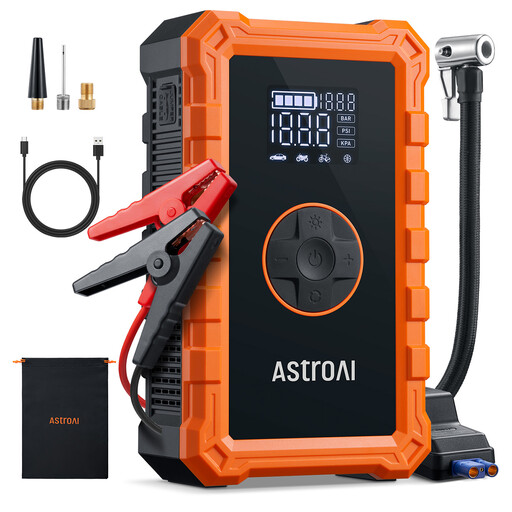
Why This Fits Their Persona: Ideal for owners of standard passenger cars (gasoline or small diesel). Its compact size and clear screen make it an accessible and reliable solution for emergencies, without unnecessary complexity.
This model offers a realistic 1500A peak current, more than enough for most gasoline engines, without making you pay for redundant capacity. The focus is on core functions.
The large 2.4-inch screen provides clear feedback on status and tire pressure, which removes uncertainty during use. The compressor automatically stops at the preset pressure.
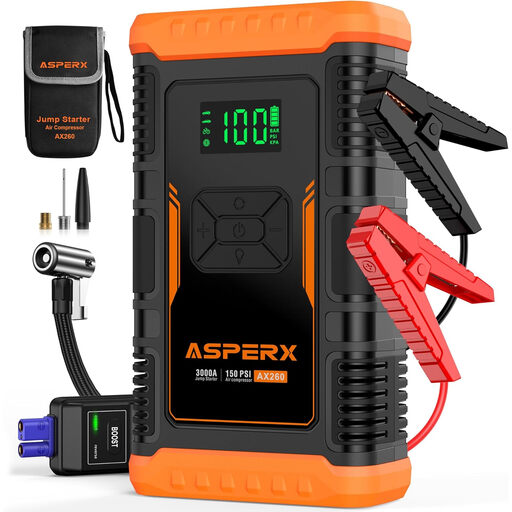
Why This Fits Their Persona: Suitable for those who need more power for a larger gasoline engine or a diesel engine (up to 8.0L). The fast compressor is a major advantage for the larger tires of an SUV or RV.
This is not a weak 'all-in-one' gadget. With an airflow of 35 L/min, the compressor is genuinely functional and fast, while the 3000A starting power is serious business for heavier vehicles.
The combination of high starting power (3000A) and a fast compressor (35 L/min) makes this a very versatile and capable device for demanding situations.
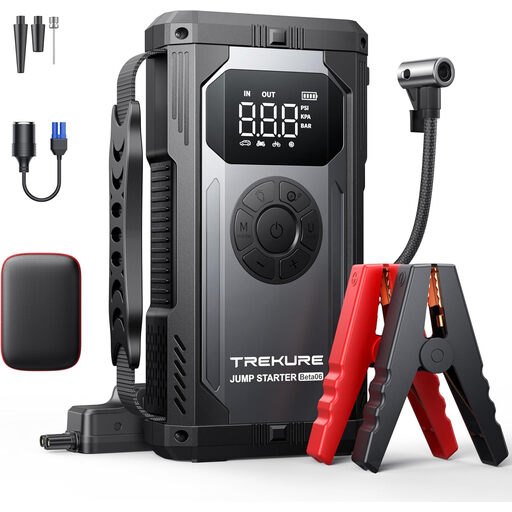
Why This Fits Their Persona: Designed for the toughest jobs. With a 5500A peak current and support for diesel engines up to 10.0L, this model is suitable for vans, tractors, boats, and other vehicles that require maximum starting power.
This model focuses on the absolute core function: extreme starting power. The 'force start' feature is specifically designed for completely dead batteries, a common problem with vehicles that have been stationary for a long time.
The massive 5500A starting power and the special 'force start' mode provide peace of mind for starting large engines and deeply discharged batteries where standard boosters would fail.
We have compiled a complete, up-to-date list of products that fully meet these strict selection criteria and safety regulations.
Even when not in use, a jump starter slowly loses its charge. It is advisable to fully charge the device every 2 to 3 months. This ensures it's ready for use when you need it. Store it in a cool, dry place, but not in the car during extreme heat or freezing temperatures.
Yes, many modern jump starters have a special 'boost' or 'force start' function. This is specifically designed to provide enough current to start an engine even when the battery has no voltage left (0 volts). Consult your model's manual to see how to activate this feature safely.
Yes, when used correctly. Quality jump starters are equipped with multiple safety mechanisms, such as protection against reverse polarity (connecting the clamps incorrectly), short circuits, and overvoltage. These systems protect your car's sensitive electronics, like the ECU. Always follow the manufacturer's instructions carefully.
