
Vandaag of morgen in huis

Kwaliteit gegarandeerd

Welkomstaanbiedingen ontgrendelen: GRATIS bezorging | Tot 80% korting | Gratis 30 dagen JoyPlus-proefperiode
Download de app
A dead battery on a cold morning or a flat tire just when you're in a hurry. These are the classic roadside emergencies every car owner dreads. A jump starter with a compressor seems like the perfect all-in-one solution. But the market is flooded with models that promise a lot but deliver little. Before you invest in a piece of mind, it's crucial to see through the marketing hype. Many buyers fall into the same traps, ending up with a device that lets them down when they need it most.
Here are the three most common mistakes you can avoid:
To avoid buyer's remorse, focus on the specifications that truly matter. Don't be distracted by marketing terms; instead, verify these three points.
The starting power, expressed in Amps (A), is the most important factor. It determines whether the portable 12v jump starter has enough power for your engine. A general guideline:
Always check the manufacturer's specifications for the recommended engine displacement (in liters).
The capacity, expressed in milliampere-hours (mAh), indicates how much energy the internal battery can store. This affects two things: how many times you can start a car before the booster itself is depleted, and how effective the power bank and jump starter is. A higher mAh value (e.g., 15,000 mAh or more) means you can not only start your car but also charge your smartphone or tablet multiple times.
For a car jump starter with a tire inflator, the maximum pressure, expressed in PSI or BAR, is important. Most car tires require a pressure between 30-35 PSI (about 2.1-2.4 BAR). A compressor that goes up to 150 PSI has more than enough capacity. A useful extra feature is a digital pressure gauge with an auto-shutoff function. This allows you to set the desired tire pressure, and the compressor will stop automatically, preventing over-inflation and making it much easier to use.
Based on these criteria, we have selected a few models that suit different user profiles.

Why This Fits Their Persona: Ideal for owners of SUVs, vans, or cars with large (diesel) engines. This model provides the power and reliability needed for demanding vehicles, even at low temperatures.
With a peak power of 4500A, this device actually delivers the power it promises, and the 150 PSI compressor is a full-fledged feature, not a gimmick. It bypasses the "all-in-one" trap by not compromising on performance.
Massive starting power for engines up to 9.0L gasoline / 8.0L diesel. The digital compressor with auto-shutoff is highly practical.
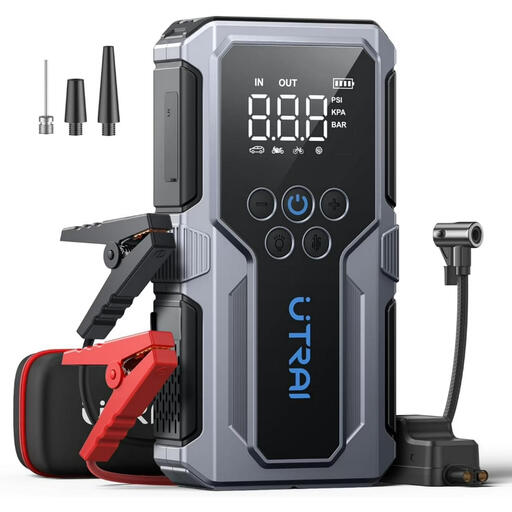
Why This Fits Their Persona: Perfect for the average car owner, campers, and travelers looking for a reliable and versatile tool. Powerful enough for most cars and compact enough to take on vacation.
This model is equipped with 10 safety features, including reverse polarity protection. The clear LCD screen displays status and tire pressure, which minimizes the chance of errors and avoids the safety trap.
Good balance between power (3000A), capacity (15,000 mAh), and features. The Quick Charge ports make it an effective battery booster with compressor and power bank.
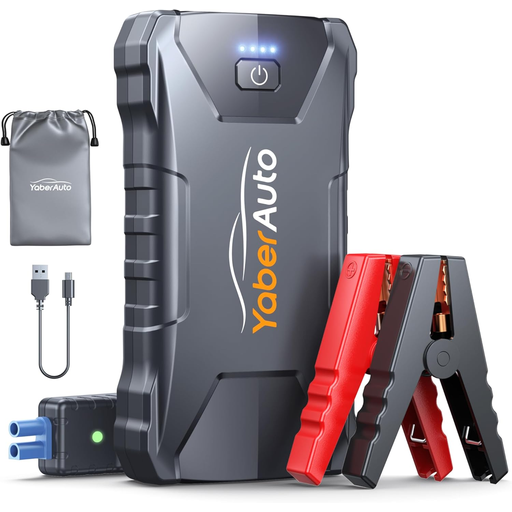
Why This Fits Their Persona: For city drivers, motorcyclists, or owners of a compact car where storage space is limited. This model is extremely light and small, and fits easily in the glove compartment or a backpack.
This model focuses on one task and does it well: starting your car. It avoids the "all-in-one" trap by not including a subpar compressor. Note: this model does not have a compressor, but it excels in portability.
Very compact and lightweight (only 340 grams). Despite its size, it's powerful enough (2000A) for most gasoline and smaller diesel engines.
Check out our full range of automotive electronics, including jump starters and chargers that meet strict selection criteria and safety regulations.
It is generally recommended to fully charge the jump starter every 3 to 6 months, even if you don't use it. Lithium batteries slowly lose their charge over time. Extreme temperatures, such as in a hot car in the summer or an ice-cold one in the winter, can affect the battery's lifespan. Always consult the manufacturer's manual for specific advice.
Yes, provided you choose a model with modern safety technology. Look for an emergency car starter with "smart" jumper cables equipped with protection against reverse polarity, short circuits, overcurrent, and overvoltage. These systems detect an incorrect connection and prevent power flow, thereby preventing damage to the ECU (the car's computer) and other electronics. Always follow the instructions in the manual.
Most models are designed for the tires of passenger cars, motorcycles, and bicycles and come with various valve adapters. Check the maximum pressure (PSI/BAR) of the compressor. For most applications, this is more than sufficient. For very large tires, such as those on a heavy truck or agricultural vehicle, a specialized, more powerful compressor is typically a better choice.
