
Vandaag of morgen in huis

Kwaliteit gegarandeerd

Welkomstaanbiedingen ontgrendelen: GRATIS bezorging | Tot 80% korting | Gratis 30 dagen JoyPlus-proefperiode
Download de app
Imagine this: you're stranded on a cold morning with a dead battery. Or you discover a flat tire just before leaving for vacation. These are situations that can derail your entire day. A jump starter with an air compressor is a multi-functional device that combines preparedness and convenience, getting you back on the road quickly without waiting for assistance.
This guide is designed to help you choose a model that fits your vehicle and your needs. We'll cover the key specifications and highlight several popular choices to help you make an informed decision.
Before you make a choice, it's helpful to know which specifications matter. Here are a few practical points to consider.
The peak current, measured in amperes (A), indicates how much power an emergency car starter can deliver to start an engine. A larger engine, particularly a diesel one, requires a higher peak current than a small petrol engine. Always check the manufacturer's specifications to see if the car jump starter is suitable for your engine type (e.g., up to 8.0L diesel). A jump starter that is too weak will not be able to start your car.
The built-in portable 12v air compressor is more than just an extra feature. Pay attention to two values: the maximum pressure (expressed in PSI or BAR) and the airflow (expressed in litres per minute, LPM). A higher maximum pressure (e.g., 150 PSI) is necessary for certain tires, while a higher airflow (e.g., 45 LPM) means the car tire inflator can inflate your tires faster. Many models also have preset modes for cars, motorcycles, or bicycles, which increases ease of use.
Modern jump starters often double as a power bank with jumper cables. They feature USB ports to charge your phone or laptop. Other useful features include a built-in LED light with an SOS function and various safety systems. Look for protection against short circuits, overheating, and reverse polarity. A CE certification indicates that the product meets European safety standards.
Based on product specifications and functionality, we have selected a few models that offer a good balance between performance and versatility.
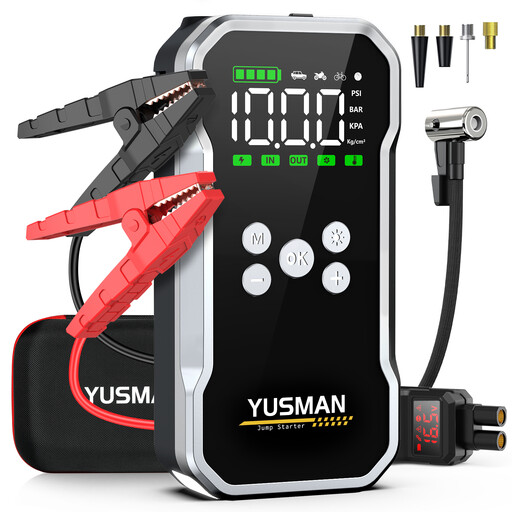
Why It Stands Out The YUSMAN F03 is designed as a complete 4-in-1 solution for the road: jump starter, air compressor, power bank, and LED light. It comes in a compact and dust-resistant storage case, making it easy to store in your trunk.
Key Features
Who It's For This model is a practical choice for daily drivers and families looking for a reliable all-in-one solution for emergencies and general maintenance, without taking up too much space.
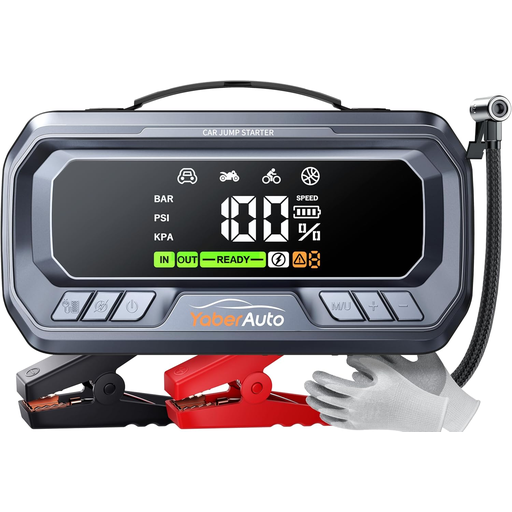
Why It Stands Out The YaberAuto YA90 distinguishes itself with its fast-charging technology and a special mode for extreme situations. The 65W PD bidirectional fast-charging port can not only rapidly charge the device itself but also power laptops and other devices at high speed.
Key Features
Who It's For This model is aimed at the tech-savvy user who is not only looking for a powerful jump starter but also values fast charging capabilities for multiple devices, such as a laptop or tablet.
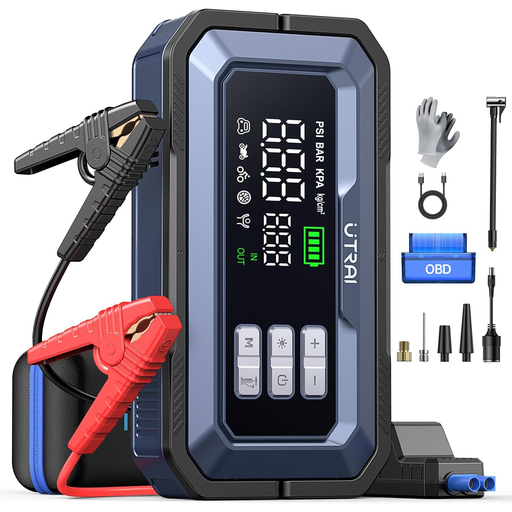
Why It Stands Out The UTRAI JS-30 is a powerhouse, designed for heavy-duty applications. With a very high peak current and the unique addition of an OBD2 fault code reader, this device is more than just an emergency starter; it's also a diagnostic tool.
Key Features
Who It's For This is a robust choice for owners of large vehicles such as SUVs, vans, RVs, or boats. It's also ideal for the serious DIY enthusiast who will appreciate the added diagnostic functionality of the OBD2 reader.
The models listed above are a great start, but you might be looking for something with different specifications or for a different budget. There are many different types of emergency power supplies available, from compact power banks to heavy-duty generators.
For a broader overview, you can browse our full range of outdoor power solutions.
It is recommended to fully charge a jump starter every 3 to 6 months, even if you don't use it. This helps keep the battery in good condition and ensures it's ready for use when you need it.
Yes, most models are designed to be stored in a car. However, always check the manufacturer's recommended temperature range. Most jump starters operate between -20°C and 60°C (-4°F and 140°F). Avoid leaving the device in direct sunlight on the dashboard for extended periods during the summer.
The main advantage is convenience and space-saving. Instead of a separate set of jumper cables and a separate air compressor, you have one compact device for both emergencies. For most drivers, this all-in-one solution provides the functionality they need in a handy format.
