
Vandaag of morgen in huis

Kwaliteit gegarandeerd

Welkomstaanbiedingen ontgrendelen: GRATIS bezorging | Tot 80% korting | Gratis 30 dagen JoyPlus-proefperiode
Download de app
A dead battery or a flat tire always happens unexpectedly and at the worst possible moment. Waiting for roadside assistance is often time-consuming and expensive. A jump starter with a compressor is a convenient all-in-one solution. This device acts as a portable jump starter for your car and can inflate your tires at the same time.
But the market is flooded with models promising impressive specifications. Unfortunately, marketing buzzwords often lead to a purchase you'll later regret. Before you invest in a car emergency starter, it's crucial to recognize the common pitfalls.
To make a good choice, it's helpful to focus on the specifications that truly matter. Don't be distracted by marketing terms; look at the facts.
The peak current, expressed in Amperes (A), indicates how much power the jump starter can deliver for a short burst. This is crucial for starting an engine. A jump starter for diesel and gasoline engines requires different power levels.
Always check the manufacturer's recommendation for the maximum engine displacement (in liters) that the device supports.
A jump starter with an air compressor is only useful if the compressor performs well. Pay attention to two values:
A useful extra feature is the auto-shutoff, where the compressor stops once the set tire pressure is reached.
The capacity of the internal battery, expressed in milliampere-hours (mAh), determines how many times you can start a car or charge your phone. A higher mAh value means more reserve capacity. This also makes the device an effective power bank with jumper cables. Most models are equipped with USB ports to charge your electronic devices and a built-in LED light with an SOS function for emergencies in the dark.
Not everyone needs the same type of jump starter. We have selected several products that fit different user profiles, based on their specifications.
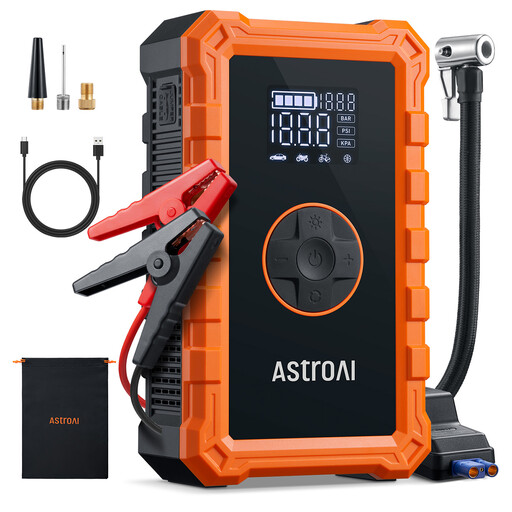
Why This Fits Their Persona: Ideal for owners of compact or mid-size gasoline cars. This model offers solid basic functionality at an accessible price. It's a practical choice for those who want to be prepared for emergencies without investing in unnecessary power.
This model doesn't focus on an extremely high peak power but offers sufficient strength with 1500A for the specified engines (up to 6.0L gasoline). The 150 PSI compressor with auto-shutoff is practical and avoids the frustration of a slow pump.
Compact design with a clear 2.4" screen that shows status and tire pressure. The compressor has 5 preset modes for ease of use.
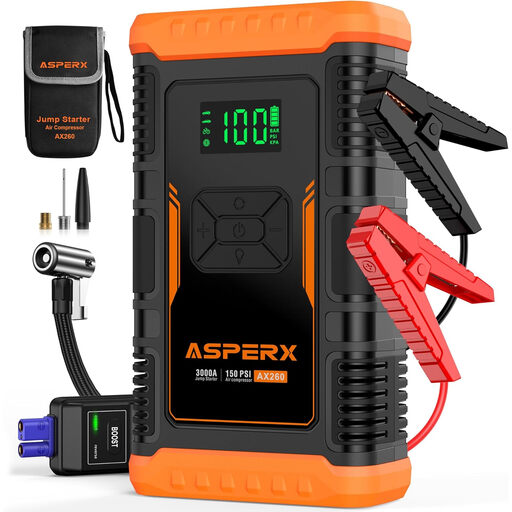
Why This Fits Their Persona: An excellent middle ground for the average driver with a family car, SUV, or RV. This model offers a powerful 3000A peak and is suitable for larger gasoline (up to 10L) and diesel engines (up to 8L), providing great flexibility.
The balance between the 3000A peak power and the broad engine compatibility is realistic. The compressor delivers a claimed 35 L/min, which ensures fast inflation and avoids the pitfall of a slow pump.
Combines a powerful jump starter with a fast compressor and power bank functionality. The honeycomb design for heat dissipation helps prevent overheating.
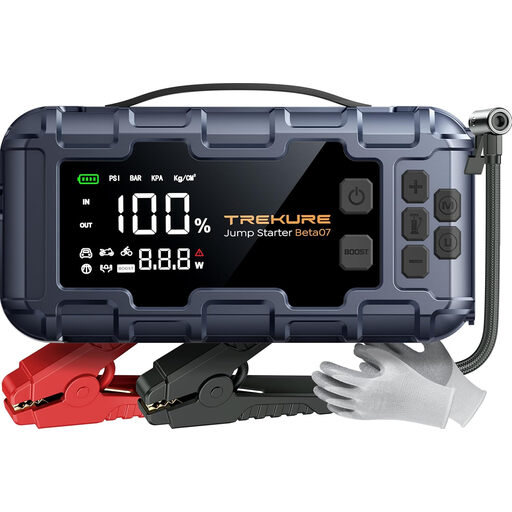
Why This Fits Their Persona: Designed for the serious user with a large RV, van, boat, or a heavy-duty diesel engine (up to 12L). This model delivers the power and robustness needed for demanding situations where reliability is not an option but a requirement.
The high 6000A peak power is functional here, aimed at starting the heaviest 12V engines. The fast compressor (45 L/min) and 45W PD fast-charging feature are practical characteristics that justify the higher specs.
Very high starting power, a fast 160 PSI compressor, and a large 3.3" smart display. The 45W PD port can quickly recharge the unit itself and functions as a fast output for laptops or tablets.
We have compiled a complete, up-to-date list of products that meet these strict selection criteria and safety regulations.
Generally, it is recommended to fully charge a jump starter every 2 to 3 months, even if you don't use it. This helps keep the internal battery in good condition and ensures it's ready for use when you need it. Always consult the manufacturer's manual for specific recommendations.
Not necessarily. It's more important to choose a model that matches your vehicle's engine. An unnecessarily high peak power makes the device more expensive without offering any extra benefit for a smaller engine. Conversely, a power level that's too low won't be able to start your car. Match the power to your engine displacement and type (gasoline or diesel).
Yes, most models are designed to be stored in a vehicle. They have a specified operating temperature range, for example, from -20°C to 60°C (-4°F to 140°F). However, it's wise to avoid leaving the device in direct sunlight behind the windshield during a heatwave, as extreme temperatures can affect the battery's long-term lifespan.
