
Vandaag of morgen in huis

Kwaliteit gegarandeerd

Welkomstaanbiedingen ontgrendelen: GRATIS bezorging | Tot 80% korting | Gratis 30 dagen JoyPlus-proefperiode
Download de app
A dead battery or a flat tire always happens unexpectedly and at the worst possible moment. A jump starter with a compressor seems like the perfect all-in-one solution to get you back on the road quickly. But the market is flooded with models that promise the world. Many drivers discover after their purchase that their new gadget falls short when it really matters.
Before you make a choice, it's helpful to know where the most common pitfalls lie. This will help you avoid a bad purchase and ensure you bring home a device that actually does its job.
To avoid buyer's remorse, it's wise to check a few technical specifications. These determine whether a battery booster with compressor is suitable for your vehicle and situation.
Look beyond the advertised peak current. The crucial question is: is the device suitable for your engine?
12v jump starter and compressor is the standard for most passenger cars and light commercial vehicles.The maximum pressure (PSI or Bar) is less important than how quickly the compressor works.
jump starter with air pump that automatically shuts off when the set tire pressure is reached is not only convenient but also prevents you from over-inflating a tire.The capacity of the internal battery, expressed in milliampere-hours (mAh), determines the endurance of your portable jump starter. A higher capacity means you can start a car or inflate a tire more times before the booster itself needs to be recharged. Features like a power bank with jumper cables and compressor for charging your phone or a built-in LED light are practical, but the performance of the starting and inflating functions remains most important.
Not every car starter with tire inflator is the same. The right choice depends on your vehicle and how you plan to use the device. Below are some models that suit different user profiles.
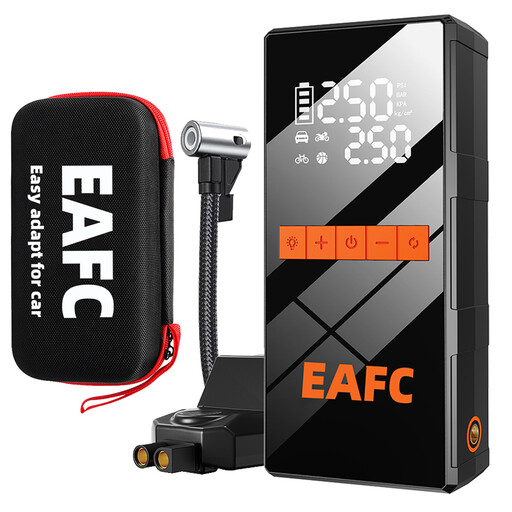
Why This Fits Their Persona: Ideal for owners of standard passenger cars (petrol up to 4.0L, diesel up to 2.0L) looking for an affordable and compact emergency solution for the glove compartment. A no-frills, functional 4-in-1 tool for the most common problems.
This model has a modest 8000mAh battery, which is realistic for its price. It focuses on the basic functions for smaller engines and avoids the pitfall of making exaggerated promises for a low price.
Its compact size and clear focus on 4-in-1 functionality (starting, inflating, power bank, LED light) make it a practical choice for the average driver.
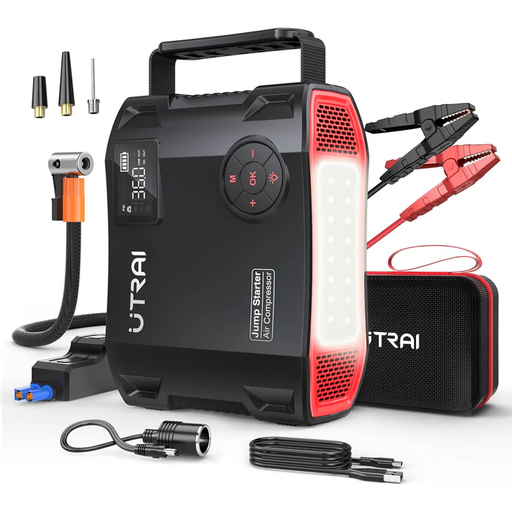
Why This Fits Their Persona: Designed for owners of large vehicles like RVs, vans, or SUVs with heavy-duty diesel engines (up to 10.0L). The high capacity and powerful starting current provide peace of mind during long trips or in cold conditions.
The 6000A peak current is backed by a very large 27000mAh battery and a fast compressor (45 L/min). This is no empty shell; the specs are balanced and geared for heavy use, avoiding the 'jack-of-all-trades' illusion.
The combination of a very high starting power, a fast compressor, and a large battery capacity makes this a reliable tool for demanding situations. The 160W DC output is an added bonus for powering other car accessories.

Why This Fits Their Persona: For the driver who wants a powerful, reliable, and versatile tool suitable for most cars, including larger petrol engines (up to 9.0L) and diesels (up to 8.0L). A great balance between power, features, and ease of use.
This model sidesteps the peak current myth by combining high power with extensive safety features and a design focused on heat dissipation. It not only delivers power but does so in a controlled and safe manner.
The clear LCD screen, 10-layer protection, and 5 preset inflation modes make the device highly user-friendly. The 'set it and forget it' function of the compressor is a major plus.
We have compiled a complete, up-to-date list of products that meet these selection criteria and comply with current safety regulations.
Most manufacturers recommend fully charging the device every 3 to 6 months, even if you don't use it. This helps maintain the health of the lithium-ion battery and ensures the booster is ready for use when you need it. Always consult your specific model's manual for precise advice.
No, that's a common misconception. The effectiveness of a jump starter depends on its starting power (Amps) and your car's engine. A multifunctional jump starter designed for a 1.6L petrol engine will likely not be powerful enough for a 3.0L diesel engine in an RV. Always check that the booster's specifications match your vehicle's engine size.
Modern jump starters are equipped with various safety systems. Features like reverse polarity protection (connecting the clamps incorrectly), short-circuit protection, overheating protection, and over-voltage protection are standard on most quality models. As long as you connect the clamps correctly and follow the instructions, using it is safe for your car's onboard electronics.
