
Vandaag of morgen in huis

Kwaliteit gegarandeerd

Welkomstaanbiedingen ontgrendelen: GRATIS bezorging | Tot 80% korting | Gratis 30 dagen JoyPlus-proefperiode
Download de app
A dead battery or a flat tyre always happens unexpectedly. A jump starter with a compressor seems like the perfect all-in-one solution. But the market is flooded with models making lofty promises. Many drivers end up disappointed with a device that isn't quite powerful enough when it really matters. Before you invest in such a vital part of your car emergency kit, it's crucial to separate the marketing hype from the facts.
Let's look at the three most common pitfalls that lead to buyer's remorse:
To avoid a bad purchase, focus on the specifications that truly matter. These are the objective criteria that determine whether a device will do its job when you need it.
The required starting power depends directly on your engine. A car jump starter must deliver enough power to turn the engine over.
If you also plan to use the device as a power bank for your laptop, capacity is crucial. Don't just look at the mAh, but also at the power in Watt-hours (Wh) if listed. A high capacity (around 20,000 mAh) is a good start. For charging laptops, a USB-C Power Delivery (PD) port of at least 45W, but preferably 65W, is a must-have. Without a PD port, your laptop will charge very slowly, if at all.
A portable tyre inflator must not only reach the correct pressure (PSI or Bar) but also do so within a reasonable time. The speed is expressed in litres per minute (L/min). A value of 25 L/min or higher is recommended for car tyres. Models with a lower flow rate are fine for a bicycle tyre, but inflating a car tyre can become a lengthy chore. An auto-shutoff feature, where the compressor stops at the preset pressure, is a very practical addition.
Below is a selection of products, matched to specific user profiles. These choices are based on an objective analysis of product specifications, not marketing claims.
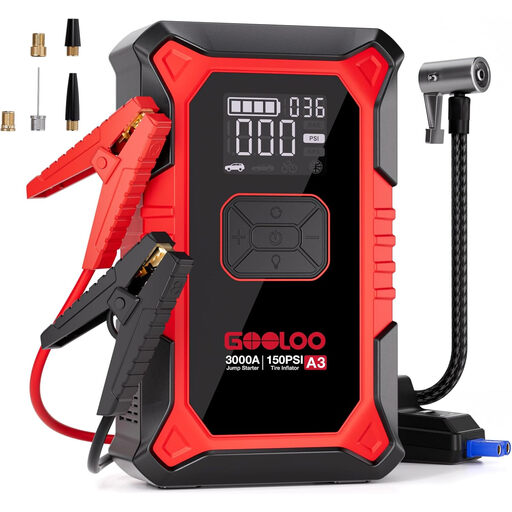
Why This Fits Their Persona: Ideal for those seeking a reliable all-in-one solution for a standard passenger car. Compact enough for the glove compartment, yet powerful enough for most petrol and smaller diesel engines.
This model balances its features well. The compressor has a decent flow rate (35 L/min) and the starting power is realistic for its target audience, thus avoiding the "jack-of-all-trades, master-of-none" trap.
The combination of a 150 PSI compressor with auto-shutoff and a powerful 3000A peak starting function in a compact form factor offers great value for daily use.
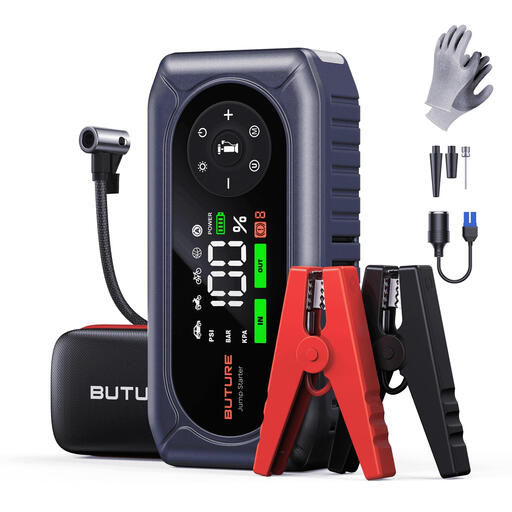
Why This Fits Their Persona: Designed for heavier-duty tasks. Perfect for owners of RVs, vans, or larger SUVs with diesel engines. The high starting power and robust build are ideal for those who want to be self-reliant on the road.
This model bypasses the peak power myth by specifying a very high peak power (4500A) suitable for diesel engines up to 8.0L. This isn't an empty promise but a specification geared towards heavy-duty use.
The combination of 4500A peak power and a design that operates in extreme temperatures (-20°C to 60°C) makes this a reliable partner for any adventure. The 500-lumen LED light is an added bonus.
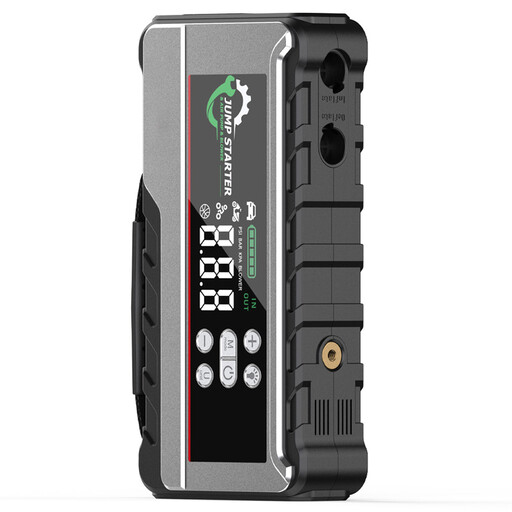
Why This Fits Their Persona: For those who demand the maximum. This is not just a jump starter, but a mobile power station. Perfect for freelancers who need to charge their laptops on the go, or for anyone who wants a powerful and versatile piece of kit.
This model avoids the unrealistic capacity trap by offering a tangible, high-end feature: PD 65W fast charging. This is a verifiable specification that demonstrates the high quality of the battery and electronics.
The PD 65W fast-charging function for laptops is unique and extremely practical. Combined with a 24,800mAh battery, 3000A starting power, and even an air duster function, this is a very complete battery booster with compressor package.
We have compiled a complete, up-to-date list of products that fully meet these strict selection criteria and current safety regulations.
Even when not in use, a jump starter slowly loses its charge. It is advisable to fully recharge the device every 3 to 6 months. This ensures the battery remains in good condition and is always ready for use.
Yes, most modern lithium-ion jump starters are designed to operate within a wide temperature range, often from -20°C to 60°C. Extreme cold can temporarily reduce the battery's performance, but it will not immediately damage the device. Always check the manufacturer's specifications for the precise operating temperatures.
The days of heavy, lead-acid battery packs are over. Thanks to modern lithium-ion technology, most jump starters with compressors are surprisingly compact and lightweight. Many models fit easily in the glove compartment or a storage space in the trunk, making them an unobtrusive but essential part of your car emergency kit.
