
Vandaag of morgen in huis

Kwaliteit gegarandeerd

Welkomstaanbiedingen ontgrendelen: GRATIS bezorging | Tot 80% korting | Gratis 30 dagen JoyPlus-proefperiode
Download de app
A dead battery or a flat tire always happens unexpectedly. Being stranded on the side of the road is not only frustrating but can also be unsafe. A jump starter with an air compressor seems like the perfect all-in-one solution. However, many models on the market fail to deliver on their promises. As a Product Recommendation Officer at Joybuy, I often see where things go wrong. Before you invest in an emergency starter for your car, it's crucial to see through the marketing hype.
Many drivers fall into a few common traps:
To avoid a bad purchase, focus on the specifications that truly matter. These are the objective criteria that determine whether a device is reliable in an emergency.
The starting power determines if the 12V battery booster can start your engine. Don't just look at the peak amps; check the recommended engine displacement (liters). A typical petrol car in the UK (up to 2.0L) needs less power than a large diesel SUV (3.0L or more).
A good emergency car starter always has built-in protection against short circuits and incorrect clamp connections.
A jump starter with compressor is only useful if the pump function is efficient. The maximum pressure, often 150 PSI tire inflator, is the upper limit. More important is the speed at which the tire inflates. Look for models that specify the inflation time, for example, "from 2.0 to 2.5 BAR in 3 minutes." An auto-shutoff feature, where the compressor stops at the preset pressure, is a practical addition that prevents over-inflation.
The capacity of the internal battery, expressed in mAh, determines how many times you can use the starter or how long you can charge your phone. A jump starter power bank with USB ports is standard, but check the output (e.g., Quick Charge) for faster charging. A built-in LED light with multiple modes (flashlight, strobe, SOS) is indispensable for roadside trouble in the dark.
Based on objective specifications, we have selected several models that suit different user profiles.
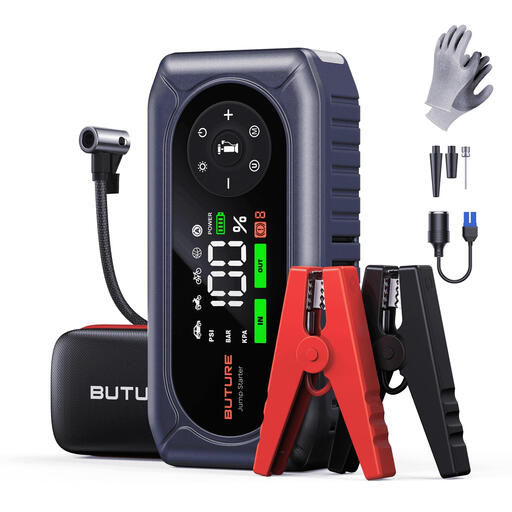
Why This Fits Their Persona: Ideal for the driver who wants one reliable device for all common emergencies. Suitable for both the daily commuter and the adventurous camper.
This model combines high starting power (4500A) with a functional 150 PSI compressor featuring an auto-shutoff function. It delivers on both fronts, so you're not left with a half-baked solution.
5-in-1 functionality: jump starter, air compressor, power bank, 500-lumen LED light, and 10 safety features. Suitable for large engines (up to 9.0L petrol / 8.0L diesel).
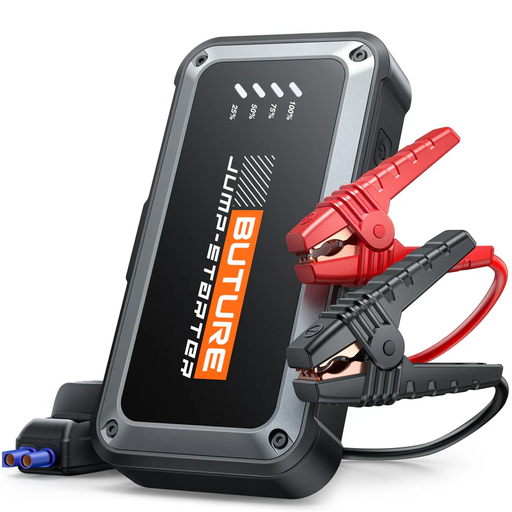
Why This Fits Their Persona: For owners of an SUV, van, or car with a large engine displacement who demand absolute certainty. The focus here is purely on maximum starting power.
This model bypasses the "peak power myth" by providing a high and reliable starting power of 3000A, specifically aimed at engines up to 9.0L petrol and 8.5L diesel. No empty promises.
Purely focused on starting power. Compact and lightweight (0.37 kg) for its output. Also functions as a 16800mAh power bank with two USB outputs.
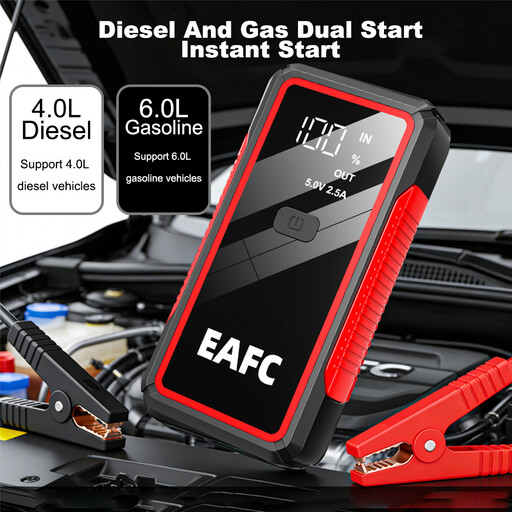
Why This Fits Their Persona: Perfect for the driver of a standard passenger car who wants an affordable and compact emergency starter for the glove compartment. No-frills, just a reliable jump start.
This model focuses on one task: starting. With 2000A peak power, it's more than enough for most cars (up to 6.0L petrol / 4.0L diesel) without making you pay for a compressor you might not need.
A great balance of price, performance, and size. The 10000mAh battery also serves as a power bank. Includes smart jumper cables with safety features.
We have compiled a complete, up-to-date list of products that meet these strict selection criteria and UK safety regulations.
Most manufacturers recommend fully charging a jump starter every 3 to 6 months, even if you don't use it. This ensures the internal battery remains in good condition and is always ready for use when you need it. Always check the manual for your specific model for precise advice.
Yes, a maximum pressure of 150 PSI is more than sufficient. The tire pressure for a passenger car is typically between 30 and 40 PSI (about 2.1 to 2.8 BAR). The 150 PSI rating indicates the pump's maximum capacity. More important for practical use is the speed at which the compressor can move air (expressed in liters per minute), as this determines how quickly your tire is back to the correct pressure.
Most portable jump starters are designed for 12V battery systems, which is standard for virtually all passenger cars, SUVs, and vans. However, it is crucial to check what engine displacement (in liters) the starter is suitable for. A model designed for a 2.0L petrol engine may struggle to start a 5.0L V8 or a heavy-duty diesel engine. This information is always clearly stated in the product specifications.
