
Vandaag of morgen in huis

Kwaliteit gegarandeerd

Welkomstaanbiedingen ontgrendelen: GRATIS bezorging | Tot 80% korting | Gratis 30 dagen JoyPlus-proefperiode
Download de app
A dead battery or a flat tire always happens unexpectedly. A jump starter with a built-in air compressor seems like the perfect all-in-one solution to get you back on the road quickly, without relying on roadside assistance. However, the market is flooded with models promising impressive specifications. Unfortunately, these promises often lead to a purchase that's of little use in practice. Before you invest, it's crucial to recognise the common pitfalls.
Many devices look good on paper but fall short when you actually need them. Watch out for the following marketing traps:
car jump starter will still leave you stranded.portable air compressor with a high PSI (pressure) rating seems powerful, but if the airflow (expressed in litres per minute) is low, it will take forever to inflate a tire. Furthermore, many cheaper models overheat quickly and shut themselves off after just one tire.12v battery booster may no longer be powerful enough for a jump-start attempt.To avoid a bad purchase, focus on the specifications that truly matter. Check these three points before making a choice.
Look beyond the advertised peak current. The most important factor is whether the device is suitable for your engine type. Manufacturers usually indicate this in litres (L).
jump starter for diesel requires significantly more power due to higher compression. Look for models explicitly rated for larger diesel engines (e.g., 3.0L or more), such as those in SUVs, RVs, and vans.The capacity of the internal battery, expressed in mAh, determines how many start attempts you can make or how many times you can charge your phone.
A good car tire pump saves you time and frustration. Pay attention to the following two values:
A reliable car jump starter is safe to use, even for those with no technical knowledge. Essential safety features include protection against sparks, reverse polarity, and short circuits. A clear display that shows the status and any error messages is a plus. The device should also function as a practical power bank for your car, with usable USB ports for charging your devices in an emergency.
Based on these criteria, we have selected a number of models that suit different user profiles.
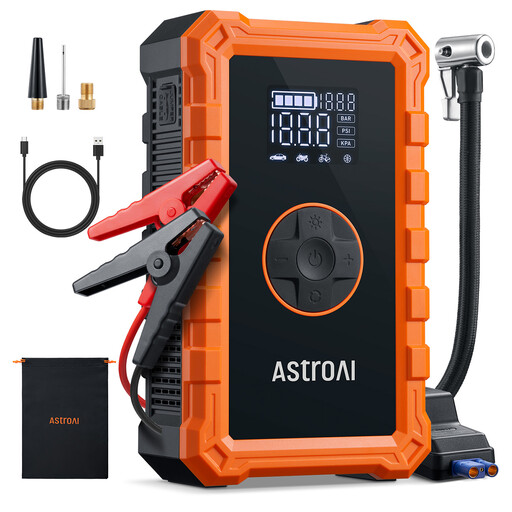
Why This Fits Their Persona: An excellent all-rounder for the average driver with a gasoline or compact diesel car. This device offers peace of mind for the most common roadside issues, without paying for extreme power you don't need.
The specifications (1500A peak, suitable for 6.0L gas/3.0L diesel) are realistic and tailored to its intended use. The compressor is functional, with an auto-shutoff feature, and not just a gimmick.
Compact all-in-one design with a clear 2.4-inch screen, which simplifies operation in a stressful situation.

Why This Fits Their Persona: Designed for drivers of heavy-duty vehicles like RVs, vans, or large diesel SUVs. These users can't risk having an underpowered jump starter and need serious starting power.
Although 8000A is a peak value, the explicit mention of compatibility with diesel engines up to 10.0L directly addresses the pitfall of an underpowered device. This provides confidence for use with heavy-duty engines.
Very high peak current combined with a 150 PSI compressor. The large 3.4-inch screen displays all necessary information at a glance.
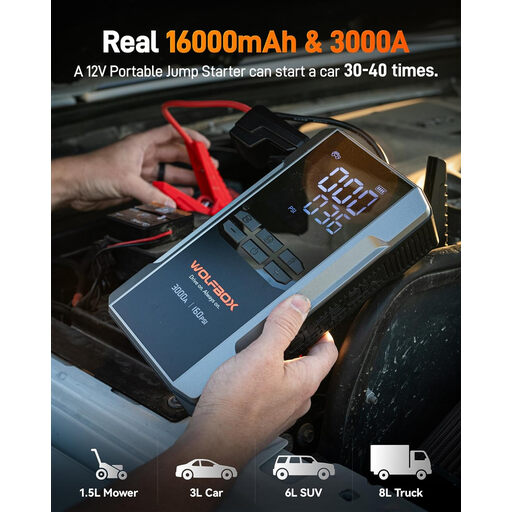
Why This Fits Their Persona: For the user who values modern technology and convenience. The fast-charging feature ensures the jump starter itself is quickly ready for use, which is ideal for those who always want to be prepared.
This model addresses a practical pitfall: a dead jump starter when you need it. The 65W fast-charging function solves this. It offers a solid balance between power (3000A peak, 8L gas/6L diesel) and modern convenience.
The 65W fast-charging function and a clear LED display offer a more user-friendly experience than standard models.
We have compiled a complete, up-to-date list of products that fully meet these strict selection criteria and local safety regulations.
Even when not in use, the battery slowly self-discharges. It's good practice to check the charge every 2 to 3 months and fully recharge the device. This ensures it's ready for use when you need it. Store it in a place with a moderate temperature to extend the battery's lifespan.
That depends on the engine. Diesel engines require more starting power. A model with a 1500A peak current may be sufficient for a smaller diesel engine (up to approx. 2.0L). For larger engines, such as those in a van or heavy-duty SUV, it is wiser to choose a more powerful model (e.g., 3000A or more) that is explicitly rated for larger diesel engines. Always check the manufacturer's specifications.
Generally, this is not recommended. For safety and optimal performance, most manufacturers advise using the functions (starting, inflating, charging) only when the device itself is not connected to a charger. Consult the manual for your specific model for the correct instructions.
