
Vandaag of morgen in huis

Kwaliteit gegarandeerd

Welkomstaanbiedingen ontgrendelen: GRATIS bezorging | Tot 80% korting | Gratis 30 dagen JoyPlus-proefperiode
Download de app
A dead battery on a cold morning or a flat tire just before an important meeting. These are situations no driver wants to face. A jump starter with an air compressor seems like the perfect 2-in-1 solution. But the market is flooded with models that promise the world. Unfortunately, exaggerated specifications and clumsy designs often lead to a purchase you'll regret.
As a Product Recommendation Officer at Joybuy, I see the challenges consumers face every day. Before you invest in roadside assistance for your trunk, it's crucial to recognize two common pitfalls:
Let's cut through the marketing jargon and look at the specifications that truly matter.
To avoid a bad purchase, focus on three concrete features. These determine whether a jump starter with air compressor is a reliable tool or a useless piece of plastic.
The starting power, expressed in Amperes (A), is the force required to turn your car's starter motor. It's crucial to know what type of engine you have.
So, don't be blindly guided by the highest number. Check the specifications for the engine displacement (L) for which the car jump starter is suitable.
A portable tire inflator and starter is only useful if the compressor does its job. Pay attention to two values:
The internal battery powers everything. Its capacity (mAh) determines how many times you can start a car or charge your phone with the power bank with jump start function. Even more important are the built-in safety features. A good 12V jump starter must have at least the following protections to prevent damage to your car's electronics or the booster itself:
A clear display that shows the battery status and any error messages is not a luxury but a necessity for safe use with battery roadside assistance.
Based on these objective criteria, we have selected a number of models that suit different user profiles.

Why This Fits Their Persona: Ideal for families with an SUV or MPV. This model combines a powerful starting function with a full-featured compressor, making it a complete solution for both daily commutes and holidays.
This device avoids the 'all-in-one' disappointment. Its 150 PSI compressor with 5 preset modes is a serious tool, not a gimmick. The 4500A peak current is more than enough for most family cars, including diesels.
Comprehensive 10-layer safety protection and a clear LCD screen for ease of use. The automatic shut-off feature on the compressor is very practical.
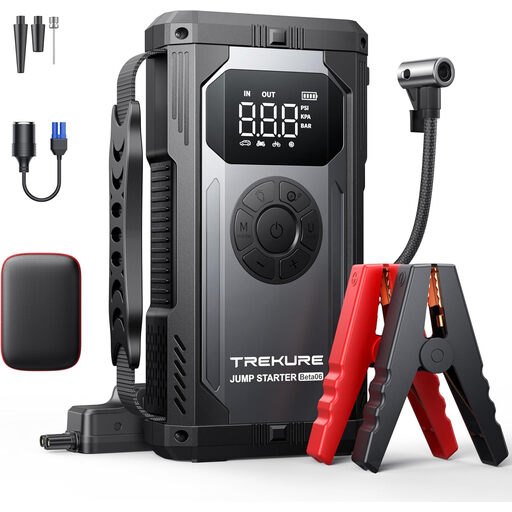
Why This Fits Their Persona: Perfect for the owner of an RV, van, or heavy-duty diesel SUV. When starting reliability is the top priority, this model provides the power needed for the toughest jobs.
This model bypasses the 'peak amps trap' by specifying a very high 5500A peak current that is genuinely suitable for engines up to 10.0L diesel. This is not an empty marketing claim, but a specification for heavy-duty use.
Extremely high starting power and a fast compressor (35 L/min). According to the manufacturer, its 'force start' technology can even revive completely dead batteries.
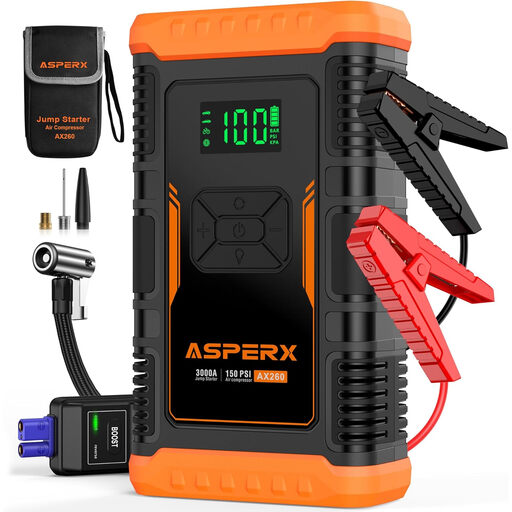
Why This Fits Their Persona: For the commuter or city driver with a standard car. This device is relatively compact and lightweight, taking up little space while still offering the dual security of a jump starter and a tire pump.
This model is designed as a lighter alternative to traditional, bulky boosters. It delivers a capable 3000A peak current and a 150 PSI compressor without the weight and size of heavier models.
Good balance between size and performance. The cordless inflator with presets and a clear LCD screen makes it very user-friendly for quick emergencies.
We have compiled a complete, up-to-date list of products that fully meet these strict selection criteria and safety regulations.
Most manufacturers recommend fully charging the jump starter every 2 to 3 months, even if you don't use it. Modern lithium batteries have a low self-discharge rate, but keeping them topped up ensures the booster is ready when you need it and extends the battery's lifespan.
Yes, you can, but with a caveat. Most jump starters have an operating temperature ranging from -20°C to 60°C (-4°F to 140°F). They are designed to function in the cold. However, extreme cold can temporarily reduce the performance of the lithium battery. It's not a problem to store it in a cold car, but don't expect maximum performance at temperatures well below freezing.
Not necessarily. An extremely high peak current is only useful if you have a very large engine (e.g., a heavy-duty diesel). For a standard gasoline car, a 4000A booster is overkill and not necessarily better than a well-designed 2000A model. Focus on the recommended engine displacement (in liters) that the manufacturer specifies and choose a model that comfortably meets that requirement. Reliability and safety features are often more important than the highest Amp number.
