
Vandaag of morgen in huis

Kwaliteit gegarandeerd

Welkomstaanbiedingen ontgrendelen: GRATIS bezorging | Tot 80% korting | Gratis 30 dagen JoyPlus-proefperiode
Download de app
Being stranded with a dead battery or a flat tire is a scenario every driver dreads. A jump starter with an air compressor appears to be the perfect all-in-one solution. Yet, the market is flooded with models that promise impressive performance on paper but fail to deliver in real-world situations. Before investing in this essential car emergency tool, it's vital to understand the key factors that separate a reliable device from a regrettable purchase.
We'll discuss the most common pitfalls and the specifications that truly matter. This will help you make an informed choice and be prepared for unexpected situations.
Many multi-function jump starters are promoted with impressive specs, but the reality is often quite different. Here are the three most important things to be aware of.
To see through the marketing hype, focus on the following technical specifications. These determine whether a jump starter with compressor will do its job effectively.
The starting power, expressed in amperes (A), is the most important factor. A small gasoline car might only need 400-600A, but an SUV, van, or a car with a large diesel engine requires significantly more.
For a reliable start, especially in cold weather or for larger engines, look for models with a peak power of at least 1500A to 2000A. Even more is recommended for heavy-duty diesel engines.
A functional air compressor is defined by two values:
A useful extra feature is the auto-shutoff function, where the compressor stops automatically once the preset tire pressure is reached.
Not every jump starter is suitable for every car or every user. Below, we highlight a model tailored to a specific user profile.
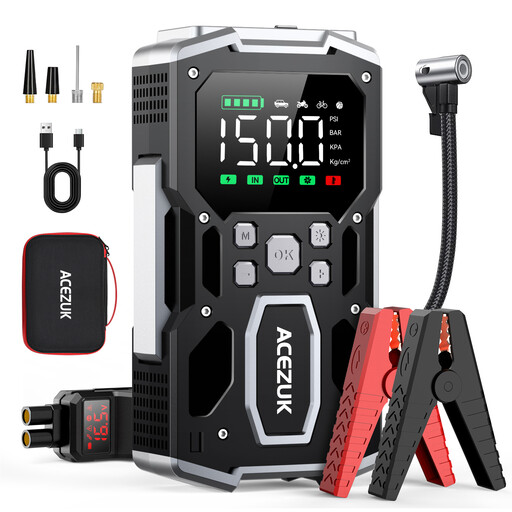
Why This Fits Their Persona: This model is ideal for those seeking a powerful, reliable all-in-one solution. Perfect for owners of large gasoline or diesel vehicles (up to 10.0L), adventurous travelers, and anyone who wants to be prepared for any scenario without carrying multiple devices.
With a peak current of 8000A, this model is powerful enough for the toughest jobs, avoiding the pitfall of an underpowered starter. The 150 PSI compressor with an airflow of 35L/min is a fully-fledged tool, not a gimmick.
A complete car emergency starter: powerful jump starter, fast tire inflator, and power bank in one. The large 3.4-inch LCD screen and 10 built-in safety features make it easy and safe to use.
This model is an excellent choice for those seeking maximum power and functionality. However, if you're looking for a more compact model for a small city car, or have a smaller budget, there are various options that better suit those specific needs.
We have compiled a complete, up-to-date list of products that fully meet these strict selection criteria and safety regulations.
1. How often should I charge a jump starter? It is advisable to fully charge the jump starter every 2 to 3 months, even if you don't use it. This helps keep the battery in good condition and ensures it's ready for use when you need it. Always consult the manufacturer's manual for specific recommendations.
2. Can a jump starter revive a completely dead battery? A jump starter is designed to provide a short, powerful burst of current to start the engine. It is not a battery charger. Once the engine is running, the car's alternator will recharge the battery. If the battery is old or faulty and can no longer hold a charge, it will need to be replaced.
3. Is a jump starter with a compressor safe for a novice to use? Yes, modern models are designed with the user in mind. Features like smart jumper clamps with protection against incorrect connection (reverse polarity) and short circuits make them very safe to use. The compressors often have an auto-shutoff function. However, it is always wise to read the manual carefully before the first use.
