
Vandaag of morgen in huis

Kwaliteit gegarandeerd

Welkomstaanbiedingen ontgrendelen: GRATIS bezorging | Tot 80% korting | Gratis 30 dagen JoyPlus-proefperiode
Download de app
A dead battery on a cold morning or a flat tire far from home; these are situations no driver wants to face. A jump starter with an air compressor seems like the ideal all-in-one solution. But the market is flooded with models that make lofty claims. Many devices are packed with features that disappoint in practice, leaving you with an expensive and unreliable tool.
As a Joybuy Product Recommendation Officer, I'm here to help you cut through the marketing hype. We'll look at the specifications that truly matter, so you can make an informed decision and avoid paying for features you'll never use. Let's avoid the most common pitfalls.
Pitfall 1: The Myth of Sky-High Peak Amps Manufacturers advertise enormous peak currents of 6000A or even 7000A. This number represents the maximum burst of current the device can deliver in a fraction of a second. For most passenger cars, this is overkill. More important is the starting current (cranking amps), which determines if the booster can actually turn over your engine, especially for a jump starter for a diesel engine. A sky-high peak rating on the box often leads to a higher price, not better performance for your specific vehicle.
Pitfall 2: Built-in "Gadgets" That Just Don't Work A portable tire inflator that takes fifteen minutes to barely inflate one tire, or a power bank with a jump-start function that charges your phone at a snail's pace. Many multifunctional jump starters cut corners on the quality of their extra features. The result is a device that's a jack of all trades but a master of none.
To avoid buyer's remorse, it's essential to look past the marketing and focus on the technical specifications that determine performance.
Ignore the flashy numbers and look at what your vehicle requires. A 12V jump starter is standard for passenger cars, but the required power varies.
A car battery booster only becomes a complete roadside emergency kit if the extras are also functional.
Not everyone has the same needs. That's why we've made a selection tailored to different types of users, based on objective product specifications.
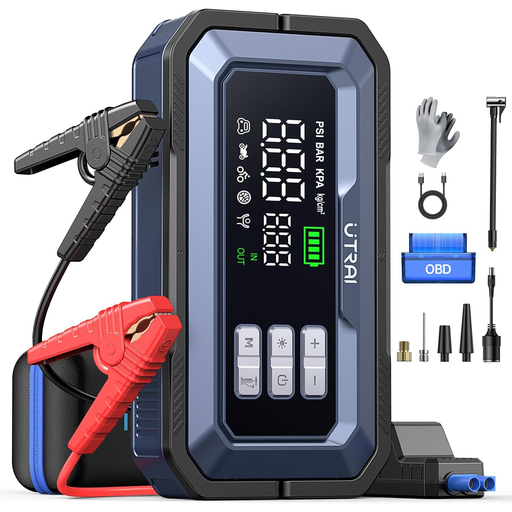
Why This Fits Their Persona: For the driver of a large diesel, RV, or light truck who wants to be prepared for anything. This isn't just a jump starter; it's a complete roadside solution.
This model bypasses the 'useless gadget' pitfall. The air compressor (150 PSI), 160W DC output, bright work light, and OBD2 fault code reader are fully-fledged tools, not toys.
7000A Peak Power: Capable of starting diesel engines up to 14L, according to UTRAI's specifications. OBD2 Reader: Reads and clears fault codes, a unique feature in this class.
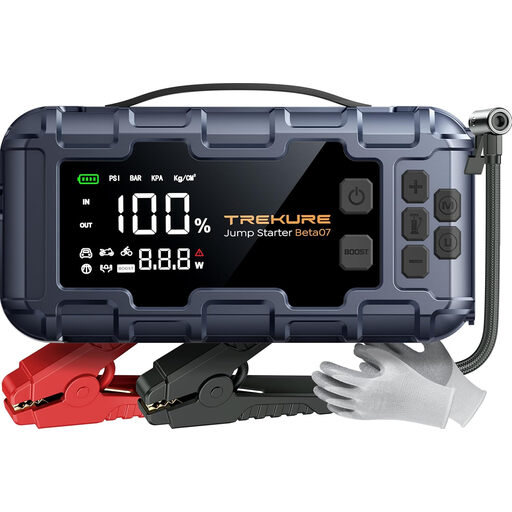
Why This Fits Their Persona: Ideal for those seeking a powerful and reliable solution for holidays and daily use, without the complexity of an OBD2 reader. Perfect for larger family cars and camper vans.
This model avoids the 'peak power overkill' trap. The 6000A is more than sufficient for most large vehicles (up to 12L diesel according to TREKURE), without making you pay for unused capacity.
Powerful Compressor: The 160 PSI / 45L/min pump is one of the faster ones in its class. Large 3.3" Display: Clearly shows all information, including tire pressure and battery status.
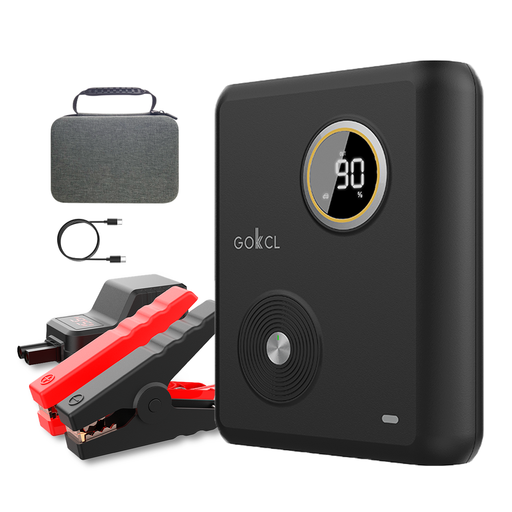
Why This Fits Their Persona: For the user who prioritises durability and reliability above all else. If you're looking for a device that will last for years and always be ready for use, even after being stored in a hot or freezing car.
This model addresses the hidden pitfall: battery degradation. The sodium-ion battery is far more resistant to extreme temperatures and has a much longer lifespan than standard lithium-ion batteries.
Sodium-Ion Battery: According to GOKKCL, it's safer, has a lifespan of up to 6000 cycles, and a standby time of up to 5 years. Temperature Resistance: Operates in a range of -40°C to 80°C.
We have compiled a complete, up-to-date list of products that fully meet these strict selection criteria and safety regulations.
For most lithium-ion jump starters, it's recommended to charge them every 3 to 6 months, even if you don't use them. This prevents the battery from deep-discharging and extends its lifespan. Models with a sodium-ion battery, like the GOKKCL GK03, have a much lower self-discharge rate and, according to the manufacturer, require far less frequent charging. Always check the manual for your specific model.
Not necessarily. A higher peak power is only useful if your vehicle needs it, such as a large diesel engine. For a standard gasoline car, an extremely high peak rating is unnecessary and often a marketing gimmick to justify a higher price. Focus on a reliable starting current that matches your engine size and type.
This depends heavily on the battery technology. Standard lithium-ion batteries perform poorly and can be damaged at temperatures below freezing. Although many models specify an operating range down to -20°C, their capacity will decrease significantly. Devices with a sodium-ion battery are specifically designed to perform much better in extreme cold and heat, making them a more reliable choice to be stored permanently in the car.
