
Vandaag of morgen in huis

Kwaliteit gegarandeerd

Welkomstaanbiedingen ontgrendelen: GRATIS bezorging | Tot 80% korting | Gratis 30 dagen JoyPlus-proefperiode
Download de app
A clicking sound and a dashboard that stays dark. A dead battery always happens unexpectedly and at the worst possible moment. A jump starter, also known as a booster pack, is a lifesaver in these situations. But the market is flooded with models that promise more than they can deliver. Before you invest in a car starter, it's wise to know the common pitfalls.
Here are the three main things to watch out for to avoid a bad purchase:
To make a good choice, focus on the specifications that truly matter. These are the factors that make the difference between a reliable tool and a useless device in your trunk.
It's crucial to understand the difference between these two values.
For an average gasoline car, a starting current of 400-600A is often sufficient. For larger gasoline engines, SUVs, or diesel vehicles, you'll need a more powerful 12V jump starter with a higher starting current. Check what the jump starter manufacturer recommends for your engine type.
The battery's technology determines its safety, lifespan, and reliability.
A modern portable jump starter is often an all-in-one device.
Below is a selection of jump starters, matched to different user profiles. These recommendations are based on objective product specifications.
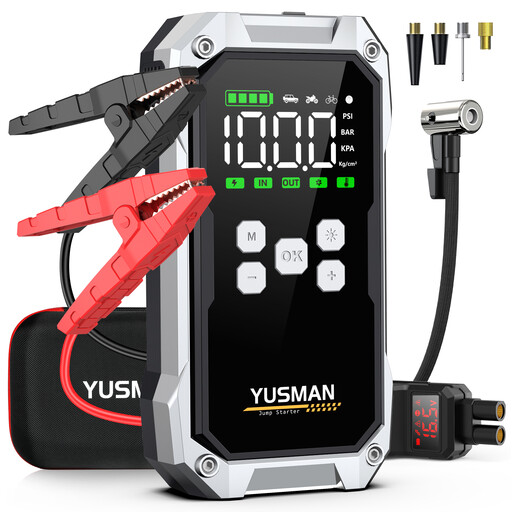
Why This Fits Their Persona: This user wants to be prepared for anything. The YUSMAN F04 combines a powerful jump starter with a built-in 150 PSI air compressor. Ideal for both a dead battery and a flat tire, whether you're on the road for work or on a family vacation.
This model doesn't just advertise a high peak power; according to the manufacturer, it's suitable for all gasoline engines and diesels up to 10.0L, indicating a robust starting capacity. The smart clamps provide the necessary safety features.
4-in-1 functionality: Jump starter, 150 PSI compressor, power bank, and LED light in one. Comes with a sturdy carrying case.
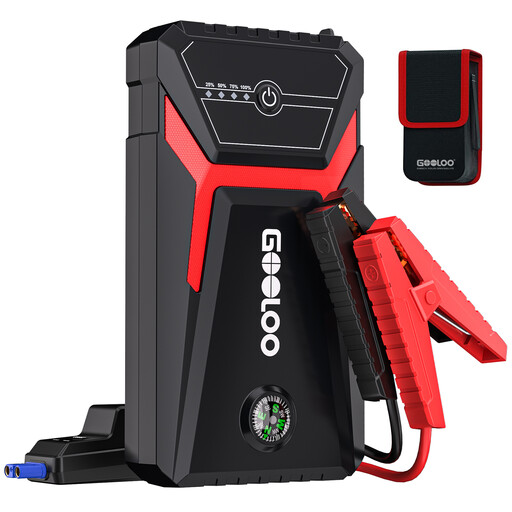
Why This Fits Their Persona: For those who rely on their car daily, a compact and reliable jump starter is essential. The GOOLOO GE1500 is small enough for the glove compartment but powerful enough for most passenger cars. No unnecessary extras, just a dependable tool for emergencies.
This model focuses on the core function. The specifications (1500A peak, suitable for 6.0L gas/4.0L diesel) are realistic for its size. The manufacturer highlights the 10 built-in safety features, which reduces the risk of damage from incorrect use.
Compact and lightweight: Weighs less than a kilogram and fits easily in a bag or glove compartment. Equipped with USB ports to also serve as a power bank.
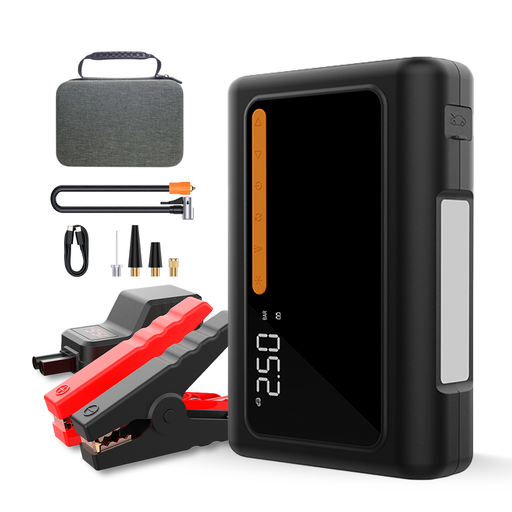
Why This Fits Their Persona: This user invests in durability, safety, and technology. The GOKKCL GK01 uses a sodium-ion battery, a technology that the manufacturer claims is superior in extreme temperatures and has a much longer lifespan. Ideal for those who want to leave the device in their car without worry, summer and winter.
This model bypasses the disadvantages of lithium. The manufacturer claims a lifespan of 6,000 cycles and a standby time of 5 years, making the misleading mAh race irrelevant. The focus is on long-term reliability and safety (no fire hazard).
Sodium-ion technology: Stable from -40°C to 80°C. Long lifespan: Lasts 7-15x longer than lithium, according to the manufacturer. Includes air pump and PD60W fast charging.
We have compiled a complete, up-to-date list of products that fully meet these strict selection criteria and safety regulations.
How often should I charge a jump starter? Most manufacturers recommend charging a lithium-ion jump starter every 3 to 6 months, even if you don't use it. This prevents the battery from discharging too deeply and extends its lifespan. Models with a sodium-ion battery often have a much lower self-discharge rate and may only need to be topped up once a year or even less. Always check the manual for your specific model.
Can I leave a jump starter in my car? Yes, but be mindful of the temperature. Standard lithium-ion boosters perform poorly in extreme cold and can be damaged by high heat, such as in a car under the full sun. Models specifically designed for a wide temperature range, like those with a sodium-ion battery, are a better choice for this.
Is a higher peak power (Amps) always better? Not necessarily. An extremely high peak power is often unnecessary for a standard passenger car. It's more important to look at the starting current and whether it matches your vehicle's engine (gas/diesel, engine size). A car jump starter with an appropriate starting power and reliable safety features is a wiser choice than a model that only excels in a high, but momentary, peak power.
