
Vandaag of morgen in huis

Kwaliteit gegarandeerd

Welkomstaanbiedingen ontgrendelen: GRATIS bezorging | Tot 80% korting | Gratis 30 dagen JoyPlus-proefperiode
Download de app
A flat car battery or underinflated tyre usually happens at the worst possible time. With a jump starter with compressor, you can deal with many situations yourself: support the battery, inflate a tyre, charge your phone or use the light by the roadside. However, many models seem more powerful and versatile than they really are in practice.
So don’t focus solely on a high amp rating or a pressure of 150 PSI. The connection, engine compatibility, battery capacity, operating time and safety features determine whether a car jump starter is genuinely suitable for your car, SUV, van or motorbike.
A rating such as 3000A, 5000A or 7000A sounds impressive, but peak current is only one product specification. Also check which 12V engines the device is designed for and whether the manufacturer distinguishes between petrol and diesel engines.
A lightweight 12V jump starter may be suitable for a compact petrol car, but that does not automatically mean it will work with a large diesel SUV. The stated engine capacity is a practical indication, not a guarantee that every vehicle will start in every situation.
A 150 PSI tyre inflator may state a high maximum pressure while its actual inflation speed remains limited. For car tyres, the correct hose, valve connection, heat protection and automatic shut-off are also more important than the maximum figure alone.
Check whether the air compressor for car tyres supports a preset pressure, works in PSI, bar or kPa, and stops once the set value has been reached. This means you won’t need to check the pressure manually as often while inflating.
A portable jump starter that sits unused in the boot for months may be flat when you need it. Pay attention to the charging method, display and maintenance instructions. Some manufacturers recommend charging the car battery booster every two to three months; other models specify a longer storage period.
Do not store the device in direct sunlight for extended periods or in an extremely hot car. Also check the stated charging and operating temperature, and fully charge the emergency jump starter before using it for the first time.
Start by choosing based on your vehicle:
A product with smart clamps, reverse-polarity protection and spark protection can make connecting the device more straightforward. Always connect the red clamp to the positive terminal and the black clamp to the negative terminal, following the instructions. Only use the supplied cables if the manufacturer specifies this.
For regular use, a jump starter with automatic shut-off is more practical than a model where you have to monitor the pressure yourself. Check:
A maximum pressure of 150 PSI does not mean that you should inflate a car tyre to that level. Always use the vehicle’s recommended tyre pressure, which is usually shown on a sticker inside the door frame, fuel flap or handbook.
A power bank for cars is useful when the device has USB-C, USB-A or a 12V output. In addition to mAh, check the watt-hour rating if one is provided. This gives you a more useful indication of the stored energy.
Useful extras include an LCD display, LED emergency light, SOS or flashing mode, a carry case and a separate 12V output for items such as a cool box or car vacuum cleaner. Also look for protection against reverse polarity, short circuits, overheating, overcharging and overloading.
Any CE or other conformity markings should relate to the specific product and its accompanying documentation. Do not regard such a marking as proof that the device is suitable for every car.
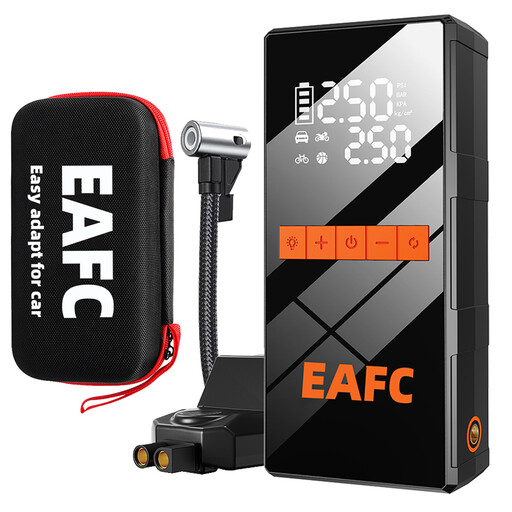
Why it suits this profile: This compact model is designed for 12V vehicles with petrol engines up to 4.0 litres and diesel engines up to 2.0 litres. This makes it a practical choice for a smaller car or motorbike and occasional use.
The product description clearly states the maximum engine capacity and automatic compressor shut-off. However, check that your vehicle falls within these limits.
150 PSI maximum pressure, four pressure units, LED lighting and USB output in a 190 × 87 × 42 mm housing.
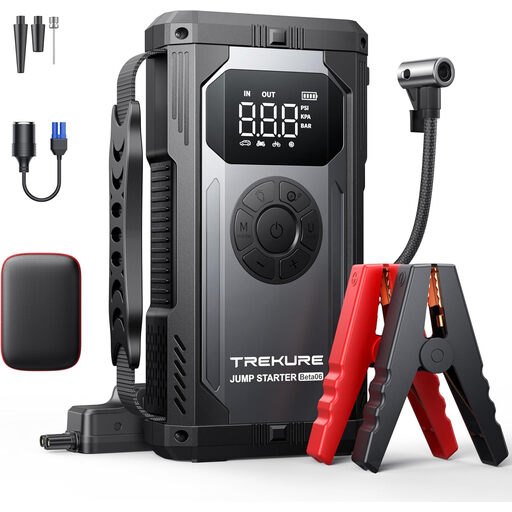
Why it suits this profile: The specifications are aimed at cars, SUVs, motorbikes and vans with petrol engines up to 10.0 litres or diesel engines up to 10.0 litres. The LCD screen displays battery and tyre pressure information.
The compressor has a preset pressure function with automatic shut-off. The manufacturer also lists ten protection features; however, the device must still be used according to the instructions.
5500A peak current, 150 PSI, a stated inflation speed of 35 litres per minute and dual USB output.
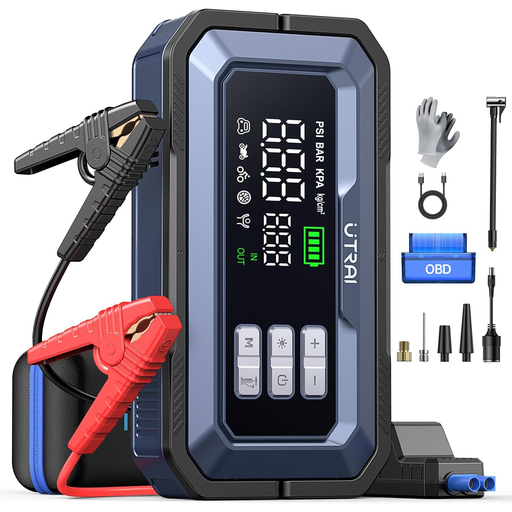
Why it suits this profile: This model is intended for drivers of larger vehicles and anyone who needs additional connections on the road. The product information lists diesel engines up to 14 litres, hybrid models and an OBD2 adapter.
The specifications list starting current, battery capacity, operating temperature and the 160W 12V output separately. This makes it easier to compare the features with your intended use.
7000A peak current, 150 PSI compressor, 160W DC output, 18W USB-C charging and 2000-lumen LED lighting according to the product description.
We’ve put together a complete, up-to-date list of products that fully meet these strict selection criteria and the applicable European safety requirements.
A jump starter for diesel cars is an emergency aid, not a replacement for a worn-out battery or faulty charging system. If the same starting problem occurs again, have the car checked.
This depends on the battery type, storage temperature, charging interval and frequency of use. Check the manufacturer’s charging advice and top up the device regularly, even when you are not using it. The compressor may also consume capacity more quickly than charging a phone.
No. Check the stated engine capacity, fuel type and any restrictions relating to hybrid vehicles. A device designed for 12V systems is not intended for the high-voltage batteries in electric cars. If in doubt, follow the vehicle and product instructions.
The cost of charging is usually limited, but energy consumption varies according to the battery capacity and charging adapter. The greater expense is more likely to result from poor maintenance or replacement following prolonged exposure to heat. Charge the device using the supplied or recommended cable, and avoid storing the battery completely flat.
