
Vandaag of morgen in huis

Kwaliteit gegarandeerd

Welkomstaanbiedingen ontgrendelen: GRATIS bezorging | Tot 80% korting | Gratis 30 dagen JoyPlus-proefperiode
Download de app
A flat battery or underinflated tyre rarely happens at a convenient time. With a jump starter with compressor, you can often get back on the road without having to wait for roadside assistance or a garage. However, many models look similar. A high peak current, 150 PSI and a long list of features don’t automatically mean a device is right for your car.
So pay close attention to the specifications, how long the compressor can run and the safety features. Read on to find out which pitfalls to watch out for and which models suit different needs.
A high peak current sounds appealing, but check the stated engine capacity too. A 12V jump starter for a small petrol car has different requirements from a jump starter for an SUV or diesel vehicle. Check the separate figures for petrol and diesel engines, and make sure your vehicle uses a 12V system.
A device specified for 12V vehicles isn’t suitable for 24V systems, such as those in heavy goods vehicles. For hybrid vehicles, always follow the instructions and compatibility information in the manual. You must not use a regular car battery booster to start the high-voltage battery in an electric car.
150 PSI is the maximum pressure, not the speed at which a tyre is inflated. Airflow, measured in litres per minute, gives you a better idea of the practical pumping speed. Also check whether the compressor switches off automatically at the pressure you set.
A digital tyre inflator with a display that lets you select PSI, BAR or kPa means you won’t have to guess while inflating. Bear in mind that a built-in compressor is generally intended for emergencies and topping up tyres. It’s not a substitute for a dedicated workshop compressor.
A portable jump starter contains a battery that slowly loses charge, even when you’re not using it. Some models recommend recharging every two to three months; others specify a longer storage period. Check the product information for details.
Store your emergency car starter in a cool, dry place and don’t leave it in a very hot car for long periods. Recharge it after use. After all, a flat jump starter won’t be much help when you need it in a breakdown.
Compare these three details:
According to the product information, the GOOLOO A3 is suitable for petrol engines up to 9.0 litres and diesel engines up to 6.5 litres. The UTRAI JS-30 is listed as supporting petrol and diesel engines up to 14 litres. These figures are product specifications, not a guarantee that every battery will start in every situation. Don’t attempt to start a damaged, frozen or leaking battery.
As well as the maximum pressure, check:
Always follow the recommended rest periods. For example, the UTRAI JS-9 specifies that the compressor must not be used continuously for more than 10 minutes. Let the device cool down afterwards. Check the recommended tyre pressure on the sticker inside the door frame, in the owner’s manual or in the tyre manufacturer’s information—not against the pump’s maximum PSI rating.
A car jump starter should come with clear connection instructions. Many models have protection against reverse polarity, short circuits, overheating and overloading. This reduces the risk of incorrect use, but it doesn’t make the manual any less important.
Check whether the kit includes smart jump leads, sturdy clamps, a charging cable, an air hose, adapters and a storage bag. A light with flashing or SOS modes is useful if you break down on a dark road. However, move your car as far off the road as possible and use a warning triangle in accordance with the Highway Code.
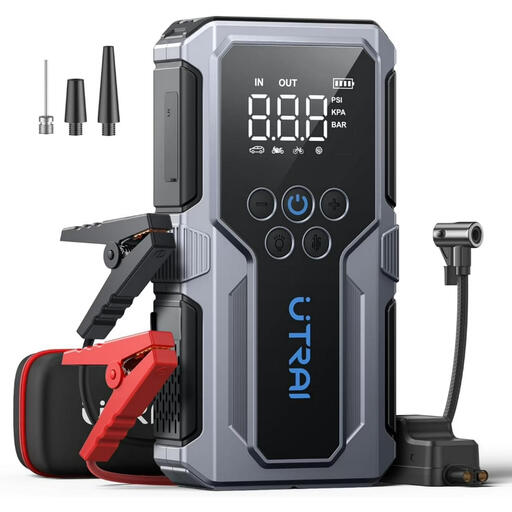
Why it suits this profile: This model combines a 12V car battery booster, compressor and power bank in a relatively compact package for everyday use.
The LCD screen shows the battery level and tyre pressure. The product information also lists 10 safety protections and automatic pump shut-off.
3000A peak current, up to 150 PSI, USB and USB-C charging ports, and three light modes.

Why it suits this profile: Its higher stated peak current, display and choice of pump modes make it a good fit for drivers who want extra control when using it with a car, SUV or boat.
The product specifications list separate limits of up to 9.0 litres for petrol and 8.0 litres for diesel, as well as automatic shut-off at the set tyre pressure.
4500A peak current, 150 PSI, five inflation modes, four adapters and a stated two-year warranty.
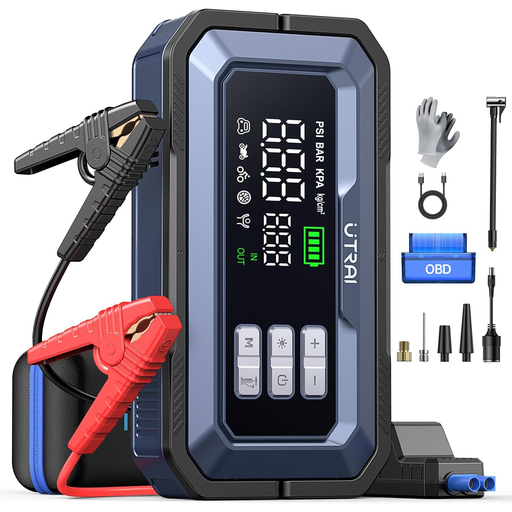
Why it suits this profile: This model is designed for larger vehicles, outdoor use and situations where you also need to power 12V accessories.
The specifications list support for diesel engines up to 14 litres, pump temperature protection and a 160W 12V output.
7000A peak current, 150 PSI, OBD2 adapter, 2000-lumen light, 160W DC output and four pressure units.
We’ve put together a complete, up-to-date list of products that meet these strict selection criteria and comply with the current European safety regulations.
No. Check 12V compatibility, the maximum engine capacity and the separate figures for petrol and diesel. A 24V vehicle or a damaged, frozen or leaking battery will generally be outside the intended use.
That depends on the battery type, charging cycles, storage temperature and maintenance. Product information for various models states that they can manage more than 1000 charging cycles, but this doesn’t guarantee a set lifespan in all conditions. Store the device as directed in the manual and recharge it periodically.
Power use is generally limited, as you only run the compressor for short periods and recharge the device via USB-C or an adapter. Energy use depends on the battery capacity, tyre pressure, outside temperature and how long you use it. A built-in pump is most useful for emergencies; for regular tyre maintenance, a separate compressor may be more efficient.
