
Vandaag of morgen in huis

Kwaliteit gegarandeerd

Welkomstaanbiedingen ontgrendelen: GRATIS bezorging | Tot 80% korting | Gratis 30 dagen JoyPlus-proefperiode
Download de app
A flat car battery or soft tyre rarely comes at a convenient time. A jump starter with compressor combines emergency starting assistance, a tyre inflator and often a power bank for your car in one portable device. It’s handy for car drivers, SUV and van owners, motorcyclists, campervan owners and outdoor enthusiasts.
However, a high amp rating or “150 PSI” doesn’t tell you everything. Read on to find out which specifications matter and what pitfalls to avoid before you buy a car jump starter.
A 3000A jump starter sounds powerful, but its stated peak current doesn’t guarantee that it will start every vehicle. Also check:
A jump starter for a compact car may have different limits from a model designed for an SUV, van, boat or campervan.
A 150 PSI compressor may have a high maximum pressure rating, but its actual inflation speed also depends on airflow, the hose and how long it can be used. For a car tyre, a stable pressure reading and automatic shut-off are often more useful than a high PSI figure alone.
Also check the maximum continuous operating time. Several models have a limit of around 10 minutes, after which the compressor needs to cool down.
A portable jump starter is only useful if it’s charged. Lithium batteries slowly lose charge over time and may perform less well in cold weather or prolonged heat. Check whether the product has a clear charge indicator, and recharge it periodically as instructed in the manual, for example every three to six months.
Choose a 12V jump starter that’s suitable for your vehicle type and engine capacity. Some models, for example, list limits such as petrol engines up to 8.5 or 9.0 litres and diesel engines up to 6.5 or 8.0 litres. These are manufacturer specifications, so always check that they match your vehicle.
Don’t use a car battery booster if the battery is damaged, frozen or leaking. If you’re unsure about the battery or electrical system, it’s safer to seek professional help.
These features are useful in a car tyre inflator:
The recommended tyre pressure is shown on the sticker inside the door frame or fuel flap, or in your vehicle’s handbook. Don’t automatically use the compressor’s maximum pressure as your tyre pressure.
A higher stated capacity can be useful if you want to charge several devices, but the usable capacity may be lower than the marketing figure. For example, the Porbi X11 lists a nominal capacity of 14,800 mAh alongside its 24,800 mAh capacity. So check both figures.
For use on the go, USB-C, fast charging and a built-in light are useful extras. Also check whether the box includes the cables, battery clamps, air hose and storage bag. A light with torch, flashing and SOS modes can be handy if you break down in the dark, but it doesn’t replace a warning triangle or high-visibility vest.
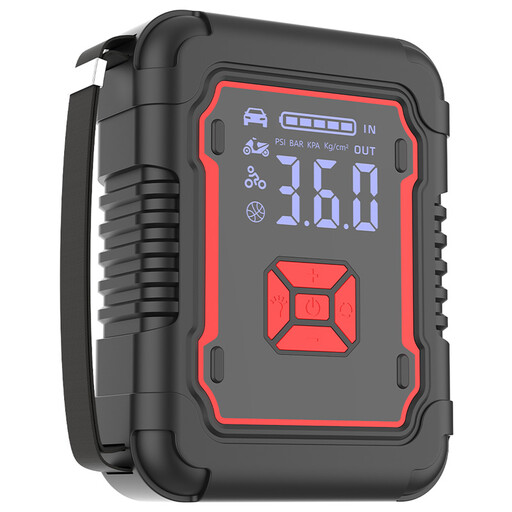
Why it suits this type of user: According to the product information, this compact model combines a 3000A jump-start function, a 150 PSI compressor, a power bank and emergency lighting for 12V petrol and diesel vehicles.
The LCD screen, adjustable pressure and automatic shut-off help you avoid relying on the PSI figure alone.
Stated capacity of 20000 mAh, QC3.0 18W output, 150 PSI compressor and three lighting modes.
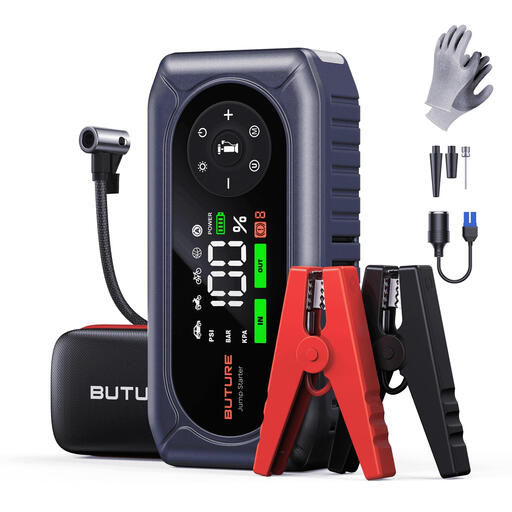
Why it suits this type of user: According to the product description, the BC02 offers extra settings for different vehicles and tyre types, and supports petrol engines up to 9.0 litres and diesel engines up to 8.0 litres.
The specifications list five inflation modes, three pressure units and automatic shut-off, making the compressor settings easier to monitor.
4500A peak current, 150 PSI compressor, four nozzles, LCD screen and a stated two-year warranty period.
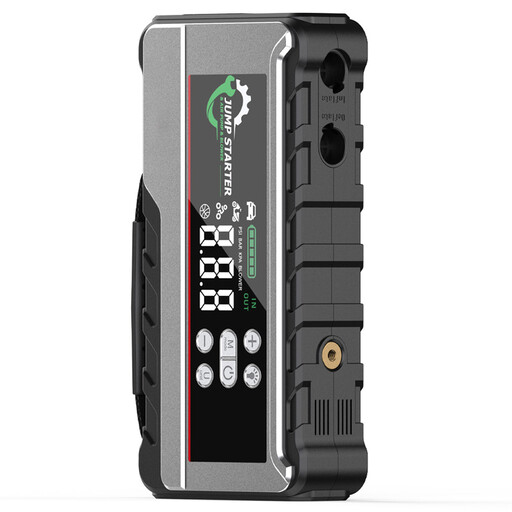
Why it suits this type of user: This model is aimed at drivers and outdoor enthusiasts who want to do more than jump-start vehicles and inflate tyres, such as powering laptops or inflating larger items.
The stated nominal capacity is shown alongside the total capacity. The compressor limit and charging details are also clearly specified.
3000A peak current, 150 PSI, PD65W via USB-C, power bank function and a separate air blower for some inflatables.
We’ve put together a complete, up-to-date list of products that meet these strict selection criteria and current European safety regulations.
Always follow the instructions for your chosen device when jump-starting a vehicle. In practice, this usually means:
A jump starter is not a traditional car battery charger. It usually provides emergency assistance, but it won’t charge a flat battery in the same way or as fully as a suitable battery charger. For long-term maintenance, you may want to consider a separate 12V battery charger.
No. Check the 12V compatibility, engine type and maximum engine capacity in the product information. The condition of the battery also matters. Don’t try to jump-start a damaged, leaking or frozen battery.
Its lifespan depends on charging cycles, storage temperature and maintenance. Keep the device somewhere dry and out of direct sunlight. Recharge it periodically, even when you’re not using it. Follow the manufacturer’s charging and storage instructions.
You’ll usually charge the jump starter beforehand via USB-C, a mains socket or sometimes a 12V socket. The compressor uses the device’s internal battery when inflating. This means the running costs are limited to charging, but the available operating time varies by model and how you use it.
