
Vandaag of morgen in huis

Kwaliteit gegarandeerd

Welkomstaanbiedingen ontgrendelen: GRATIS bezorging | Tot 80% korting | Gratis 30 dagen JoyPlus-proefperiode
Download de app
A flat battery or soft tyre usually happens at the worst possible moment: in a dark car park, on the motorway or just before setting off with the caravan. A jump starter with compressor combines a car jump starter, portable compressor, car power bank and LED emergency light in one device. That is practical, but not every offer tells the full story.
So do not focus solely on a big number such as 6000A or 150 PSI. Usability also depends on vehicle compatibility, battery capacity, controls and how the compressor dissipates heat.
A high peak current sounds appealing, but it does not tell you everything about whether the engine will start successfully. Also check:
A 12V jump starter is not automatically suitable for a lorry with a 24V system. Always check the vehicle and jump starter manuals too. Claims about the number of starts or performance in extreme temperatures come from the brand’s product information and are not a guarantee for every real-world situation.
150 PSI is a maximum pressure rating. For a car tyre, the combination of airflow, hose, connector and operating time is more relevant. A compact 150 PSI tyre inflator may be suitable for small top-ups while you are on the road, but it often needs a break to cool down.
A tyre inflator with automatic stop is convenient: you set the required pressure and, according to the product description, the pump stops when that value is reached. Do check whether the pressure can be set in PSI, bar or kPa, and compare the selected value with the sticker on the door pillar or in your car’s handbook.
A figure such as 20,000 or 24,800 mAh describes the battery capacity, but not how much energy remains available for starting, inflating and charging devices. Also look at:
A portable jump starter that lies unused in the car for months should be checked and recharged regularly. Lithium batteries should not be left in a hot, enclosed car for long periods.
Choose a model that suits your vehicle. For a small city car, a model for petrol engines up to 4.0 litres may be sufficient. For an SUV, van, motorhome or diesel car, it is sensible to have more headroom. Look for an explicit mention of petrol and diesel engines and the maximum engine capacity.
Do not use a jump starter with a damaged, leaking or frozen battery. Connect red to the positive terminal and black to the negative terminal or a suitable earth point, as instructed by the manufacturer. Do not allow the clamps to touch each other.
In addition to maximum pressure, it is useful for a device to have:
Allow a portable compressor to cool down as instructed in the manual. Various models specify a maximum continuous operating time of around ten minutes. A compressor is intended for topping up tyres while you are on the road, not necessarily for prolonged use as a workshop machine.
Look for reverse-polarity protection, short-circuit protection, overload protection and temperature protection. These features reduce the risk of incorrect use, but they do not replace making the correct connections. A forced-start mode should only be used when you are certain that the terminals are connected correctly and the standard mode does not work.
When buying, check whether the product information names a manufacturer or responsible party in the EU, whether a manual is available and what warranty terms apply. A CE mark refers to the manufacturer’s declaration of conformity; it is not a general quality ranking. Safe storage is particularly important for batteries: keep the device out of the reach of children.
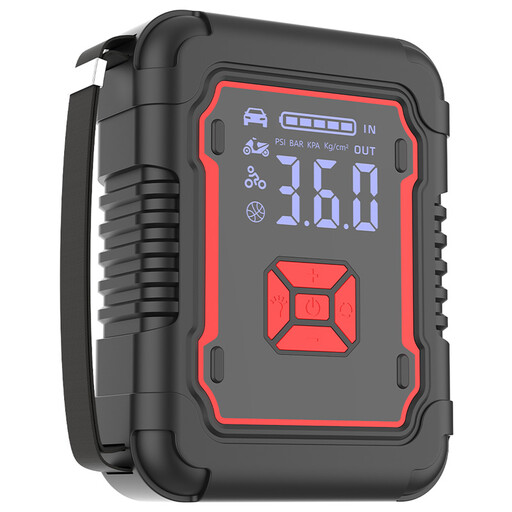
Why it suits this profile: A compact choice for motorists who want to keep a car emergency starter and tyre inflator in the boot for occasional use.
The product information specifies a 150 PSI compressor with automatic stop and a digital pressure display. This means you do not have to rely solely on the maximum pressure rating.
3000A peak current, 20,000mAh battery according to the product information, QC3.0 charging output and three LED modes.
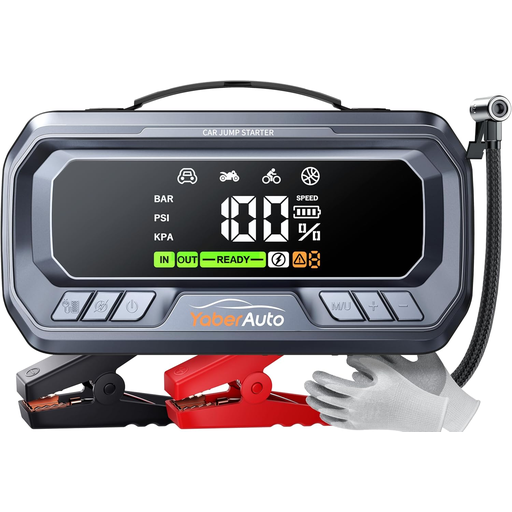
Why it suits this profile: Designed for drivers of SUVs, vans and larger vehicles who also want to charge several devices while travelling.
The specifications state 12V compatibility, automatic pump shut-off and a display showing pressure data. Do check the stated engine limit against your own vehicle.
6500A peak current, 160 PSI compressor, USB-C PD up to 65W and a stated 16,000mAh battery.
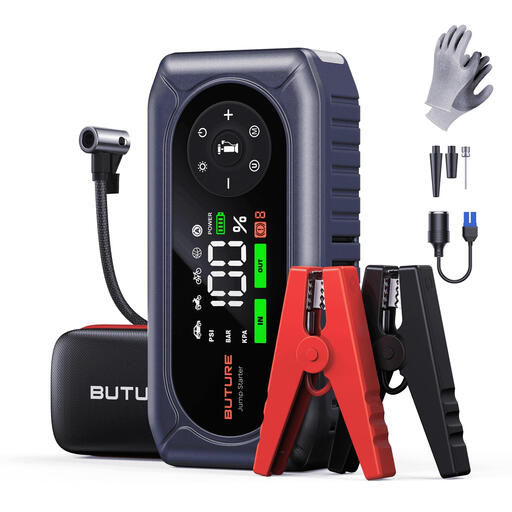
Why it suits this profile: Suited to people travelling by car, SUV, motorbike or boat who want to use multiple pressure settings and accessories.
The listed features include five pressure modes, three pressure units, automatic shut-off and ten protection functions. Do allow the compressor to cool down between uses.
4500A peak current, 150 PSI, LCD screen, four nozzles and stated support for up to 9.0 litres of petrol and 8.0 litres of diesel.
We have put together a complete, up-to-date list of products that fully meet these strict selection criteria and the applicable European safety regulations.
No. Many models are designed for 12V vehicles, but the permitted engine capacity varies. Also check whether your vehicle has a petrol, diesel or hybrid powertrain. A 24V system used in certain lorries and buses requires a different type of device.
That depends on storage, charging habits, temperature and usage. Follow the charging interval in the manual and recharge the device after use. Avoid storing it in a hot car for long periods, as heat can put strain on the lithium battery.
The compressor uses relatively high amounts of energy while inflating, particularly with larger tyres or a significant pressure difference. The total load depends on the inflation time and battery capacity. Use the recommended pressure and allow the pump to cool down when instructed in the manual.
