
Vandaag of morgen in huis

Kwaliteit gegarandeerd

Welkomstaanbiedingen ontgrendelen: GRATIS bezorging | Tot 80% korting | Gratis 30 dagen JoyPlus-proefperiode
Download de app
A flat battery or soft tyre usually happens at the worst possible time: on your way to work, during a road trip or in a dark car park. A jump starter with compressor combines a car jump starter with a portable tyre inflator, power bank and often LED emergency lighting.
However, not every model is suitable for every vehicle. A high amp rating, for example, doesn’t automatically mean a device is right for your engine. So watch out for these common pitfalls.
A 12V car jump starter rated at 3000A, 5500A or even 7000A sounds powerful. But peak current is only one specification. Check whether the manufacturer says the device is suitable for your petrol or diesel engine and its capacity.
A compact portable jump starter for a small petrol engine may not offer enough headroom for a large diesel SUV. Conversely, you could end up paying too much for a heavy-duty model if you only drive a small city car.
A jump starter with air compressor rated to a maximum of 150 PSI may be suitable for various tyres and inflatables. That doesn’t mean you should inflate a car tyre to 150 PSI. Always use the tyre pressure recommended by your car’s manufacturer, usually shown on the door frame, fuel filler flap or in the handbook.
A digital pressure gauge and automatic shut-off are more practical than a high maximum pressure alone.
An emergency jump starter needs to be charged and stored correctly. Some models recommend recharging every few months. Don’t leave the device in a hot, enclosed car for long periods either. Also check whether the kit includes smart jump leads, a suitable air hose, nozzles and a storage bag.
Most products in this category are designed for 12V systems. They’re not suitable for 24V systems found in some heavy goods vehicles and buses. An electric car with a high-voltage battery can’t be jump-started this way either.
Next, compare the stated engine support, for example, petrol engines up to 9,0 litres and diesel engines up to 6,5 litres. These figures come from the product information and aren’t a guarantee for every situation. Don’t attempt to start a damaged, frozen or leaking battery.
Alongside the maximum 150 PSI tyre inflator pressure, airflow and maximum run time are also important. A figure such as 35 litres per minute gives you an idea of the pumping speed. Check whether the compressor needs to cool down between uses too. Some models have a continuous-use limit of around ten minutes.
An automatic shut-off means you don’t have to stay by the tyre the whole time. Support for PSI, BAR and KPA makes the device suitable for different vehicles and uses.
Useful safety features include:
A boost function is for emergencies, not a replacement for a faulty car battery. Fully charge the jump starter before first use, connect red to the positive terminal and black to the negative terminal or a suitable earth point. Always follow the instructions for your chosen model.
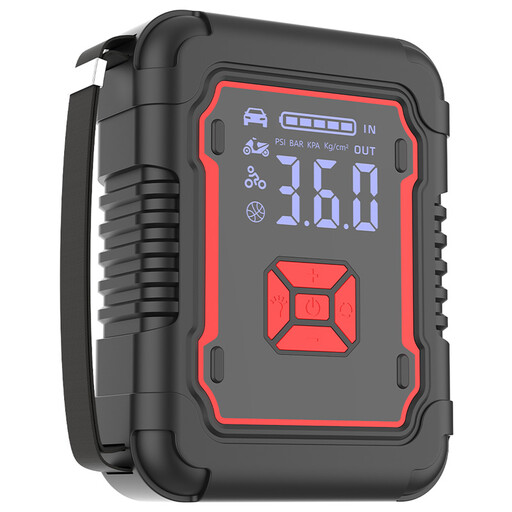
Why it suits this user: A compact kit for motorists looking for a 12V car jump starter with basic features for everyday use, holidays and roadside emergencies.
The product information lists 12V compatibility, a digital pressure gauge and automatic shut-off. Make sure you check your vehicle’s engine capacity before buying.
3000A peak current, 150 PSI compressor, QC3.0 power bank and three LED modes, according to the product specifications.
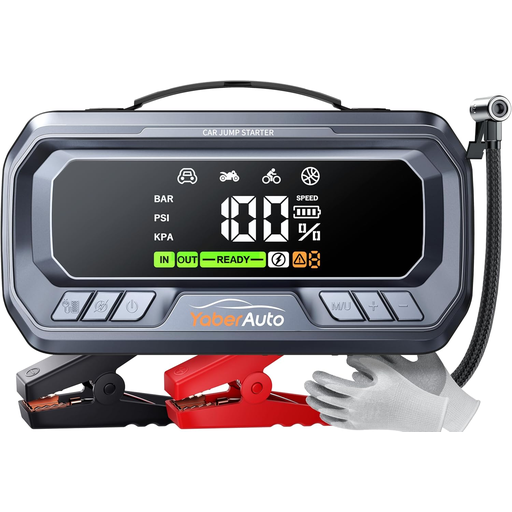
Why it suits this user: Designed for drivers of larger cars, SUVs and vans who also want fast charging for a laptop or phone.
The specifications list a 3,3-inch screen, automatic shut-off when inflating and a 160 PSI compressor. Check that the stated engine support matches your vehicle.
6500A peak current, 65W PD input and output, 160 PSI and a four-mode LED light, according to the product description.
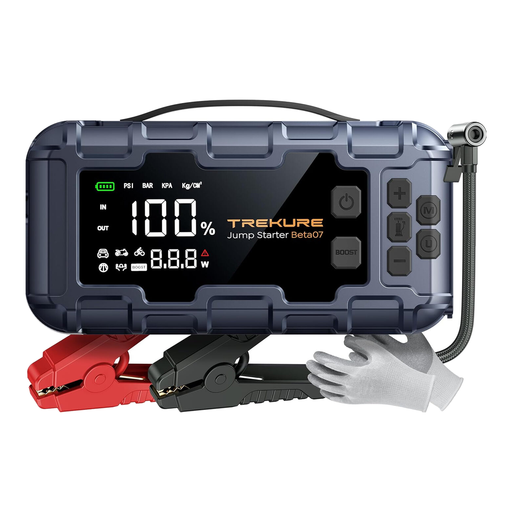
Why it suits this user: A good choice for anyone who wants to combine several functions on the road, such as emergency jump-starting, inflating tyres, charging mobile devices and lighting.
The product information lists a 3,3-inch screen, five pressure modes and ten layers of protection. Don’t run the compressor for longer than the manual allows.
6000A peak current, 160 PSI, 45W USB-C PD and 600-lumen LED lighting, according to the listed product specifications.
We’ve put together a complete, up-to-date list of products that meet these strict selection criteria and the applicable European safety regulations.
Don’t use the device with a damaged or leaking battery. A jump starter can provide temporary help with a flat battery, but it won’t fix a mechanical fault or a worn-out battery.
No. Check that your vehicle has a 12V system and compare the stated engine capacity for petrol and diesel. Models also vary in their support for cars, boats, motorbikes and vans. 24V systems and the high-voltage batteries in electric cars are generally outside the scope of this type of device.
Its lifespan depends on charging cycles, storage temperature and maintenance. Recharge the device after use and check the manual for the recommended maintenance interval. Store it in a dry place and avoid leaving it in a hot car for long periods.
The electricity needed to recharge it is usually minimal. The main costs arise if the lithium battery loses capacity over time or accessories need replacing. A model with automatic shut-off and clear pressure readings helps prevent unnecessary pumping.
