
Vandaag of morgen in huis

Kwaliteit gegarandeerd

Welkomstaanbiedingen ontgrendelen: GRATIS bezorging | Tot 80% korting | Gratis 30 dagen JoyPlus-proefperiode
Download de app
A flat car battery or soft tyre usually strikes at the worst possible moment: before your commute, on the motorway or at a campsite. A jump starter with compressor combines a car jump starter with a portable tyre inflator, helping you prepare for several types of roadside trouble.
However, not every model is right for every vehicle. A high amp rating, 150 PSI on the packaging and a large battery capacity don’t tell the whole story. Read on to find out which specifications matter and what to watch out for when choosing a car battery booster.
A peak current of, say, 3000A, 4500A or 7000A sounds impressive. But this figure alone doesn’t tell you whether a device is suitable for your car. Also check:
A jump starter is designed to help start a car with a flat or weak battery. It won’t replace a faulty battery or solve a problem with the alternator or starter motor.
A 150 PSI tyre inflator can theoretically reach a high pressure, but that doesn’t automatically mean it will inflate a car tyre quickly. For everyday use, airflow, hose length, heat build-up and automatic shut-off also matter.
A digital pressure setting with automatic shut-off makes it easier to set the desired pressure. Always check your vehicle’s recommended tyre pressure. The compressor’s maximum pressure isn’t the pressure you should normally use in a car tyre.
A product might list a capacity of 20,000mAh, for example, while its stated rated capacity is lower. This isn’t unusual, but compare models on the same basis. Also consider:
A portable jump starter left unused in a hot car for months may lose capacity. Store it somewhere dry and check its charge level regularly, following the manual.
Choose a model to suit your vehicle, not simply the one with the highest advertised figure. A different model may be suitable for a compact petrol car than for a diesel SUV, van or campervan.
A jump starter for SUVs and diesel vehicles should be suitable for your engine size according to its product specifications. For example, the BuTure BC02 states that it supports petrol engines up to 9.0 litres and diesel engines up to 8.0 litres. The UTRAI JS-30 states that it supports diesel engines up to 14 litres. This information comes from the respective brands’ product descriptions; before buying, check that your vehicle and battery are actually covered.
A jump starter with air compressor is especially practical when it supports several units, such as PSI, BAR and kPa. An LCD screen makes the set and measured pressure easier to read. Preset modes for cars, motorbikes, bicycles and balls can make it simpler to use.
Check the maximum run time. According to the BuTure BC02 product information, the compressor must not be used continuously for more than ten minutes and must be allowed to cool down afterwards. This matters if you need to inflate several tyres.
Look for features such as:
A CE mark indicates that the responsible party declares the product meets applicable EU requirements. Also check that a clear manual, manufacturer details and warranty information are available. A certification mark doesn’t guarantee that every use scenario will go smoothly.
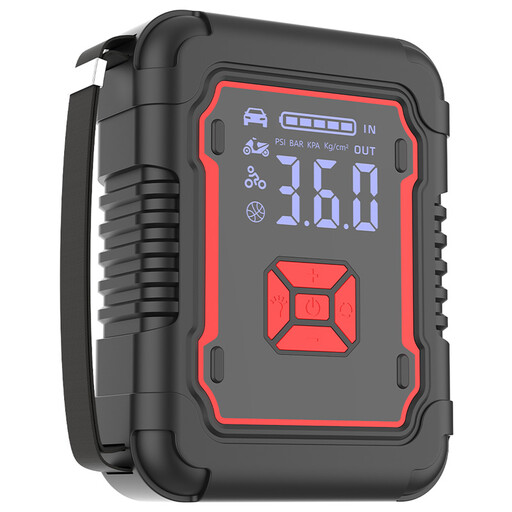
Why it suits this user: The X9 combines a 12V car jump starter, compressor, power bank and LED light in a device weighing around 800 grams. It’s a good fit for drivers and commuters who want to keep a compact roadside emergency kit in the boot.
The product information lists both a peak current of 3000A and support for 12V petrol and diesel vehicles. The compressor has a stated maximum pressure of 150 PSI and automatic shut-off.
Stated battery capacity of 20,000mAh, QC3.0 18W output, three light modes and support for cars, SUVs, vans and motorbikes.

Why it suits this user: This model is aimed at drivers of larger petrol and diesel vehicles who value a clear display, adjustable pressure and several safety features.
The description lists five inflation modes, three pressure units, automatic shut-off and protection against reverse polarity, overload and more.
Peak current of 4500A according to the product specifications, an LCD screen, 150 PSI compressor, 500-lumen light and a stated two-year warranty.
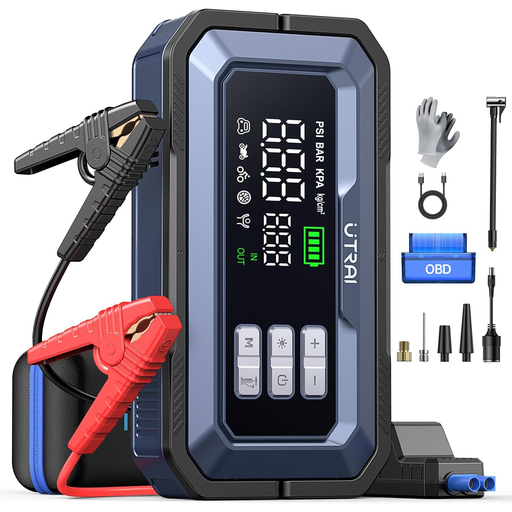
Why it suits this user: This model is designed for people with larger vehicles or higher power needs, such as SUV and van owners or outdoor enthusiasts.
The product information mentions pump temperature monitoring, several layers of protection and a compressor that stops when it reaches the set pressure.
According to the specifications, it offers 7000A peak current, support for diesel engines up to 14 litres, a 160W 12V output, a 150 PSI pump and an OBD2 adapter.
We’ve put together a complete, up-to-date list of products that meet these strict selection criteria and the applicable European safety requirements.
No. A 12V rating means the electrical system runs at 12 volts. The maximum petrol or diesel engine size, the condition of the battery and the vehicle manual all still matter. Check these details before buying.
It depends on the battery type, storage conditions, charging frequency and use. A device stored flat or somewhere warm for a long time may lose capacity more quickly. Charge it according to the manual and check the charge level periodically.
The compressor uses a relatively large amount of energy while inflating. As a result, the remaining battery capacity can drop noticeably after use. Recharge the jump starter after an emergency. The USB power bank function also uses energy, depending on the connected device.
