
Vandaag of morgen in huis

Kwaliteit gegarandeerd

Welkomstaanbiedingen ontgrendelen: GRATIS bezorging | Tot 80% korting | Gratis 30 dagen JoyPlus-proefperiode
Download de app
A flat battery or underinflated tyre always seems to happen at the worst time. A jump starter with compressor combines a car jump starter with a portable tyre inflator, often with a power bank and LED light as well. This makes it useful for commuters, campers, motorcyclists and drivers of SUVs or vans.
However, not every car jump starter is suitable for every vehicle. High amp ratings on the packaging don’t tell the whole story. You should also check vehicle compatibility, battery capacity, safety features and how the air compressor should be used.
A powerful 12V jump starter rated at, for example, 3,000 A, 5,500 A or 7,000 A might sound appealing. However, peak current doesn’t guarantee that the device will start every engine. Check the following in particular:
A 24V lorry, bus or heavy commercial vehicle will usually fall outside this category. You also shouldn’t try to start a damaged, leaking or frozen battery with a car battery booster.
An air compressor rated at 150 PSI may have a high maximum pressure, but that tells you little about how long it will take to inflate a car tyre. Also check the airflow in litres per minute, the maximum operating time and whether it has an automatic shut-off function.
A compressor rated at, for example, 35 l/min is different to use from a model with no airflow figure specified. Make sure you let the pump cool down as instructed in the manual. Continuous pumping for too long can cause heat to build up in the compressor and battery.
A portable battery booster is only useful if it has enough charge. Lithium batteries gradually lose charge during storage. Check the battery level periodically and charge the device in line with the product manual. Don’t store it in a hot, enclosed car for long periods, and keep it away from water, fire and children.
For most cars, motorbikes, SUVs and vans, 12V is the relevant vehicle voltage. Then compare the stated engine capacity limit. One model may, for example, be suitable for petrol engines up to 9.0 litres and diesel engines up to 6.5 litres, while another may specify diesel engines up to 14 litres.
Don’t use a car jump starter outside the stated specifications. Claims about the number of starting attempts, performance in low temperatures and starting a very flat battery come from the brand’s product description and shouldn’t be taken as a universal guarantee.
Look out for these three things:
Always use the tyre pressure recommended for your car, for example on the sticker inside the door frame or in the owner’s manual.
Look for smart jump leads with protection against reverse polarity, short circuits, overheating and overcurrent. According to the product descriptions for various models, several layers of protection are built in, but check which features are actually listed for each product.
A complete kit usually includes:
A CE mark is a manufacturer’s conformity marking for applicable EU rules. Also check the manual, the responsible market operator and the warranty information.
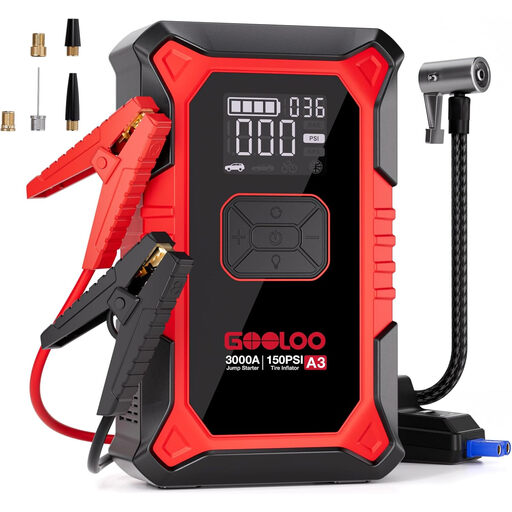
Why it suits this type of user: The product description specifies 3,000 A, support for 12V vehicles and five inflation modes for cars, SUVs, bikes, balls and custom settings.
According to the product information, the display shows tyre pressure and the pump switches off automatically when it reaches the set value. The stated limits are clear: up to 9.0 litres for petrol and 6.5 litres for diesel.
150 PSI, 35 l/min, USB device charging, an LED light and a stated warranty period of 18 months.
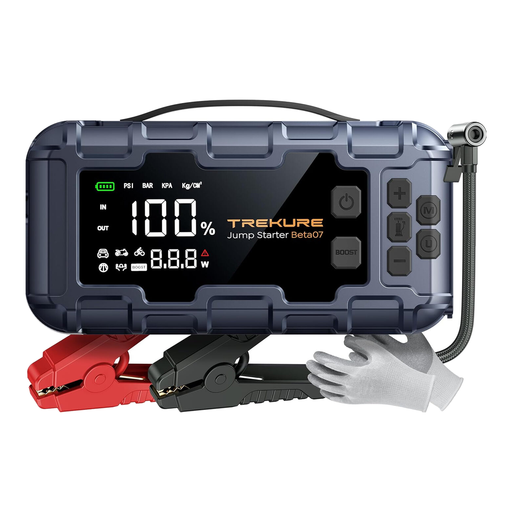
Why it suits this type of user: According to the product description, this model is aimed at drivers of larger 12V petrol or diesel vehicles and has a 3.3-inch display.
The specifications list more than just 6,000 A: they also include a 160 PSI compressor, 45 l/min airflow and five pre-set pressure modes.
45W USB-C PD, two USB-A ports, a 600-lumen LED light and insulated gloves included.
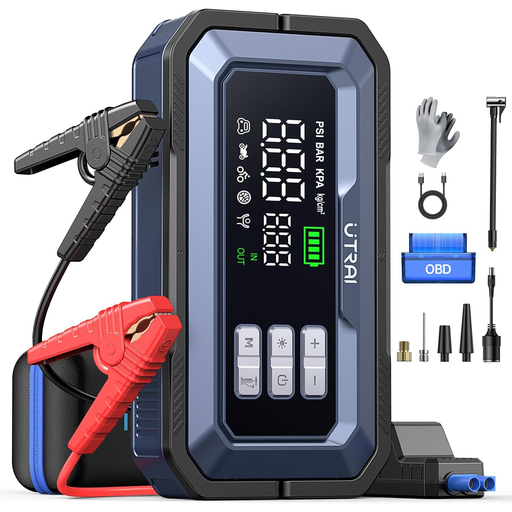
Why it suits this type of user: The combination of a 160W DC output, OBD2 adapter, compressor and lighting makes it well suited to long journeys, camping and vehicles with extra 12V equipment.
The product information lists four pressure units, five inflation modes and temperature protection for the battery and pump. However, check that the stated suitability for diesel engines up to 14 litres is right for your vehicle.
150 PSI, a 2,000-lumen work light, USB-C PD 18W, 160W DC output and an OBD2 diagnostic adapter.
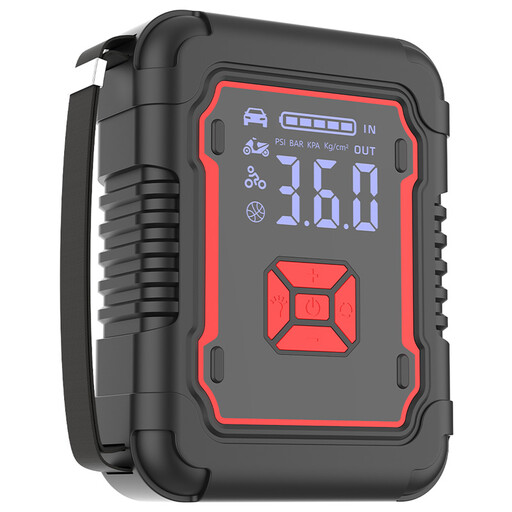
Why it suits this type of user: At a stated weight of around 800 grams and with compact dimensions, this model is easy to store in a boot, rucksack or storage compartment.
The product description lists automatic shut-off, an LCD display and clear limits: 3,000 A for 12V vehicles and a maximum pressure of 150 PSI.
A stated battery capacity of 20,000 mAh, QC3.0 18W, an LED light with three modes and four inflation modes for items other than vehicles.
We’ve put together a complete, up-to-date list of products that meet these strict selection criteria and the applicable European safety regulations.
You can, but avoid prolonged exposure to high temperatures, direct sunlight and damp. A parked car can get much hotter in summer than the recommended storage temperature. Check the charge level regularly and, ideally, keep the jump starter in the supplied bag.
Follow the manual for your chosen model. Many manufacturers recommend charging the device after use and checking it every two to three months while it’s in storage. A low battery level can limit its starting function. Fully charge the jump starter before using it for the first time.
That depends on the leak, tyre size, temperature and stated airflow. A 150 PSI compressor is designed for a range of inflation tasks, but maximum pressure doesn’t guarantee a quick fill. First check the tyre and valve for damage, and let the pump cool down between uses as instructed in the manual.
