
Vandaag of morgen in huis

Kwaliteit gegarandeerd

Welkomstaanbiedingen ontgrendelen: GRATIS bezorging | Tot 80% korting | Gratis 30 dagen JoyPlus-proefperiode
Download de app
A dead battery. It happens to everyone, and always at the worst possible moment. Fortunately, there's the jump starter, a compact device that lets you get your car running again on your own. But the market is flooded with models that promise the world. Many drivers buy a device that doesn't work for their car or pay too much for features they'll never use.
As a Joybuy Product Recommendation Officer, I'm here to help you see through the marketing jargon. Let's look at the three most common pitfalls so you can avoid a bad purchase and choose a reliable car jump starter.
Manufacturers advertise with huge numbers like 4000A, 6000A, or even 8000A. This is the peak amperage, a brief burst of current the booster can theoretically deliver. In practice, the starting power (cranking amps) is far more important. This is the sustained current needed to start your specific engine. A high peak amperage for a small petrol engine is unnecessary and often a marketing gimmick to inflate the price.
The capacity, expressed in milliampere-hours (mAh), seems like a good indicator of power. But this number often refers to the total capacity of the internal battery cells, not the actual output. It says little about how many times you can start a car. A power bank jump starter with a lower but more efficient battery may perform better in practice than a model with an inflated mAh rating.
A jump starter with an air compressor, OBD2 scanner, and disco lights sounds impressive. But every extra feature can mean a compromise on the core function: starting your car. Ask yourself if you really need those extras. A built-in compressor is handy for RV owners, but for the daily city driver, it's often unnecessary weight and extra cost.
Focus on the specifications that truly matter. Check these three points before making a choice.
The most important question: is the battery booster suitable for your engine?
A good emergency car starter protects both you and your vehicle. Look for built-in protections such as:
Modern jump starters often have a smart cable with indicator lights or a display that shows whether the connection is secure.
Think about how you will use the jump starter.
Below are a few models that suit different user profiles, selected based on their specifications and functionality.
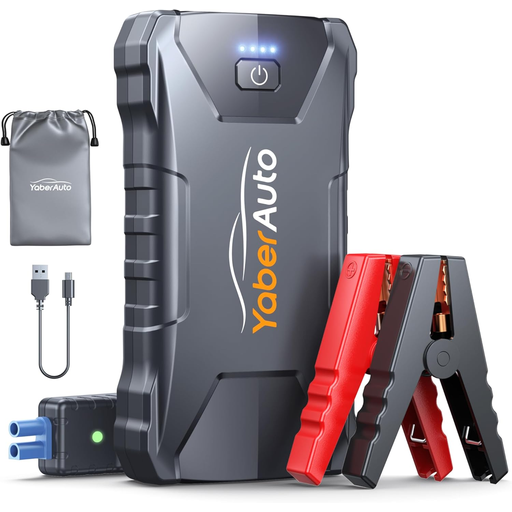
Why This Fits Their Persona: Perfect for those with a compact to mid-size car (petrol or diesel) who need a reliable, small emergency starter. It fits easily in the glove compartment and is ideal for anyone who wants to be prepared without the hassle.
This model focuses on what really counts: sufficient starting power (up to 7.0L petrol/5.5L diesel) for most cars in the UK, without making you pay for an exaggerated peak amperage.
Extremely compact and lightweight (0.340 kg), making it easy to store. Includes all essential safety features and a bright LED flashlight.
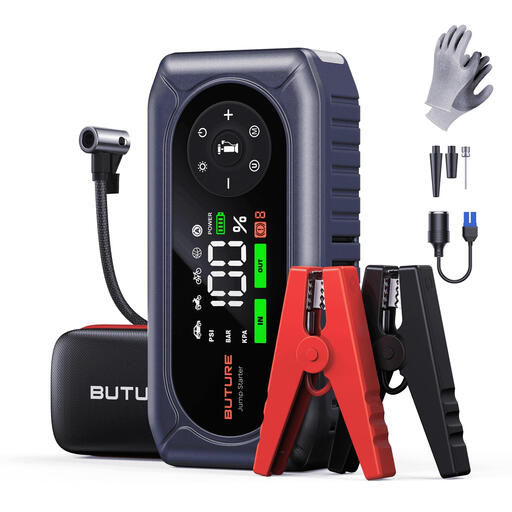
Why This Fits Their Persona: Ideal for owners of an SUV, camper, or van, or for those who like to be fully prepared on their travels. The combination of a powerful starter and a compressor makes this a versatile tool for the road.
Instead of being a superfluous gimmick, the built-in compressor is a practical feature that adds real value. The specifications are clearly focused on performance (up to 9.0L petrol/8.0L diesel and 150 PSI).
5-in-1 functionality with a digital compressor that automatically stops at the preset pressure. The clear LCD screen shows all important information at a glance.
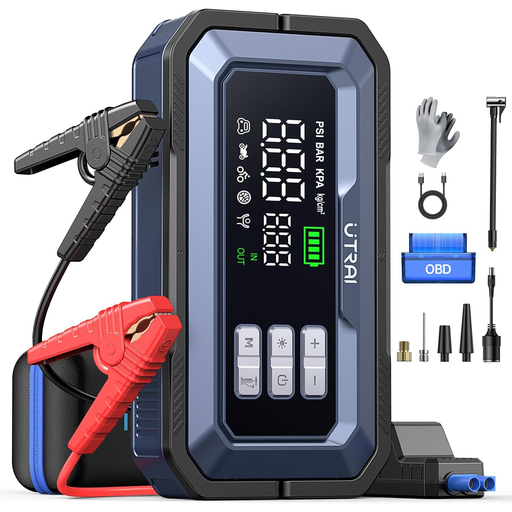
Why This Fits Their Persona: Designed for heavy-duty jobs. Think large diesel vehicles (up to 14L), boats, agricultural vehicles, or for professional use. This model delivers the power and reliability needed in demanding situations.
Here, the high peak amperage (7000A) is functional and tailored to the target audience. The extra features, like the 160W DC output and OBD2 reader, are relevant for the professional user and not just empty extras.
Extremely powerful, suitable for diesel engines up to 14L. The 160W DC output (cigarette lighter) can power 12V devices like coolers or vacuum cleaners.
We have compiled a complete, up-to-date list of products that fully meet these strict selection criteria and UK safety regulations.
Most manufacturers recommend charging the jump starter every 2 to 3 months, even if you don't use it. This helps keep the battery in good condition and ensures it's ready for use when you need it.
Not necessarily. It's more important that the booster's starting power matches your vehicle's engine. An extremely high peak amperage offers no extra benefit for a standard passenger car and can unnecessarily increase the price. Always check the recommended engine size (in litres) in the specifications.
Modern jump starters are designed to operate within a wide temperature range, for example, from -20°C to 60°C. However, it's wise to check the manufacturer's specifications. Prolonged exposure to extreme heat (like in a car in direct sunlight) or freezing cold can affect the long-term lifespan of the internal battery.
