
Vandaag of morgen in huis

Kwaliteit gegarandeerd

Welkomstaanbiedingen ontgrendelen: GRATIS bezorging | Tot 80% korting | Gratis 30 dagen JoyPlus-proefperiode
Download de app
A dead battery always happens unexpectedly and at the worst possible time. Whether you're in a hurry for work or stranded in a deserted car park in the middle of the night, waiting for roadside assistance is rarely a pleasant experience. A jump starter, also known as a booster pack or battery booster, is a compact and powerful solution that gets you back on the road in minutes. You're no longer dependent on another vehicle or a breakdown service.
This article is intended as a practical guide. We'll explain what to look for when making a purchase and highlight several popular choices, helping you find a model that suits your car and your needs.
The specifications of a car jump starter can be overwhelming. To help you out, we've listed the most important factors to consider.
The most crucial specification is the peak current, measured in Amps (A). This number indicates how much power the jump starter can deliver to start an engine. A larger engine, especially a diesel one, requires a higher peak current than a small gasoline engine.
Always check the manufacturer's specifications to see which engine displacement (in liters) the jump starter is suitable for.
Modern jump starters are often more than just a starting aid. Many models also function as a power bank, allowing you to charge your phone, tablet, or laptop on the go via USB ports. Some advanced models are even a jump starter with an air compressor, ideal for inflating a low tire. Other handy extras include a built-in LED flashlight with an SOS mode, which is useful during a breakdown in the dark.
Jump-starting a car with a dead battery must be safe. Good jump starters are equipped with multiple safety protections. Look for features like protection against short circuits, reverse polarity (connecting the clamps incorrectly), overheating, and overcharging. Smart jumper cables with indicator lights or a display can warn you if something is not connected correctly, making the process much simpler and safer.
Based on specifications and features, we have selected models that offer a great solution for various situations.

Why it stands out: This is a true all-in-one device. With an impressive peak current of 8000A, it's suitable for virtually all gasoline and large diesel engines (up to 10.0L). The built-in 150 PSI air compressor makes this device a complete roadside emergency kit.
Pros:
Who is it for? For the driver who wants to be prepared for anything. Ideal for owners of large cars, RVs, boats, or for those who often go on adventures and need a multifunctional device.
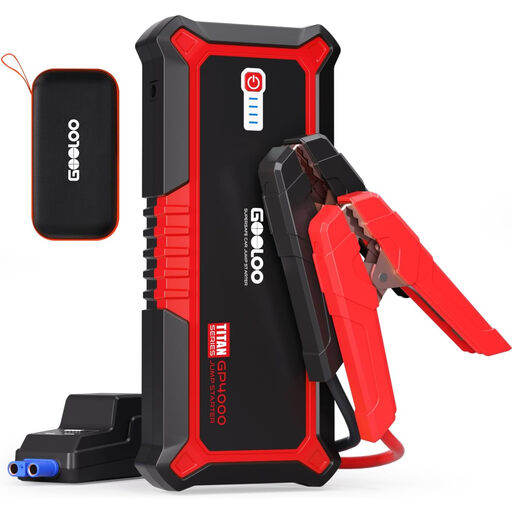
Why it stands out: The GOOLOO GP4000 combines a very high peak current of 4000A with a robust and reliable design. It's powerful enough for all gasoline engines and diesel engines up to 10.0L. The "BOOST" button is a handy feature for reviving even deeply discharged batteries.
Pros:
Who is it for? Perfect for drivers of heavy-duty vehicles, such as pickup trucks, vans, and large SUVs, who need a reliable and powerful battery booster that performs even under tough conditions.
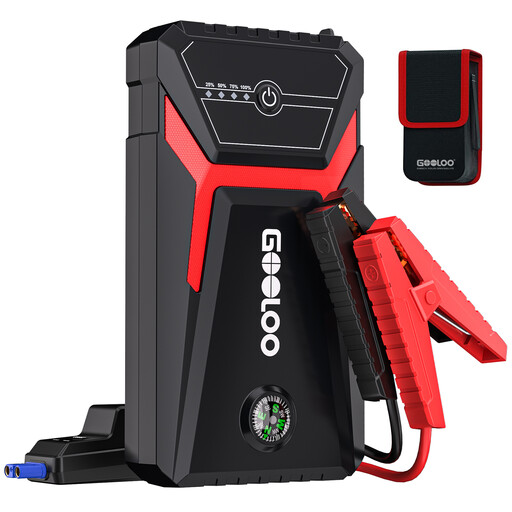
Why it stands out: The GE1500 is a compact and affordable jump starter that still delivers enough power for most passenger cars. With a peak current of 1500A, it's suitable for gasoline engines up to 6.0L and diesel engines up to 4.0L. Its light weight and small size make it easy to store in the glove compartment.
Pros:
Who is it for? The ideal choice for the daily commuter with a standard gasoline or light diesel car. A reliable and compact solution for emergencies, without unnecessary bells and whistles.
These three models offer a good overview of what's on the market, but perhaps you're looking for something slightly different. Every vehicle and every driver has unique needs.
For a broader overview of jump starters and traditional jumper cables, you can browse our full range.
? See all our Jumper Cables and Jump Starters here
Using one is simpler than it looks and safer than traditional jumper cables. Follow these steps:
Even when not in use, a jump starter slowly loses its charge. It is recommended to fully charge the jump starter every 2 to 3 months. This ensures it's ready for use when you need it. Always fully recharge it after use as well.
No, compatibility depends on the engine. A jump starter designed for a small gasoline engine won't have enough power to start a heavy-duty diesel engine. Always check that the peak current (Amps) and the recommended engine displacement (liters) of the jump starter match your vehicle.
