
Vandaag of morgen in huis

Kwaliteit gegarandeerd

Welkomstaanbiedingen ontgrendelen: GRATIS bezorging | Tot 80% korting | Gratis 30 dagen JoyPlus-proefperiode
Download de app
A flat car battery or soft tyre usually strikes at the worst possible time. Especially on a long drive, at a campsite or when you need to get to work early. A jump starter with an air compressor combines a portable car battery booster with a tyre inflator, but there are big differences between models.
Look out for these three common pitfalls:
A 12V jump starter is designed for cars, vans and other vehicles with a 12V system. You should also consider the engine type. Diesel engines often need more power to start than petrol engines, especially in low temperatures.
A figure such as 6000A car jump starter usually describes the peak output. Don’t use it as your only buying criterion. Also check:
According to the product description, the TREKURE Beta07 is designed for 12V petrol and diesel vehicles with engine capacities of up to 12 litres, with peak current of up to 6000A. This is a manufacturer’s claim, not a guarantee that it will start every vehicle in every situation.
A 160 PSI portable compressor may also be suitable for bicycle tyres, balls and other inflatables. For car tyres, however, these are the most relevant points:
According to the product information, the Beta07’s compressor can inflate a tyre from 25 to 36 PSI in around three minutes. Treat this as an indicative figure: temperature, tyre size and the starting pressure all affect the actual time.
Always use the tyre pressure recommended for your vehicle. You’ll usually find it on a sticker inside the door frame, on the inside of the fuel filler flap or in the handbook. The maximum pressure shown on the tyre sidewall is not automatically the right pressure for everyday driving.
A jump starter only works if its internal battery has enough charge. Charge the device at home and check the battery level before you set off. A car power bank is particularly handy if you need to charge your phone or sat nav on the way.
Useful features include:
According to the product description, TREKURE lists ten layers of protection and a 600-lumen lamp with four modes for the Beta07. Always check the handbook before use, connect the clamps in the correct order and don’t let them touch each other. The supplied gloves are an accessory; they don’t replace safe working practices or roadside assistance if the situation is unsafe.
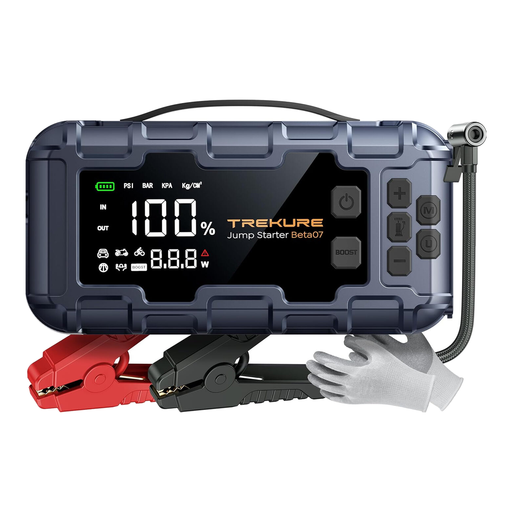
Why it suits this profile: This combination of jump starter, compressor and power bank is a good choice for drivers who want to carry one device for several roadside emergencies.
The specifications list more than just 6000A peak current: they also include 45 l/min airflow, a 3.3-inch display and five pressure modes. This lets you check the key features before you buy.
12V support, compressor up to 160 PSI according to the product description, 45W USB-C and two USB-A ports.

Why it suits this profile: This isn’t a jump starter, but it’s a useful additional option for drivers who carry out their own car or motorbike maintenance and minor repairs.
Its purpose is clear: a 12V ratchet with 45 Nm of torque and a 3/8-inch drive. So don’t expect it to work as a battery booster or compressor.
Compact 3 cm head, LED light and a stated weight of 0.78 kg.

Why it suits this profile: For campers and travellers, this is an addition to a portable car battery booster, not a replacement for one. It’s designed to keep things chilled while you’re on the move.
Its purpose and power requirements are clearly distinct from those of a jump starter: this device runs on 12/24V DC or 100–240V AC and is designed as a cool box.
40-litre capacity, temperature range of -20 to 20 °C according to the product description, and three battery protection levels.
We’ve put together a complete, up-to-date list of products that meet these strict selection criteria and current European safety regulations.
Don’t leave a jump starter in a hot car permanently. High temperatures can cause its internal battery to age more quickly. Check the charge level regularly, especially before a holiday or a long winter drive. Clean the clamps after use and store the cables somewhere dry.
A jump starter with an air compressor is designed to help in a breakdown. Don’t try to start the engine if the cables are damaged, the battery is leaking or you can smell burning. If in doubt, calling for professional roadside assistance is the safest option.
You can if the device is rated for both and the vehicles have a suitable 12V system. Check the vehicle limits, particularly the engine capacity and diesel engine type. A model’s 6000A figure is a peak value, not a universal guarantee.
Its lifespan depends on storage temperature, charging habits and how often it’s used. Charge the battery according to the handbook, avoid storing it at 0% for long periods and check the device regularly. The compressor may also be put under more strain than the starting function, depending on tyre size and use.
The inflator uses the jump starter’s internal battery. How much energy it needs depends on the tyre pressure, tyre volume and ambient temperature. Only inflate when needed, then recharge the device. This helps you keep enough charge in reserve in case you need to start a vehicle.
