
Vandaag of morgen in huis

Kwaliteit gegarandeerd

Welkomstaanbiedingen ontgrendelen: GRATIS bezorging | Tot 80% korting | Gratis 30 dagen JoyPlus-proefperiode
Download de app
A dead battery or a flat tyre always happens unexpectedly. A jump starter with an air compressor seems like the perfect all-in-one solution. But the market is flooded with models that promise more than they can deliver. Many car owners only discover their purchase is useless when they need it most. Before you invest in such a car emergency kit, it's crucial to recognise the common pitfalls.
Many devices fail due to three specific problems:
portable car tyre inflator that takes half an hour to slightly inflate one tyre and then overheats is not a tool but a frustration.To avoid a bad purchase, focus on a few verifiable specifications rather than marketing claims. These determine whether a 12v multi-function jump starter is worth its price.
Look beyond the peak current and search for the starting current (also called 'cranking amps'). This is the power the device can deliver for several seconds. For most petrol engines up to 2.0 litres, a starting current of 300-400A is sufficient. For larger petrol engines or diesels, you'll quickly need 500A or more.
The battery technology is just as important. Traditional lithium-ion batteries can be sensitive to temperature and have a higher self-discharge rate. Newer technologies, such as sodium-ion, offer more stable performance in extreme temperatures (-40°C to 80°C) and have a significantly lower self-discharge rate, allowing them to remain reliable in your car for months.
A good jump starter with tyre inflator should be more than a gadget. Check two values:
Not everyone has the same needs. We've highlighted a few popular choices that suit different situations and requirements.
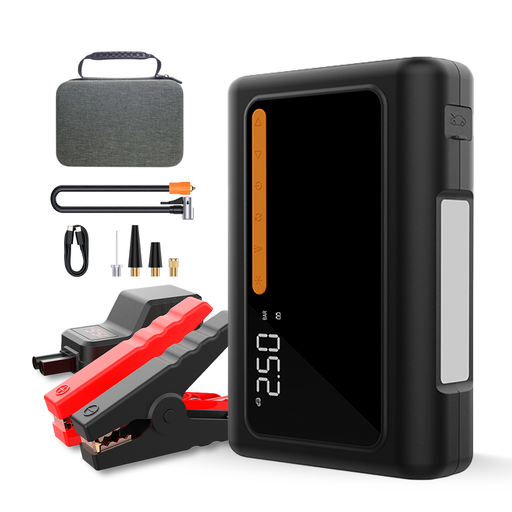
Why This Fits Their Persona: Ideal for those who want a single, reliable device in their car for both starting issues and tyre emergencies. This user values convenience and peace of mind, without worrying about constantly recharging the unit.
The sodium-ion battery has a very low self-discharge rate (~1% per month) and operates from -40°C to 80°C. This tackles the pitfall of a dead or non-functional jump starter at its root.
Combines a jump starter with a compressor in one robust device. The battery technology is designed for long-term reliability without constant maintenance.

Why This Fits Their Persona: For the driver of a larger car, diesel vehicle, or RV who demands maximum starting power and prefers specialised tools. This person may already own a separate compressor and is now looking for a powerful, reliable `power bank with jumper cables`.
This device sidesteps the weak compressor pitfall by not having one. It focuses entirely on delivering very high starting power (3000A peak), suitable for engines up to 8.0L petrol or 6.0L diesel.
Specialises in pure starting power. The 65W fast-charging feature ensures the jump starter itself is quickly ready for use again. The clear LED display shows its status.
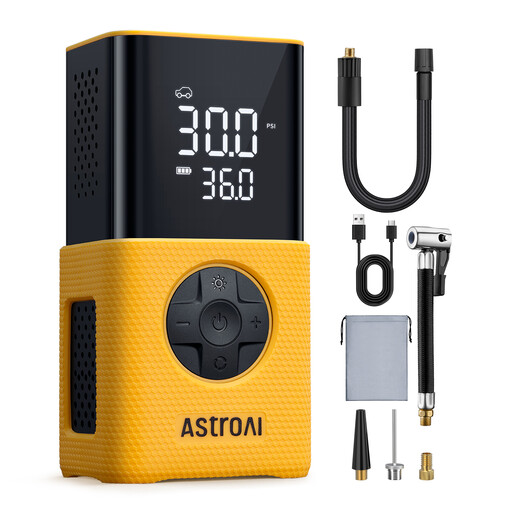
Why This Fits Their Persona: Perfect for the car owner who primarily needs a fast, accurate, and compact tyre inflator for regular maintenance. Starting issues are less of a concern, but correct tyre pressure is paramount.
This model focuses on one job and does it well. It avoids the pitfall of a slow, inaccurate compressor. According to AstroAI, its inflation speed is 2x faster than average, and its "TrueGauge" technology ensures precise measurements.
Very compact and portable. The auto-stop feature and the bright dual display make it very easy to use. It also functions as a power bank and has a built-in LED light.
In addition to functional emergency tools, personalising your car can also enhance your driving pleasure and visibility.
We have compiled a complete, real-time list of products that fully satisfy these strict selection criteria and UK safety regulations.
This depends heavily on the battery technology. A traditional lithium-ion jump starter with compressor is best checked and topped up every 3 to 6 months. Models with a sodium-ion battery, like the GOKKCL GK01, have a much lower self-discharge rate and, according to the manufacturer, often only need to be charged once a year or even less to stay ready.
Yes, the better models are certainly capable of this. It might take a bit longer than at a petrol station, but a device with a maximum pressure of 150 PSI and a reasonable airflow can easily take a standard SUV tyre from 30 to 36 PSI. The auto-stop feature is especially useful here, so you don't have to constantly monitor the pressure.
Always check the device's operational temperature range. Standard lithium-ion batteries can lose their capacity and power in freezing temperatures. If you plan to keep the jump starter in your car permanently, a model specifically designed for extreme temperatures (e.g., -20°C or lower) is a wise choice. Sodium-ion batteries generally perform better in this regard.
