What should you look for when choosing?
First, decide which ingredients you want to juice for your guests. Then compare how the appliance collects juice and how easy it is to clean: the feed chute, juice jug and pulp container each serve a different purpose.
| What to consider |
What to look for when buying |
Who is this important to? |
| Ingredients |
Choose a citrus juicer for citrus fruit; consider a centrifugal juicer or slow juicer if you also want to juice other fruit or leafy greens. Check which ingredients the specific model can handle. |
If I mainly serve oranges, I want an appliance suited to citrus; other ingredients change the choice. Around 37% of consumers say citrus is their main reason for buying a juicer. |
| Time for several glasses |
Compare the feed chute, juice jug capacity and pulp container separately. A wider feed chute or larger container does not, by itself, tell you how much juice the appliance will produce. |
If I’m making juice for several guests, I want to minimise chopping and interruptions. Around 36% of consumers prioritise preparing several glasses. |
| Variety of ingredients and cleaning |
Check that the model is suitable for the ingredients you want to use and find out which parts need cleaning. Bear in mind that a slow juicer may require extra preparation and cleaning. |
If I also want to juice leafy greens, I weigh up that variety against the extra work. Around 27% of consumers say their main need is a juicer for mixed ingredients, including leafy greens. |
Joybuy products
These Joybuy products are suited to juicing citrus or making juice from a range of ingredients.
 No image available
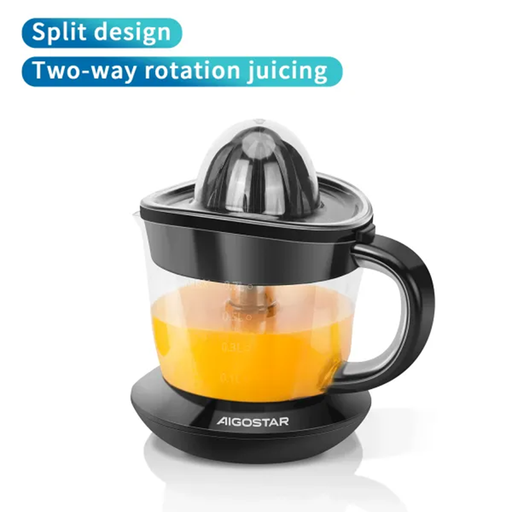
Aigostar citrus juicer 40 W, 0.7 l, black, two-way rotation
Ideal for breakfast with guests who enjoy citrus juice, with juice collected by the glass or in a container.
The product information lists a 700 ml capacity, two juicing cones and an adjustable filter.
According to the product description, this citrus juicer is designed for citrus fruit, not harder fruit.
View at Joybuy
 No image available
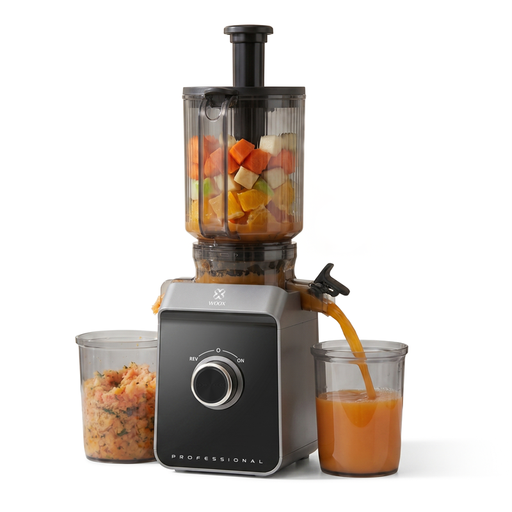
WOOX MX0289 slow juicer, 150 W, 600 ml juice jug
Suited to anyone who wants to juice fruit and vegetables, using the juice jug and pulp container while preparing juice.
The product information lists a juice jug with a maximum fill mark at 600 ml, an 836 ml pulp container and a Ø130 mm feed chute.
According to the instructions, continuous use is limited to 10 minutes, followed by a 20-minute rest. Cut fibrous vegetables into 3–4 cm pieces; frozen fruit and ice cubes are not suitable.
View at Joybuy
Frequently asked questions
Which juicer is right if my guests want different kinds of juice?
Start with the ingredients: a citrus juicer is suitable for citrus alone; for quickly making juice from ingredients such as hard fruit and vegetables, consider a centrifugal juicer; and for leafy greens, a slow juicer is an option. The Consumentenbond describes these differences in use; then compare the preparation and cleaning required for the specific model.
How do I compare the capacity of a juicer?
Look at the feed chute, juice jug and pulp container separately. The feed chute indicates how many ingredients will fit, not how much juice you’ll collect; likewise, the continuous juicing amount listed for the Braun SJ7000GY is not the capacity of a juice jug.
How can I cut down on cleaning after breakfast?
For each model, check which parts can be removed and are listed as dishwasher-safe in the manual. Bosch lists dishwasher-safe parts for the MES3500, and Princess does so for the 202040; this does not automatically apply to every part or other models.
Can I make fresh orange juice in advance?
The Voedingscentrum recommends keeping fresh orange juice in the fridge for 1–2 days. You can decide whether to make it fresh for your guests or keep it chilled; this advice does not automatically apply to every mixed juice.
Does a slow juicer make demonstrably healthier juice?
Not as a general rule. The Consumentenbond reports no higher levels of the vitamins and minerals mentioned in juice from slow juicers than in juice from centrifugal juicers. The Voedingscentrum recommends eating vegetables and fruit rather than drinking them.


