
Daily juicer with limited worktop space
You want to check in advance whether the appliance will fit on your worktop and can be put away after use. Hurom Europe and Bosch Netherlands publish the dimensions of specific slow juicers.


A citrus press is all you need for citrus fruit. For juice made mainly from hard fruit and vegetables, a centrifugal juicer is a good fit, while a slow juicer is an option if you also want to juice leafy greens. Then choose based on the space you have and how much cleaning each model involves: a slow juicer doesn’t automatically produce more juice or vitamins, according to the Dutch Consumers’ Association.
You want to check in advance whether the appliance will fit on your worktop and can be put away after use. Hurom Europe and Bosch Netherlands publish the dimensions of specific slow juicers.
You mainly juice oranges for breakfast and want to keep preparation and washing up simple. Braun Household Netherlands and Philips describe citrus presses for this kind of use.
You want to juice leafy greens or other ingredients too, and take the extra preparation time and cleaning into account when choosing. The Dutch Consumers’ Association discusses the differences between centrifugal and slow juicers.
A good fit if: you mainly juice oranges, lemons or other citrus fruit.
Bear in mind: this press isn’t designed to replace a juicer for apples or leafy greens.
A good fit if: you mainly want to make juice from hard fruit and vegetables on busy mornings.
Bear in mind: a centrifugal juicer is generally less suitable for soft ingredients and leafy greens; the Dutch Consumers’ Association also highlights noise as something to consider.
A good fit if: you regularly want to juice a variety of ingredients, including leafy greens.
Bear in mind: processing usually takes longer than with a centrifugal juicer. According to the Dutch Consumers’ Association, this type of juicer doesn’t automatically produce more juice.
| What to consider | What should you check? | Who is this important for? |
|---|---|---|
| Space and storage | Measure the space, cupboard height and room needed for filling, pouring and removing detachable parts. Hurom Europe lists the H310A as measuring 16 × 17,2 × 39,5 cm; Bosch Netherlands gives the MESM731M dimensions as 427 × 152 × 152 mm. | If I have limited worktop space, I also want room to fill the appliance and remove its parts. Around 36% of consumers put where to place and store the appliance first. |
| Cleaning | Check which parts detach on each model and which the manual says are dishwasher-safe. Hurom lists three parts to wash for the H310A; Bosch says the MESM731M has dishwasher-safe parts. | After breakfast on a weekday, I want to take apart and wash as few components as possible. Around 36% of consumers give ease of cleaning top priority. |
| Ingredients | Check that the model is suitable for the ingredients you usually juice. A citrus press is designed for citrus fruit; for other ingredients, check the guidance for the specific model. The Dutch Consumers’ Association discusses, among other things, using slow juicers for leafy greens. | If I want to juice other fruit, vegetables or leafy greens as well as citrus, the appliance needs to suit those ingredients. Around 28% of consumers choose ingredients as their main criterion. |
The external dimensions don’t necessarily tell you how much room you’ll need to add ingredients, put a glass underneath or remove parts.
Measure the space, including clearance above and around the appliance. Remember to allow room for the jug or glass too.
The Dutch Consumers’ Association says that a slow juicer doesn’t necessarily produce more juice than a centrifugal juicer. So the type of juicer alone doesn’t guarantee better nutrient retention or a higher yield.
Choose based on the ingredients you want to juice, and compare the steps involved in using and cleaning the exact model.
Philips describes the HR2738/00 as a 25 W citrus press, while a Joybuy product title lists the same model number as an 800 W centrifugal juicer.
If in doubt, check the full model number, appliance type and specifications against the manufacturer’s product information.
The CitrusQuick range is worth considering if you mainly juice citrus fruit; the CJ3000WH is a specific model in the range.
Philips makes both citrus presses and centrifugal juicers, so check the model number and appliance type.
The VitaExtract MESM731M is a slow juicer for which Bosch publishes specific appliance dimensions.
The H310A is a slim slow juicer for anyone weighing up available space and cleaning requirements for each model.
This selection includes citrus presses for citrus fruit and a slow juicer for making fruit and vegetable juice.
 No image available
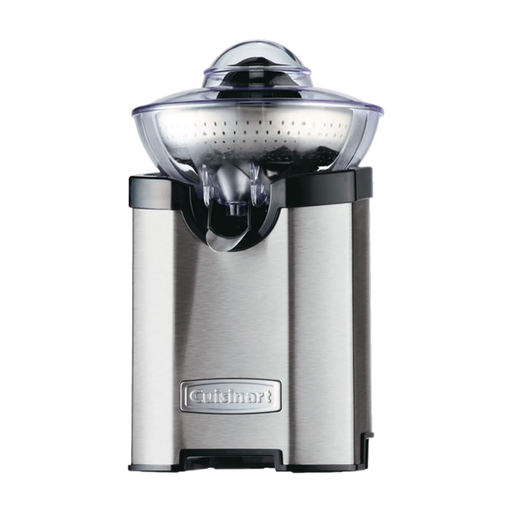
An option for citrus fruit if you want to pour the juice straight into a glass.
100 W; stated dimensions 17 × 17 × 29 cm. The product description lists a drip-stop spout and detachable dishwasher-safe parts.
 No image available
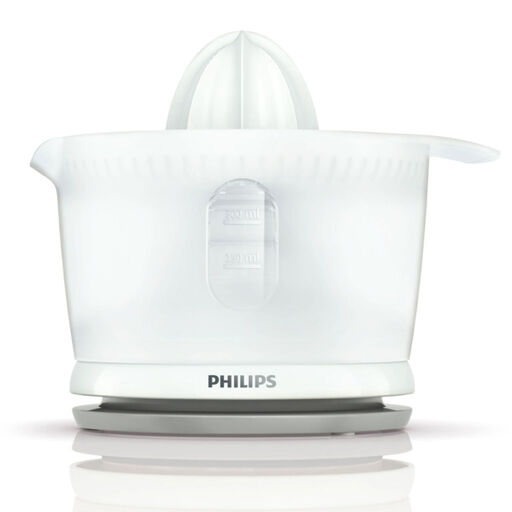
A citrus press with a collection jug for anyone who wants to collect the juice before pouring it.
500 ml jug, 25 W and stated dimensions of 14,5 × 19,7 × 16,4 cm. The product description lists detachable dishwasher-safe parts.
 No image available
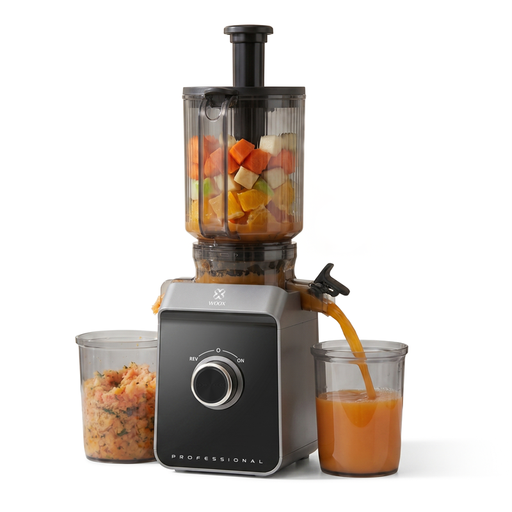
A slow juicer for anyone who wants to make fruit and vegetable juice and check the available space in advance.
150 W; 600 ml juice cup, 836 ml pulp container and stated dimensions of 189 × 170 × 395 mm. The instructions say to defrost frozen ingredients before use.
 No image available
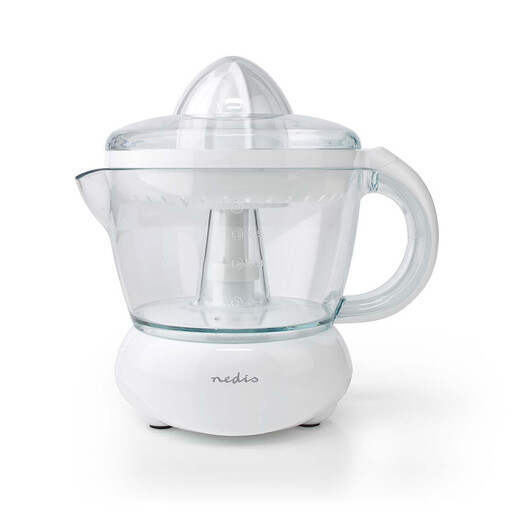
A citrus press for oranges, lemons and grapefruits.
Stated dimensions of 15 × 20 × 19 cm. The product description lists a detachable measuring jug and automatic rotation in two directions.
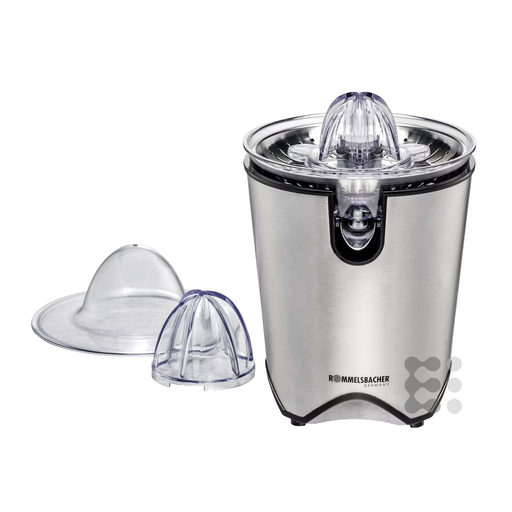 No image available
A citrus press for oranges, lemons, limes and grapefruits.
The product description lists an automatic on/off function, a drip-stop spout and detachable dishwasher-safe parts.
No, that isn’t guaranteed by the type of juicer. The Dutch Consumers’ Association says that a slow juicer doesn’t necessarily produce more juice than a centrifugal juicer; the yield depends on the appliance. The Netherlands Nutrition Centre recommends eating vegetables and fruit rather than drinking them: juice isn’t a substitute for whole fruit.
Wash fruit and vegetables under running water, even if you’re going to peel them afterwards, as recommended by the Netherlands Nutrition Centre. Follow the manual for the specific model when cleaning it: a note that some parts are dishwasher-safe doesn’t mean that the motor unit or every part can go in the dishwasher.
The Dutch government says there is no fixed statutory period for the legal guarantee in the Netherlands. What you can reasonably expect from a product is taken into account; if a product doesn’t meet those expectations, contact the seller.
Check the product information and usage restrictions for the exact version. The Netherlands Food and Consumer Product Safety Authority outlines CE requirements for certain electrical consumer products and points out that manufacturers and importers are responsible for safe materials that come into contact with food. A brand name or CE marking alone doesn’t confirm every feature of a specific version.