If you only need to juice citrus fruit, an electric citrus press is the right choice; for quick juice from firm fruit and vegetables, a centrifugal juicer is a better fit. The Consumentenbond describes centrifugal juicers as fast, often with a large feed tube; a slow juicer is worth considering mainly if leafy greens are important, but it generally works more slowly. In a shared office, cleaning arrangements and the parts of the specific model that can be cleaned matter too. Hurom’s noise claim for the H320N is not an independent measurement in your office.
Who is an office juicer suitable for?
Colleagues who tidy up together
If the appliance needs to be clean and ready to use again after each breakfast session, look for removable parts, a sieve and a pulp outlet. Bosch and WMF list dishwasher-safe parts for specific models; always check which parts these are.
The breakfast rush
If colleagues are making juice from apples or carrots one after another, the feed tube and collection capacity are useful points of comparison. Bear noise in mind too: the Consumentenbond says centrifugal juicers are often noisier.
Fans of fresh orange juice
If the office mainly wants orange juice, compare citrus presses and check how you pour the juice and clean the parts. WMF describes direct pouring into a glass for the Stelio 0416030012.
What should you look for in an office juicer?
Electric citrus press
Choose this option: if you mainly juice citrus fruit and want to pour it straight into a glass. WMF describes this pouring method for the Stelio 0416030012.
Bear in mind: this press is not suitable for apples, carrots or leafy greens; check which detachable parts can be cleaned.
Centrifugal juicer
Choose this option: if several colleagues want to make juice from firm fruit and vegetables in a short time. The Consumentenbond cites quick juicing and an often-large feed tube as key features; check the parts of the specific model.
Bear in mind: centrifugal juicers can be noisier, and a large feed tube doesn’t eliminate the need to clean the sieve.
Slow juicer
Choose this option: if leafy greens are regularly on the menu and quiet operation matters more than speed. Hurom claims that the H320N produces little noise and vibration.
Bear in mind: a slow juicer generally works more slowly and is often more expensive. Hurom’s noise claim is not an independent measurement in an office.
For a shared office breakfast, your priorities mainly depend on the ingredients, the morning rush and who cleans up afterwards.
| What to consider |
What to look for when buying |
Who should pay closer attention? |
| Cleaning after shared use |
Check the manual to see which parts are removable and dishwasher-safe; agree on who will clean them. |
If I want the kitchen to be ready to use after every breakfast session, I look for parts that are practical to clean and a clear cleaning arrangement. Around 33% of consumers put cleaning after shared use first. |
| Quick juice for people taking turns |
Compare the feed tube, the capacity of the juice container and the ingredients the model can process. |
During a short morning break, I want to be able to make several glasses without much pre-cutting. Around 27% of consumers give quick throughput top priority. |
| Quiet juicing with different ingredients |
Decide whether leafy greens are really on the menu; compare noise levels only using measurements taken under similar conditions. |
If I want to process leafy greens without disturbing colleagues unnecessarily, I weigh up both needs together. Around 20% of consumers prioritise quiet juicing with a variety of ingredients. |
| Citrus fruit only |
Check whether the press pours straight into a glass and how to clean the reamer and sieve. |
If breakfast is all about fresh orange juice, I don’t need features for apples or leafy greens. Around 20% of consumers give an appliance for citrus only top priority. |
Common buying mistakes
-
Choosing an appliance based on the product title alone
A Joybuy listing describes the Unold 48880 as a slow juicer, while Unold lists the model number under ice cream makers in its manual overview.
Before ordering, compare the full model number, appliance type and manufacturer’s specifications. Don’t treat the listing as confirmation that it is a juicer.
-
Choosing a slow juicer because of a general vitamin claim
The Consumentenbond doesn’t describe higher juice yield or more nutrients as an automatic benefit of slow juicers. The Voedingscentrum points out that juicing leaves much of the fibre in the pulp.
Choose based on the ingredients, preparation time and cleaning, and check information for the specific model.
-
Assuming consumer terms apply to a business purchase
ACM ConsuWijzer distinguishes between consumer protection and a contract that an entrepreneur uses mainly or exclusively for business purposes.
Check who the buyer is and ask about the sales, service and warranty terms that apply to the purchase before ordering.
Brands to compare
Bosch
The VitaJuice 2 MES25A0 is a centrifugal juicer for a range of fruit and vegetables.
- Bosch lists a 1250 ml juice container, two speeds, a large feed tube, dishwasher-safe parts and a safety locking lid for the MES25A0.
- These product specifications say nothing about noise levels or whether all Bosch models are suitable for shared offices.
Philips
The Viva Collection HR1832/30 is a compact centrifugal juicer.
- Philips claims this version can be cleaned in under a minute.
- That isn’t an independently measured cleaning time in an office. Check this model’s capacity and cleaning instructions.
Braun
The CitrusQuick 1 CJ3000WH is an electric citrus press for juicing citrus fruit.
- Braun lists five pulp settings for this model, which starts when you press the fruit down.
- This press is not a substitute for a juicer that handles vegetables and other fruit; check the model’s cleaning instructions.
WMF
The Stelio 0416030012 is a citrus press that pours straight into a glass.
- According to WMF, the removable sieve and two reamers are dishwasher-safe; the model also has a drip-stop feature.
- These features apply to this model and don’t automatically apply to the whole WMF range.
Hurom
The H320N is a slow juicer to consider if the office also wants to process leafy greens.
- Hurom lists a 2 l hopper for the H320N.
- Hurom’s claims about low noise and vibration are not independent measurements under office conditions. They don’t support a general conclusion about higher nutrient levels or juice yield.
Joybuy products for the shared kitchen
These product choices suit two different breakfast scenarios: making fruit and vegetable juice with a slow juicer, or squeezing citrus fruit with an electric citrus press.
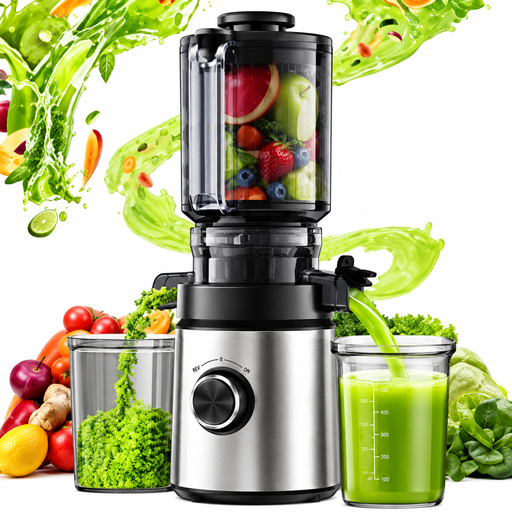 Image unavailable
Slow juicer for fruit and vegetables, 2 l, 130 mm XL feed tube, includes 2 glasses
This slow juicer is a good fit for a breakfast session where colleagues want to make juice from fruit and vegetables.
The product name lists a capacity of 2 l, a 130 mm XL feed tube and 2 glasses.
View at Joybuy
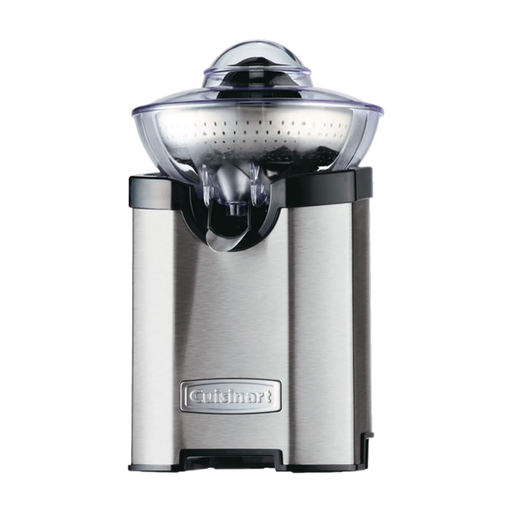 Image unavailable
Cuisinart CCJ210E electric citrus press
This citrus press is suited to an office breakfast where you’re only juicing citrus fruit.
The product information lists a 1 l reservoir, an extra-wide spout, an anti-drip system and removable dishwasher-safe parts.
The press is designed for citrus fruit; choose another option if you also want to make juice from apples, carrots or leafy greens, for example.
View at Joybuy
Frequently asked questions
Is a slow juicer automatically healthier or does it always produce more juice?
No. According to the Consumentenbond, juice yield depends on the appliance, and juice from a slow juicer doesn’t automatically contain more nutrients than juice from a centrifugal juicer. The Voedingscentrum notes that juicing leaves much of the fibre in the pulp, so juice isn’t a substitute for whole fruit.
How should you store leftover fresh orange juice?
Ideally, make only as much as you need to drink straight away. The Voedingscentrum gives a storage time of 1–2 days in the fridge for fresh orange juice; this isn’t a shelf-life guarantee for every mixed juice.
Does consumer protection apply if the office buys the appliance?
Not automatically. According to ACM ConsuWijzer, consumer protection doesn’t apply when an entrepreneur uses a contract mainly or exclusively for business purposes. Who the buyer is and how the appliance is used both matter, so check the sales, service and warranty terms before buying.
What should you look for in an electrical appliance in the Netherlands?
Check whether the appliance falls under the Warenwetbesluit elektrisch materiaal and review its electrical specifications and instructions for use. The NVWA describes an applicable scope of 50–1000 V alternating current or 75–1500 V direct current for electrical equipment covered by the regulations mentioned; a CE mark alone doesn’t prove that a model is suitable for your intended use.


